

Archive position — measured, not model output
1 like on Devpost
505 of the 7,850 archived projects have more likes, and 1,758 share exactly 1 — so this project's #973 place in the like-ranked listing is a tie-break inside that group, not a ranking.
Projects (log scale)
Likes on Devpost. ▲ marks this project's group.
Show the figures
| Likes | Projects | Share of archive |
|---|---|---|
| 0 | 5,587 | 71.2% |
| 1 | 1,758 | 22.4% |
| 2 | 284 | 3.6% |
| 3–4 | 132 | 1.7% |
| 5–9 | 75 | 1.0% |
| 10+ | 14 | 0.2% |
 User Stories BotA demo video on every pull request
Get a demo video on every new feature
GitHub App that watches your pull requests and records a narrated, captioned demo.
Save time on demo prep and make informed decisions faster with a video walkthrough of every new feature.
Executive Summary
What the company appears to be
Drama Creator, as described by its author, is a local-first, AI video production workflow tool designed for independent creators and small teams. It organizes AI-generated video content into a structured, traceable process across four stages: storyboarding, asset management, shot generation, and final export. The system emphasizes state-aware automation, dependency tracking, and human control over the final generation step.
What changed
During the OpenAI Build Week 2026 hackathon, the project underwent production-hardening improvements focused on reliability and traceability. These include state verification of workspaces and models, improved reference handling (e.g., deduplication, stale handle recovery), a deliberate human gate before final generation, and fresh preview rendering to avoid cached media artifacts.
The single most important open question — the commercial due-diligence read
Is there evidence that this tool has traction or adoption beyond the author’s own development environment? The description provides no data on users, revenue, customer feedback, or market interest. It is unclear whether the tool addresses a real market need or if it remains an experimental prototype.
What The Product Actually Is
The description states that Drama Creator is a local-first AI video production workflow tool. It organizes content through four stages:
- Story and storyboard
- Public assets
- Shot videos
- Final export
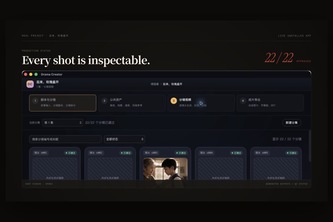
It presents each shot as a node in a dependency graph, showing script, references, candidates, approvals, QC records, and assembly state.
Key functional elements include:
- A shot workspace that displays all relevant metadata for a given shot.
- Managed generation path that prepares prompts and references, validates workspace/model identity, waits for uploads to settle, rejects duplicates, and stops before final generation.
- An explicit human-controlled submit boundary, where the final generation decision remains with the creator.
- Assembly previews that are revision-aware to prevent stale cached media from appearing.
The system is built using technologies such as:
- Codex + GPT-5.6
- ffmpeg
- Playwright
- Rust, Tauri, Node.js, TypeScript
This is a self-reported technical architecture and functional description — not independently verified or validated in production use.
Positioning & Claim Evolution
The author positions Drama Creator as a structured, traceable, and inspectable workflow for AI video creation that avoids reliance on heavy studio stacks. It aims to make complex AI filmmaking accessible to independent creators and small teams.
Key claims:
- One prompt does not make a finished film; a usable production requires structure.
- The tool keeps the process local, inspectable, and coherent.
- It treats AI generation as a production dependency graph, not just a prompt history.
- The core idea is to combine local-first provenance, state-verified automation, and an explicit human-controlled submit boundary.
The project evolved from an existing tool into a hardened prototype during Build Week, with improvements focused on:
- State-aware managed generation
- Reliable reference handling
- Human gatekeeping before final generation
- Fresh preview rendering
These changes reflect a shift from demo functionality to production-grade reliability. However, the description does not indicate any prior commercial or user-facing version.
Target Customer & ICP
The author states that Drama Creator targets independent creators and small teams who need coordination beyond individual generated clips — such as story intent, reusable references, versions, quality evidence, and final editing.
It is implied that these users are:
- Not part of large studios
- Likely working with AI video generation tools
- Require traceability and control over their creative process
However, the description does not specify:
- Exact user personas or roles (e.g., director, editor, animator)
- Customer segments or use cases beyond general AI filmmaking
- Whether it is intended for solo creators or collaborative teams
No evidence of actual customers or target market segmentation exists.
Business Model & Pricing Evidence
There is no evidence in the description of a business model or pricing structure. The author does not mention:
- Revenue streams
- Subscription tiers or licensing models
- Paid features or freemium options
- Monetization strategy
The tool is described as being developed for a hackathon and is open-sourced, with no indication that it has moved beyond prototype status.
Technical & Delivery Signals
The project is built using:
- Codex + GPT-5.6 as an implementation partner (not just code generator)
- ffmpeg, Playwright, Rust, Tauri, Node.js, TypeScript
- macOS-based UI via Tauri
- Local-first architecture
Key technical improvements made during Build Week:
- State verification of workspace and model identity
- Reliable handling of references (deduplication, stale handles)
- Human gate before final generation
- Revision-aware preview rendering to avoid cached media issues
The author notes that:
- The repository includes focused tests and regression test results
- All relevant tests pass (e.g., 22/22 managed-generation tests, 354/354 repo tests)
- A validated final output was produced (3840×2160 H.264/AAC at 30 fps)
These are self-reported technical achievements and do not imply commercial viability or scalability.
Traction & Maturity Signals
There is no evidence of traction, adoption, or user feedback beyond the author’s own development efforts. The description states:
- The tool was submitted to a hackathon
- It includes 22 approved shots, 236 graph nodes, and 405 dependency edges in its validated project
- A final output was produced (3840×2160 H.264/AAC at 30 fps and 270.8 seconds)
- The repository excludes credentials, browser profiles, private media, and third-party data
No mention of:
- Customers or users
- Revenue or monetization
- Market validation or feedback loops
- Product-market fit indicators
This is a prototype with limited real-world usage.
Competitive Context
The description does not provide any information about:
- Competitors in the AI video generation space
- Existing tools or platforms that perform similar functions
- How Drama Creator differentiates from other workflows or tools
It is unclear whether this addresses a gap in the market or overlaps with existing solutions. The author makes no claims about competitive positioning or differentiation beyond its own internal design philosophy.
Open Questions & Risks
Several risks and open questions are evident:
- No commercial traction or user base: The tool appears to be an experimental prototype, not a product in active use.
- Limited scope of functionality: It is described as local-first and focused on AI video production workflows — but lacks broader features or integrations.
- Self-reported metrics only: All performance claims are based on internal testing; there is no external validation or benchmarking.
- No monetization strategy: No indication of how the tool would generate revenue or scale.
- Single-founder development: The team size is listed as one, suggesting limited capacity for rapid growth or iteration.
Questions the description leaves open
- What specific problems in AI video production are you trying to solve? How do you know these are real and widespread?
- Have you tested this tool with actual users outside of your own development environment?
- Are there any plans for monetization or commercial deployment beyond the prototype phase?
- What is the roadmap for scaling beyond a local-first, single-user workflow?
- How would you integrate third-party AI services or models into this system?
- What are the key assumptions behind your dependency graph approach, and how do they hold up under real-world usage?
Overall Assessment
Based on the self-reported description alone, there is insufficient evidence to support a commercial investment or partnership decision.
The project is described as a prototype built during a hackathon, with no demonstrated traction, revenue, or customer base. While it shows technical sophistication and a clear understanding of workflow challenges in AI video production, there is no indication that it has moved beyond experimental development.
Confidence level: Low
This tool may represent a promising idea for future development, but currently lacks the commercial signals needed to justify further due diligence or investment.
User Stories BotA demo video on every pull request
Get a demo video on every new feature
GitHub App that watches your pull requests and records a narrated, captioned demo.
Save time on demo prep and make informed decisions faster with a video walkthrough of every new feature.
Source
Submitted to the OpenAI 2026 hackathon on Devpost. Project home on Devpost. Back to the full gallery on Devpost.
This competitive analysis was produced by top-founders.com (opens in a new tab)
Generated by a language model from this project's public Devpost page — its tagline, the author's own write-up and any built-with tags listed there — as captured in August 2026. Short quotations are the author's words. It is an opinion on the idea as a business, not on the people behind it, and it reflects the description as published then. If the project has moved on, request a correction below. The analysis is not independent research and contains no verified traction, revenue or customer data.
An independent guide by KFG International LLC — not affiliated with, endorsed by, or connected to Devpost or OpenAI.