

Archive position — measured, not model output
0 likes on Devpost
2,263 of the 7,850 archived projects have more likes, and 5,587 share exactly 0 — so this project's #4,898 place in the like-ranked listing is a tie-break inside that group, not a ranking.
Projects (log scale)
Likes on Devpost. ▲ marks this project's group.
Show the figures
| Likes | Projects | Share of archive |
|---|---|---|
| 0 | 5,587 | 71.2% |
| 1 | 1,758 | 22.4% |
| 2 | 284 | 3.6% |
| 3–4 | 132 | 1.7% |
| 5–9 | 75 | 1.0% |
| 10+ | 14 | 0.2% |
 User Stories BotA demo video on every pull request
Get a demo video on every new feature
GitHub App that watches your pull requests and records a narrated, captioned demo.
Save time on demo prep and make informed decisions faster with a video walkthrough of every new feature.
Executive Summary
What the company appears to be
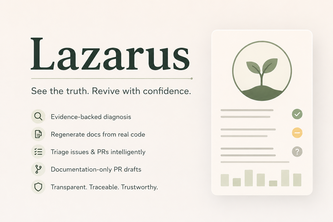
Lazarus is a self-reported open-source diagnostic tool for stale repositories. The author states it performs a five-stage evidence-backed pipeline that analyzes a repository’s runtime dependencies, documentation, issue and PR backlog, and generates a Revival Report with human decision checklist. It operates without modifying source code or installing dependencies, and claims to never guess — only cite evidence.
What changed
The project was built as a personal hackathon submission (Devpost entry for OpenAI 2026). It is described as a full-stack tool with CLI, API, and frontend components, built in Python, FastAPI, React/TypeScript, and WebGL. It includes a deliberate adversarial audit process that found and fixed bugs in its own logic.
Single most important open question
Is there any evidence of real-world usage or adoption beyond the author’s own testing? The description states no revenue, customers, or traction data are available — only self-reported claims about functionality and correctness.
What The Product Actually Is
The description states that Lazarus is a five-stage diagnostic pipeline for stale open-source repositories. It performs:
- Read-only clone of the repository.
- Dependency and runtime diagnosis from manifest files and CI config.
- Documentation regeneration via static AST analysis.
- Triage of issues and PRs into categories like duplicate, obsolete, valid, or stalled.
- Draft documentation-only pull request on a fork, never touching source code.
It synthesizes all findings into a Revival Report with human decision checklist, where every claim traces back to real files or API responses.
The author states that the system is built as an installable Python package, wrapped by a FastAPI layer and served via a React/TypeScript frontend. It uses standard library Python code and avoids third-party runtime dependencies.
Inference The tool appears to be a developer utility for diagnosing abandoned open-source projects, not a commercial product or service. It is self-contained and designed for use by maintainers or contributors who want to understand the state of a repo before deciding whether to revive it.
Positioning & Claim Evolution
The author states that Lazarus was built to answer the question: “What would a careful, skeptical engineer do on their first day?” The tool is positioned as a diagnostic, not a fixer, and claims to be evidence-backed — never guessing or assuming.
It is described as a self-contained, deterministic system that avoids black-box dependencies. It also claims to be auditable and honest about uncertainty, with partial reports generated when full evidence isn’t available.
Inference The positioning is clear: it’s a tool for engineers who want to assess the health of open-source projects without risk or guesswork, not a platform or marketplace. It is not positioned as a SaaS offering or commercial product.
Target Customer & ICP
The description states that Lazarus targets open-source maintainers and contributors who are evaluating stale repositories. The author notes that such users often face the problem of unclear documentation, obsolete dependencies, and unmerged fixes.
It is implied that the tool is for technical users, not general audiences — those comfortable with CLI, Git, and codebases.
Inference The ICP (Ideal Customer Profile) appears to be technical developers or maintainers who are assessing open-source projects before engaging. It is not a product for end-users or commercial customers.
Business Model & Pricing Evidence
The description does not state any pricing model, revenue streams, or business model. It is described as a personal hackathon project, not a commercial offering.
Inference There is no evidence of a monetization strategy or pricing structure. The tool appears to be open-source and self-hosted.
Technical & Delivery Signals
The author states that Lazarus was built in stages, starting with SOPs, then deterministic scripts, then verified against real repositories (e.g., WuJie1010/Facial-Expression-Recognition.Pytorch). It uses:
- Python (standard library)
- FastAPI
- React/TypeScript
- WebGL for frontend
- Git and GitHub APIs
- AST analysis
- Static analysis
It was packaged as a Python wheel, with CLI entry points, and wrapped in an API layer. The system is designed to be process-isolated and safe — never modifying source code or installing dependencies.
Inference The tool is built with strong engineering rigor and process isolation. It is not a prototype but a working system with multiple layers (CLI, API, frontend), though it’s unclear if it has been deployed beyond the author's own environment.
Traction & Maturity Signals
The description states that the project was submitted to a hackathon (OpenAI 2026) and includes evidence of:
- End-to-end testing on real repositories.
- A deliberate adversarial audit that found and fixed bugs.
- Packaging as an installable Python package.
- Live frontend dashboard with polling.
However, there is no evidence of any real-world usage, adoption, or customer base. No revenue, no users, no metrics beyond the author’s own testing.
Inference The tool is mature in engineering terms but lacks commercial traction or user engagement.
Competitive Context
The description does not mention competitors or similar tools. It is a self-contained diagnostic tool, not part of a broader ecosystem or marketplace.
It appears to be unique in its approach: diagnosing stale repos without touching code, with evidence-backed reporting.
Inference There is no clear competitive landscape described, but the tool’s niche is likely in developer diagnostics for open-source projects, where tools like Dependabot or Snyk may offer related features, though not this specific diagnostic workflow.
Open Questions & Risks
- No evidence of real-world usage or adoption — it's a hackathon project with no traction.
- Self-reported only — no third-party validation, audits, or independent verification.
- Not a commercial product — no pricing, customers, or monetization strategy.
- Limited scope — focused on open-source diagnostics; not clear if it has broader applicability.
- Author-only team — one-person project with no external contributors or support structure.
Inference The tool is technically sound but lacks commercial viability or scalability without further development and adoption.
Questions the description leaves open
- What real-world repositories have you tested Lazarus on beyond the two mentioned?
- Have you received any feedback from open-source maintainers who tried it?
- Is there a plan to expand beyond Python-based repositories or CI providers?
- How do you intend to scale beyond a single-person development model?
- Are there any plans for monetization or commercial use cases?
Overall Assessment
Not evidenced.
The description states that this is a hackathon submission, not a commercial product or venture. There is no evidence of revenue, customers, traction, or business model beyond the author’s own testing and self-reporting.
Inference This is not a viable investment or partnership opportunity at this stage — it is a personal project with no demonstrated commercial potential. It may be a useful tool for developers but lacks the scale, traction, or monetization strategy to be considered for funding or collaboration.
User Stories BotA demo video on every pull request
Get a demo video on every new feature
GitHub App that watches your pull requests and records a narrated, captioned demo.
Save time on demo prep and make informed decisions faster with a video walkthrough of every new feature.
Source
Submitted to the OpenAI 2026 hackathon on Devpost. Project home on Devpost. Back to the full gallery on Devpost.
This competitive analysis was produced by top-founders.com (opens in a new tab)
Generated by a language model from this project's public Devpost page — its tagline, the author's own write-up and any built-with tags listed there — as captured in August 2026. Short quotations are the author's words. It is an opinion on the idea as a business, not on the people behind it, and it reflects the description as published then. If the project has moved on, request a correction below. The analysis is not independent research and contains no verified traction, revenue or customer data.
An independent guide by KFG International LLC — not affiliated with, endorsed by, or connected to Devpost or OpenAI.