

Archive position — measured, not model output
1 like on Devpost
505 of the 7,850 archived projects have more likes, and 1,758 share exactly 1 — so this project's #971 place in the like-ranked listing is a tie-break inside that group, not a ranking.
Projects (log scale)
Likes on Devpost. ▲ marks this project's group.
Show the figures
| Likes | Projects | Share of archive |
|---|---|---|
| 0 | 5,587 | 71.2% |
| 1 | 1,758 | 22.4% |
| 2 | 284 | 3.6% |
| 3–4 | 132 | 1.7% |
| 5–9 | 75 | 1.0% |
| 10+ | 14 | 0.2% |
 User Stories BotA demo video on every pull request
Get a demo video on every new feature
GitHub App that watches your pull requests and records a narrated, captioned demo.
Save time on demo prep and make informed decisions faster with a video walkthrough of every new feature.
Executive Summary
What the company appears to be
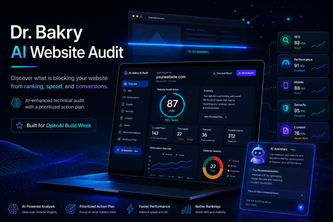
Dr. Bakry AI: Evidence-to-Fix Website Audit is a self-reported tool that audits websites for SEO, performance, accessibility, security, mobile experience, content, technical structure, and conversion signals. It generates deterministic scores based on technical evidence, then uses AI (Groq and optionally GPT-5.6) to explain findings in Arabic or English, create prioritized recommendations, and produce developer-ready tasks. The platform supports re-audits to verify fixes, and integrates with AI agents via structured reports.
What changed
The project evolved from a simple website audit idea into a more complex system that includes:
- A re-audit workflow for tracking improvements
- Optional integration of GPT-5.6 for validation and verification steps
- AI agent support for accessing structured audit data
- Use of Codex to improve architecture, test coverage, and security
Single most important open question
Is there any evidence of traction or usage beyond the author’s own website (bakry.tech)? The description states no revenue, customers, or adoption data are available.
Note: This analysis is based solely on the self-reported project description provided by the author. All claims are unverified and should be treated as such.
What The Product Actually Is
The description states that Dr. Bakry AI is a website audit tool designed to turn technical evidence into actionable fixes. It audits public websites for multiple categories including SEO, performance, accessibility, security, mobile experience, content, technical structure, and conversion signals.
Key features include:
- Deterministic scoring calculated before AI is used
- Use of Groq API for explanations in Arabic or English
- Generation of prioritized recommendations and developer-ready tasks
- Support for re-audit workflows to track improvements or regressions
- Optional integration with GPT-5.6 for validation and verification steps
- Integration with AI agents via structured reports
The platform operates through two components:
- A static Astro landing page at bakry.tech
- A Laravel 12 application hosted on audit.bakry.tech, which handles crawling, processing, and generating reports.
Inference: The product is described as a website intelligence service that can be used by humans, developers, or AI agents.
Positioning & Claim Evolution
The author states the inspiration came from seeing a post about OpenAI Build Week and wanting to build something useful for their own site. Initially, it was a basic audit tool but evolved during Build Week into:
- A system that provides clear improvement plans
- A re-audit workflow to verify changes
- An AI agent integration layer
The positioning has shifted from being just an interface for website audits to becoming a specialized intelligence service that can be consumed by humans or AI agents.
Inference: The evolution suggests the author is trying to position this as more than a simple audit tool — potentially a platform for website intelligence and automation.
Target Customer & ICP
The description does not explicitly name target customers or define an Ideal Customer Profile (ICP). However, it implies:
- Business owners who need help understanding website issues
- Developers who want structured tasks from audits
- AI agents that require structured data from audits
- Users interested in Arabic or English language support for audit reports
It also notes that the tool addresses challenges faced by Arabic websites where audit reports are often difficult to understand and disconnected from business goals like visibility, trust, and sales.
Inference: The ICP likely includes small-to-medium businesses with websites needing improvement, especially those operating in Arabic-speaking markets or seeking localized support.
Business Model & Pricing Evidence
There is no evidence of pricing information, revenue models, or monetization strategies in the description. The author mentions:
- The public audit remains free and affordable to operate
- GPT-5.6 integration will remain optional
- No mention of paid tiers or subscriptions
Inference: The business model appears to be based on a free tier with optional premium features, though no details are provided.
Technical & Delivery Signals
The platform uses:
- Laravel 12 for backend processing
- MySQL database
- Hostinger shared hosting (with cron jobs)
- Groq API as default AI provider
- Optional PageSpeed Insights integration
- Database queues instead of Redis or Docker due to shared hosting constraints
Security measures include:
- SSRF protection
- Private network blocking
- Redirect destination validation
- Response-size limits
- robots.txt support
The system avoids storing full website HTML and only sends limited structured evidence to AI providers.
Inference: The architecture reflects a constrained environment (shared hosting), which may limit scalability or performance, but shows effort toward reliability and security.
Traction & Maturity Signals
There is no evidence of traction, revenue, customer base, or adoption beyond the author’s own website. The description states:
- It was submitted to an OpenAI hackathon
- It is connected to bakry.tech
- No mention of users, customers, or usage metrics
Inference: There is no indication of real-world usage or product-market fit.
Competitive Context
The description does not provide any information about competitors or competitive landscape. The author does not reference existing tools in the market for website auditing or AI-powered analysis.
Inference: No competitive context is available from the provided description.
Open Questions & Risks
- No traction or usage data – The product exists only as a concept and self-reported implementation.
- Shared hosting limitations – May constrain scalability, performance, and reliability.
- AI dependency risks – Reliance on Groq and optional GPT-5.6 could create instability if these services are unavailable.
- Lack of monetization clarity – No pricing or business model details make it hard to assess viability.
- Self-reported nature – All claims are unverified; no third-party validation exists.
Inference: The lack of external validation, traction, and clear business model raises significant concerns about product maturity and commercial potential.
Questions the description leaves open
- Has the platform been used by anyone other than yourself?
- What is the current user engagement or feedback from those who have tried it?
- How do you plan to scale beyond shared hosting limitations?
- Are there any plans for monetization or pricing models?
- What are your long-term goals for this product — is it meant to be a standalone tool or part of a larger platform?
- Can you share more about how the re-audit workflow works in practice?
- How do you ensure consistent quality when using different AI providers (Groq vs GPT-5.6)?
- What are the technical and operational challenges you've encountered during development?
Overall Assessment
Not evidenced.
Note: This is a self-reported project with no verified traction, revenue, or customer data. The author describes a functional prototype but provides no evidence of commercial viability or market demand. Any investment or partnership decision would require further due diligence into actual usage, performance metrics, and scalability.
User Stories BotA demo video on every pull request
Get a demo video on every new feature
GitHub App that watches your pull requests and records a narrated, captioned demo.
Save time on demo prep and make informed decisions faster with a video walkthrough of every new feature.
Source
Submitted to the OpenAI 2026 hackathon on Devpost. Project home on Devpost. Back to the full gallery on Devpost.
This competitive analysis was produced by top-founders.com (opens in a new tab)
Generated by a language model from this project's public Devpost page — its tagline, the author's own write-up and any built-with tags listed there — as captured in August 2026. Short quotations are the author's words. It is an opinion on the idea as a business, not on the people behind it, and it reflects the description as published then. If the project has moved on, request a correction below. The analysis is not independent research and contains no verified traction, revenue or customer data.
An independent guide by KFG International LLC — not affiliated with, endorsed by, or connected to Devpost or OpenAI.