

Archive position — measured, not model output
0 likes on Devpost
2,263 of the 7,850 archived projects have more likes, and 5,587 share exactly 0 — so this project's #2,933 place in the like-ranked listing is a tie-break inside that group, not a ranking.
Projects (log scale)
Likes on Devpost. ▲ marks this project's group.
Show the figures
| Likes | Projects | Share of archive |
|---|---|---|
| 0 | 5,587 | 71.2% |
| 1 | 1,758 | 22.4% |
| 2 | 284 | 3.6% |
| 3–4 | 132 | 1.7% |
| 5–9 | 75 | 1.0% |
| 10+ | 14 | 0.2% |
 User Stories BotA demo video on every pull request
Get a demo video on every new feature
GitHub App that watches your pull requests and records a narrated, captioned demo.
Save time on demo prep and make informed decisions faster with a video walkthrough of every new feature.
Executive Summary
What the company appears to be
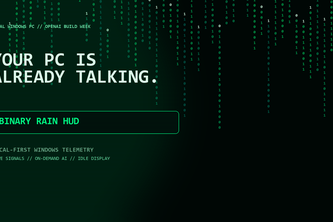
Binary Rain HUD is a local-first Windows telemetry dashboard and idle screensaver, built by one developer (Stephen Sims). It visualizes system metrics such as CPU, RAM, GPU activity, VRAM, and local Ollama models in real time. The application also offers an optional AI health brief via GPT-5.6, triggered by user interaction. It is designed to be privacy-conscious, with no automatic data transmission.
What changed
The project evolved from a basic binary-rain prototype into a more feature-rich system during Build Week, incorporating structured output from GPT-5.6, enhanced GPU detection, improved privacy boundaries, and automated tests. The author notes that the core functionality remains local-first, with optional AI features requiring an OpenAI key.
The single most important open question
Is there any evidence of traction or commercial interest beyond the developer’s own use case? The description does not indicate any revenue, customers, or adoption metrics — only a self-reported personal project.
What The Product Actually Is
The description states that Binary Rain HUD is:
- A local-first Windows telemetry dashboard and idle screensaver
- Visualizes system metrics including CPU, RAM, GPU activity (NVIDIA/AMD/Intel), VRAM, and local Ollama models
- Uses HTML Canvas rendering for binary rain and utilization trends
- Built with Node.js, PowerShell, and Windows Task Scheduler
- Operates on 127.0.0.1 and excludes sensitive data like keystrokes or screen contents from AI payloads
- Includes an optional Axiom brief powered by GPT-5.6, which can be triggered manually
Inferred: The product is a hybrid of utility (telemetry display) and ambient experience (screensaver), with optional AI interpretation.
Positioning & Claim Evolution
The author claims:
- Binary Rain HUD sits “between” dense engineering tools and decoration
- It is useful while working, cinematic when stepping away, and honest about what it collects
- The project was initially a pre-event prototype, but evolved into a more complete tool during Build Week
Inferred: The positioning reflects an intent to offer a privacy-conscious, aesthetically driven system monitor that bridges the gap between functionality and visual appeal.
Target Customer & ICP
The description does not state:
- Who the intended users are
- Whether there is a defined customer segment or persona
- If this targets developers, power users, or general consumers
Not evidenced: No evidence of target customer definition or ideal customer profile (ICP).
Business Model & Pricing Evidence
The description states:
- The system works locally, with no automatic data transmission
- The AI health brief is optional and requires an OpenAI key
- No pricing information, monetization strategy, or business model is provided
Inferred: The product appears to be a free, local utility with optional paid features (e.g., GPT access). There is no indication of a commercial model beyond the developer’s own use.
Technical & Delivery Signals
The description states:
- Built using Node.js, HTML/CSS/JS, PowerShell, and Windows Task Scheduler
- Uses OpenAI Responses API with structured output and no storage
- Implements GPU detection for multiple vendors
- Includes automated tests for privacy, telemetry fallbacks, settings validation, and path safety
- Demo video created using Python, FFmpeg, and PowerShell
Inferred: The technical stack is lightweight and local-first. The author emphasizes privacy boundaries, structured AI output, and reproducibility.
Traction & Maturity Signals
The description states:
- The project was submitted to the OpenAI 2026 hackathon
- It includes a zero-key local experience that works immediately
- The author mentions automated tests, release packaging, and a public demo
Not evidenced: No evidence of revenue, customers, or adoption metrics. No mention of usage beyond the developer’s own environment.
Competitive Context
The description does not state:
- Who the competitors are
- Whether there are similar products in the market
- How this product differentiates from existing system monitors or AI dashboards
Not evidenced: No competitive analysis or positioning relative to other tools.
Open Questions & Risks
- The project is self-reported, with no independent verification of claims
- There is no evidence of traction, revenue, or customers
- The author states that the AI feature requires an OpenAI key, which may limit adoption without a clear monetization path
- The product is local-first and not cloud-based — this could be a limitation for broader scalability or integration
Inferred: The lack of commercial traction or evidence of user demand raises questions about viability as a product or business.
Questions the description leaves open
- What is the intended user base, and how did you identify them?
- Are there any plans to monetize the AI features beyond requiring an OpenAI key?
- How do you plan to scale beyond a single developer’s use case?
- Have you considered integrating with other platforms or APIs beyond Windows?
- What is your long-term roadmap for privacy, security, and feature expansion?
Overall Assessment
The description states that this is a personal project submitted to a hackathon. There is no evidence of:
- Revenue
- Customers
- Traction
- Commercial viability
- A defined business model or monetization strategy
Inferred: This appears to be a developer-side project, not a commercial product, with no clear path to investment or partnership at this stage.
User Stories BotA demo video on every pull request
Get a demo video on every new feature
GitHub App that watches your pull requests and records a narrated, captioned demo.
Save time on demo prep and make informed decisions faster with a video walkthrough of every new feature.
Source
Submitted to the OpenAI 2026 hackathon on Devpost. Project home on Devpost. Back to the full gallery on Devpost.
This competitive analysis was produced by top-founders.com (opens in a new tab)
Generated by a language model from this project's public Devpost page — its tagline, the author's own write-up and any built-with tags listed there — as captured in August 2026. Short quotations are the author's words. It is an opinion on the idea as a business, not on the people behind it, and it reflects the description as published then. If the project has moved on, request a correction below. The analysis is not independent research and contains no verified traction, revenue or customer data.
An independent guide by KFG International LLC — not affiliated with, endorsed by, or connected to Devpost or OpenAI.