

Archive position — measured, not model output
0 likes on Devpost
2,263 of the 7,850 archived projects have more likes, and 5,587 share exactly 0 — so this project's #4,894 place in the like-ranked listing is a tie-break inside that group, not a ranking.
Projects (log scale)
Likes on Devpost. ▲ marks this project's group.
Show the figures
| Likes | Projects | Share of archive |
|---|---|---|
| 0 | 5,587 | 71.2% |
| 1 | 1,758 | 22.4% |
| 2 | 284 | 3.6% |
| 3–4 | 132 | 1.7% |
| 5–9 | 75 | 1.0% |
| 10+ | 14 | 0.2% |
 User Stories BotA demo video on every pull request
Get a demo video on every new feature
GitHub App that watches your pull requests and records a narrated, captioned demo.
Save time on demo prep and make informed decisions faster with a video walkthrough of every new feature.
Executive Summary
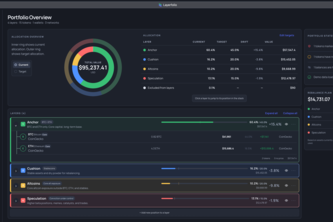
What the company appears to be: Layerfolio is a self-reported local-first portfolio decision tool for crypto investors managing assets across wallets, networks, DeFi protocols, and manual holdings. The author states it organizes positions into four customizable strategic layers—Anchor, Cushion, Altcoins, and Speculation—and compares current allocation with user-defined targets to calculate drift and generate rebalance plans.
What changed: The project was submitted as part of the OpenAI 2026 hackathon, indicating a recent development phase. It is described as built using Codex and GPT-5.6 during OpenAI Build Week, suggesting an early-stage product with AI-assisted development.
Single most important open question: Is there any evidence of actual user adoption or feedback from real crypto investors beyond the author’s own use case?
What The Product Actually Is
The description states that Layerfolio is a local-first portfolio decision tool for self-directed crypto investors. It organizes positions into four customizable strategic layers: Anchor, Cushion, Altcoins, and Speculation.
It compares current allocation with user-defined targets, calculates drift, and generates a rebalance plan at the layer level.
The application supports:
- Wallet and manual position tracking
- Aave receipt-token and Hyperliquid position support
- Automatic CoinGecko and DexScreener pricing
- Per-contract scam and safe overrides
- Snapshot analytics for concentration, networks, valuation sources, and allocation coverage
- An optional Bets journal for selected active ideas
- English and Russian interfaces
- Local JSON backup and restore
- A one-click demo portfolio that requires no API keys
Inference: The product appears to be a browser-based tool with no backend or cloud account required. It stores data locally in IndexedDB and localStorage.
Positioning & Claim Evolution
The author states that most portfolio trackers answer “What do I own?” while Layerfolio asks “Does what I own still match my strategy?”
This suggests a shift from simple asset tracking to strategic portfolio alignment, focusing on conviction, allocation drift, and rebalancing.
It also positions itself as a tool for self-directed crypto investors managing assets across multiple wallets, networks, DeFi protocols, and manual holdings.
The claim is that it helps users maintain their intended strategy despite the complexity of holding assets in different places.
Inference: The positioning implies a niche within the broader crypto portfolio management space, targeting sophisticated individual investors who want more than just balance views.
Target Customer & ICP
The description states Layerfolio targets self-directed crypto investors managing assets across wallets, networks, DeFi protocols, and manual holdings.
It is designed for users who:
- Hold assets in multiple places
- Want to align their portfolio with a defined strategy
- Need tools to manage conviction, allocation drift, and rebalancing
Inference: The ICP likely includes crypto investors who are not institutional but have significant portfolios or complex holdings across protocols and networks.
Business Model & Pricing Evidence
There is no evidence of pricing, monetization, or business model in the description.
The author states that Layerfolio is a local-first tool with no backend, cloud account, or portfolio-wide transaction reconstruction. It stores data locally and does not require API keys for its demo.
Inference: The product appears to be free-to-use, possibly with optional premium features or paid integrations (e.g., for advanced analytics), but this is not stated.
Technical & Delivery Signals
The project was built using:
- AlchemyAPI
- Codex
- Coingecko
- DexScreener
- Etherscan
- GPT-5.6
- Hyperliquid
- IndexedDB
- React
- TypeScript
- Vite
It was developed during OpenAI Build Week and uses Codex iteratively to trace inconsistencies, refine risk handling, extend support for Aave and Hyperliquid, implement pricing and rebalancing, add tests, and prepare a reproducible public release.
Inference: The tool is built with modern web technologies and integrates with several crypto data and infrastructure APIs. It leverages AI tools like Codex and GPT-5.6 for development, suggesting an early-stage product with rapid iteration capabilities.
Traction & Maturity Signals
There is no evidence of traction or user adoption in the description.
The project was submitted to the OpenAI 2026 hackathon and is described as a one-person effort by Napala Tlukhovskaia.
It includes a one-click demo portfolio that requires no API keys, suggesting it's designed for demonstration or early testing.
Inference: The product is likely in an early prototype or MVP stage with no verified users or revenue.
Competitive Context
The description does not mention any competitors. It positions itself as a tool that asks “Does what I own still match my strategy?” rather than just showing balances.
It focuses on strategic layering, drift calculation, and rebalancing, which are features found in some portfolio tracking tools but not necessarily in a local-first format.
Inference: The competitive landscape is unclear. It may overlap with general crypto portfolio trackers or niche tools focused on DeFi strategy, but no direct comparison is made.
Open Questions & Risks
- No revenue or user data: The product has no evidence of traction, customers, or monetization.
- Local-first design implies limited scalability: No backend or cloud account means no data syncing or multi-device support.
- AI-assisted development without clear product ownership: While Codex was used, the human-owned product decisions remain explicit, but this raises questions about long-term maintainability and clarity of ownership.
- Single-person team: The project is built by one person, which may limit its ability to scale or iterate quickly.
Questions the description leaves open
- What specific user feedback has been gathered from real crypto investors?
- How does Layerfolio handle data portability or migration for users who want to switch tools?
- Are there any plans to introduce monetization or premium features in the future?
- How is risk classification managed, and what happens when AI-generated classifications are incorrect?
- What is the long-term vision for the product beyond the hackathon phase?
Overall Assessment
Not evidenced.
The description does not provide any information about funding rounds, valuation, headcount, or commercial traction. It is a self-reported, unverified account of a project submitted to a hackathon by one individual.
Inference: At this stage, Layerfolio appears to be an early-stage prototype with no clear path to commercial viability or investment readiness. Any potential for growth depends on whether the founder can build a user base and develop a sustainable business model beyond the demo phase.
User Stories BotA demo video on every pull request
Get a demo video on every new feature
GitHub App that watches your pull requests and records a narrated, captioned demo.
Save time on demo prep and make informed decisions faster with a video walkthrough of every new feature.
Source
Submitted to the OpenAI 2026 hackathon on Devpost. Project home on Devpost. Back to the full gallery on Devpost.
This competitive analysis was produced by top-founders.com (opens in a new tab)
Generated by a language model from this project's public Devpost page — its tagline, the author's own write-up and any built-with tags listed there — as captured in August 2026. Short quotations are the author's words. It is an opinion on the idea as a business, not on the people behind it, and it reflects the description as published then. If the project has moved on, request a correction below. The analysis is not independent research and contains no verified traction, revenue or customer data.
An independent guide by KFG International LLC — not affiliated with, endorsed by, or connected to Devpost or OpenAI.