

Archive position — measured, not model output
1 like on Devpost
505 of the 7,850 archived projects have more likes, and 1,758 share exactly 1 — so this project's #967 place in the like-ranked listing is a tie-break inside that group, not a ranking.
Projects (log scale)
Likes on Devpost. ▲ marks this project's group.
Show the figures
| Likes | Projects | Share of archive |
|---|---|---|
| 0 | 5,587 | 71.2% |
| 1 | 1,758 | 22.4% |
| 2 | 284 | 3.6% |
| 3–4 | 132 | 1.7% |
| 5–9 | 75 | 1.0% |
| 10+ | 14 | 0.2% |
 User Stories BotA demo video on every pull request
Get a demo video on every new feature
GitHub App that watches your pull requests and records a narrated, captioned demo.
Save time on demo prep and make informed decisions faster with a video walkthrough of every new feature.
Executive Summary
Company: doodleloop
Self-reported basis: The analysis is based entirely on the author's own description of doodleloop, submitted as part of a Devpost hackathon entry. No independent verification or external evidence is available.
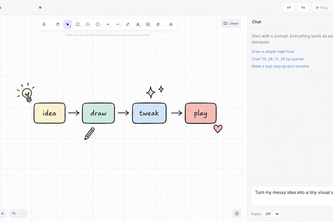
What it appears to be: A tool that allows users to generate editable hand-drawn visuals from text prompts and then replay those visuals as animated videos with narration. It uses AI to interpret user input and render diagrams, which can be manually edited before being turned into a narrated video.
What changed: The project is described as a hackathon submission, suggesting it is in early development or prototype form.
Single most important open question: Is there any evidence of traction, revenue, or customer adoption beyond the author’s own description?
What The Product Actually Is
The description states that doodleloop is an AI-native infinite whiteboard for creating visual explanations. Users interact with it via a chat interface to generate architecture diagrams, flowcharts, charts, timelines, tables, and other visuals. Once the canvas is created and edited, users can click a “Video” button to generate a narrated walkthrough video of the canvas, which is fully exportable as an .mp4 file.
Inference: The product combines AI-generated visuals with user-editable elements and automated video generation. It appears to be a tool for content creators or educators who want to produce animated visual explanations from text prompts.
Positioning & Claim Evolution
The author claims that doodleloop is designed to make the style of educational content created by creators like Theo, Primeagen, or calebwritescode attainable on any topic. The product aims to support visual storytelling through AI-assisted drawing and narration.
Inference: This positioning suggests a focus on educational or instructional content creation, where visual explanations are key. The author frames it as a way to democratize high-quality visual learning tools.
Target Customer & ICP
The description does not explicitly state the target customer or ideal customer profile (ICP). It implies that doodleloop is for users who want to create visual explanations and may be content creators, educators, or technical professionals. However, no specific segment or persona is defined.
Not evidenced: No evidence of a defined ICP, user personas, or target market segmentation.
Business Model & Pricing Evidence
There is no mention in the description of any pricing model, monetization strategy, or business model. The author states that after polishing the app, they may either open-source it or monetize it to fund GPU acquisition for wildfire prediction modeling.
Inference: If monetized, it could be a SaaS or freemium model, but no evidence supports this claim.
Technical & Delivery Signals
The project is built using:
- Excalidraw
- GPT-5.6 (author-declared)
- Remotion
- TTS
- Typescript
- Vercel
The author mentions building a custom RegionGraph to handle layout, coordinates, nesting, reflow, and collision repair deterministically.
Inference: The tool is built on modern web technologies and integrates AI for drawing and narration. It uses a semi-structured approach to layout management, suggesting some level of engineering sophistication.
Traction & Maturity Signals
The project is described as a hackathon submission, indicating it is in early development or prototype form. There is no evidence of:
- Revenue
- Customers
- User adoption
- Product-market fit
- Any traction metrics
Not evidenced: No data on usage, retention, or growth.
Competitive Context
The description does not mention any competitors. However, the concept of AI-generated visual explanations and animated storytelling aligns with tools like:
- Excalidraw (for whiteboarding)
- Canva or Figma (for design)
- Notion or Obsidian (for knowledge management)
- Lumalabs, Runway, or Pika Labs (for AI video generation)
Inference: The product may compete with or complement these tools, but no explicit competitive analysis is provided.
Open Questions & Risks
- No traction or revenue evidence: The project is a hackathon submission and lacks any sign of adoption.
- Unverified technology stack: GPT-5.6 is not a known model (author may be misrepresenting version).
- Single-founder team: The team size is listed as 1, which may limit execution capacity.
- Unclear monetization path: No business model or pricing strategy is described.
- Unproven market need: The author’s own description does not validate demand for this specific tool.
Questions the description leaves open
- What specific use cases are you targeting, and how do you know they exist?
- How do you plan to monetize the product, if at all?
- What is your timeline for moving beyond prototype status?
- Do you have any early adopters or feedback from users?
- Are there any technical limitations or scalability issues with the current architecture?
Overall Assessment
Not evidenced: No data to support a commercial due-diligence read. The project is described as a hackathon submission and lacks any evidence of traction, revenue, customers, or business model.
Confidence level: Very low. This is a pre-product, pre-traction idea with no verified commercial signals. It may be an early-stage prototype or concept, not a viable investment or partnership opportunity at this stage.
User Stories BotA demo video on every pull request
Get a demo video on every new feature
GitHub App that watches your pull requests and records a narrated, captioned demo.
Save time on demo prep and make informed decisions faster with a video walkthrough of every new feature.
Source
Submitted to the OpenAI 2026 hackathon on Devpost. Project home on Devpost. Back to the full gallery on Devpost.
This competitive analysis was produced by top-founders.com (opens in a new tab)
Generated by a language model from this project's public Devpost page — its tagline, the author's own write-up and any built-with tags listed there — as captured in August 2026. Short quotations are the author's words. It is an opinion on the idea as a business, not on the people behind it, and it reflects the description as published then. If the project has moved on, request a correction below. The analysis is not independent research and contains no verified traction, revenue or customer data.
An independent guide by KFG International LLC — not affiliated with, endorsed by, or connected to Devpost or OpenAI.