

Archive position — measured, not model output
0 likes on Devpost
2,263 of the 7,850 archived projects have more likes, and 5,587 share exactly 0 — so this project's #2,930 place in the like-ranked listing is a tie-break inside that group, not a ranking.
Projects (log scale)
Likes on Devpost. ▲ marks this project's group.
Show the figures
| Likes | Projects | Share of archive |
|---|---|---|
| 0 | 5,587 | 71.2% |
| 1 | 1,758 | 22.4% |
| 2 | 284 | 3.6% |
| 3–4 | 132 | 1.7% |
| 5–9 | 75 | 1.0% |
| 10+ | 14 | 0.2% |
 User Stories BotA demo video on every pull request
Get a demo video on every new feature
GitHub App that watches your pull requests and records a narrated, captioned demo.
Save time on demo prep and make informed decisions faster with a video walkthrough of every new feature.
Executive Summary
What the company appears to be
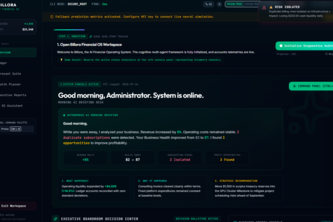
Billora is described as an AI Financial Operating System for startups and agencies. The author states it helps users analyze, predict, and optimize business decisions through collaborative AI agents. It combines real-time dashboards, forecasting, business memory, executive reporting, and multi-agent AI orchestration into a single workspace.
What changed
The project was built as a hackathon submission (OpenAI 2026) and is described as an evolution from traditional finance dashboards to an AI-native operating system. It includes features like scenario simulation, executive reporting, and multi-agent AI coordination.
Single most important open question
Is there any evidence of traction, revenue, or customer adoption beyond the author’s self-reported project description?
Note: This analysis is based entirely on the self-reported, unverified account provided by the author. No external verification, funding data, customer names, or performance metrics are available.
What The Product Actually Is
The description states that Billora is an “AI Financial Operating System” built to help startups and agencies make better financial decisions. It includes:
- Real-time financial dashboards
- Forecasting capabilities
- Business memory engine
- Executive reporting
- Multi-agent AI system (Financial Analyst, Forecast Agent, Risk Agent, etc.)
- Scenario simulation engine
It is described as a platform where AI doesn’t just answer questions but actively collaborates and recommends actions.
Inference: The product appears to be a software-as-a-service (SaaS) or web-based financial intelligence tool. It uses React, TypeScript, Express, and GPT-5.6 for its development stack.
Positioning & Claim Evolution
The author claims Billora is an “AI Financial Operating System” that shifts focus from interpreting data to making decisions through AI collaboration.
It positions itself as a replacement for traditional financial tools like spreadsheets, dashboards, and forecasting software — aiming to reduce time spent on data interpretation and increase decision-making efficiency.
Inference: The positioning evolved from a simple dashboard to an intelligent workspace where AI agents act as collaborators rather than assistants. This is a shift toward AI-native architecture.
Target Customer & ICP
The description states that Billora targets:
- Startups
- Agencies
These are described as entities that should spend less time interpreting financial data and more time making informed decisions.
Inference: The target customer segment appears to be small-to-medium-sized businesses or freelancers who need financial clarity but lack dedicated financial teams or tools.
Business Model & Pricing Evidence
There is no evidence in the description of a business model, pricing strategy, monetization approach, or revenue streams. The author does not mention subscriptions, usage fees, enterprise tiers, or any commercial structure.
Finding: Not evidenced.
Technical & Delivery Signals
The project was built using:
- Frontend: React, TypeScript, TailwindCSS, Vite
- Backend: Express.js
- AI stack: GPT-5.6, Codex
- Architecture: Modular feature-based UI, centralized state management, lazy loading, event bus, business memory engine, scenario simulator
It includes:
- Multi-agent orchestration layer
- Executive reports
- Responsive UI
- Accessibility improvements
- Offline fallbacks
- Production-ready build with zero warnings
Inference: The technical stack suggests a modern SaaS product built for performance and scalability. However, no evidence of production deployment or live usage exists.
Traction & Maturity Signals
The project was submitted as part of the OpenAI 2026 hackathon. It includes:
- Guided demo mode
- Production-ready interface
- Zero-warning build
- Live banking integrations planned for future
However, there is no evidence of:
- Customers
- Revenue
- Usage metrics
- Product-market fit
- Live deployment or user feedback
Finding: Not evidenced.
Competitive Context
The author does not reference competitors. The description implies Billora aims to be a next-generation financial operating system, potentially competing with tools like:
- Financial dashboards (e.g., QuickBooks, Xero)
- Forecasting platforms
- AI assistant tools for business (e.g., Notion AI, ChatGPT plugins)
Inference: Without competitor names or market positioning, the competitive landscape remains unclear. The product is positioned as a novel approach to financial decision-making.
Open Questions & Risks
- No traction or revenue evidence – The project is described only as a hackathon submission.
- Unverified claims – All features and capabilities are self-reported without external validation.
- AI stack reliance – Reliance on GPT-5.6 and Codex may not scale or be commercially viable without further infrastructure or licensing details.
- Single-founder team – The project is built by one person (Francisco Javier Kacmajor), which raises questions about execution capacity.
- Ambiguity in commercial viability – No pricing, monetization, or go-to-market strategy is described.
Finding: High risk due to lack of evidence for traction, product-market fit, or commercial viability.
Questions the description leaves open
- What specific financial problems are you solving, and how do you know?
- Have you tested this with actual users or businesses?
- How will you monetize the platform? What is your pricing model?
- What are the technical limitations of GPT-5.6 in a business context?
- How do you plan to scale beyond a single developer?
- Are there any existing partnerships or integrations planned?
- What is your roadmap for moving from a hackathon prototype to a product?
Overall Assessment
Not evidenced.
The description provides no evidence of revenue, customers, traction, or commercial viability. It is a self-reported hackathon project with no external validation.
Confidence Level: Low
Reasoning: The author describes a vision and technical implementation but offers no data on adoption, performance, or business outcomes. The product is unproven in the market and lacks any indication of real-world use or demand.
User Stories BotA demo video on every pull request
Get a demo video on every new feature
GitHub App that watches your pull requests and records a narrated, captioned demo.
Save time on demo prep and make informed decisions faster with a video walkthrough of every new feature.
Source
Submitted to the OpenAI 2026 hackathon on Devpost. Project home on Devpost. Back to the full gallery on Devpost.
This competitive analysis was produced by top-founders.com (opens in a new tab)
Generated by a language model from this project's public Devpost page — its tagline, the author's own write-up and any built-with tags listed there — as captured in August 2026. Short quotations are the author's words. It is an opinion on the idea as a business, not on the people behind it, and it reflects the description as published then. If the project has moved on, request a correction below. The analysis is not independent research and contains no verified traction, revenue or customer data.
An independent guide by KFG International LLC — not affiliated with, endorsed by, or connected to Devpost or OpenAI.