

Archive position — measured, not model output
0 likes on Devpost
2,263 of the 7,850 archived projects have more likes, and 5,587 share exactly 0 — so this project's #6,837 place in the like-ranked listing is a tie-break inside that group, not a ranking.
Projects (log scale)
Likes on Devpost. ▲ marks this project's group.
Show the figures
| Likes | Projects | Share of archive |
|---|---|---|
| 0 | 5,587 | 71.2% |
| 1 | 1,758 | 22.4% |
| 2 | 284 | 3.6% |
| 3–4 | 132 | 1.7% |
| 5–9 | 75 | 1.0% |
| 10+ | 14 | 0.2% |
 User Stories BotA demo video on every pull request
Get a demo video on every new feature
GitHub App that watches your pull requests and records a narrated, captioned demo.
Save time on demo prep and make informed decisions faster with a video walkthrough of every new feature.
Executive Summary
What the company appears to be
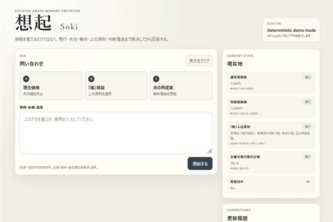
Soki (想起) is a self-reported prototype for a decision-aware memory system designed to support long-term human–AI collaboration. It claims to preserve not just information but also the state, hierarchy, relationships, source authority, and rationale behind decisions — particularly in contexts where decisions change over time, such as creative work, project management, or knowledge systems.
What changed
The author states that Soki began from a personal problem encountered while managing long-running creative projects. It evolved into a prototype that demonstrates how an AI can resolve current vs. obsolete information, rejected alternatives, and decision rationale — without replacing human judgment.
Single most important open question
Is there evidence of real-world usage or traction beyond the author’s own development and testing? The description is entirely self-reported and lacks any indication of customers, revenue, or adoption.
Note: This analysis is based solely on the self-reported project description provided by the author. No external verification, historical data, or third-party sources are available. All claims are treated as stated by the author, not proven facts.
What The Product Actually Is
The description states that Soki is a decision-aware memory prototype for long-term human–AI collaboration. It is built as a small Node.js web application with a deterministic decision-resolution core, and includes:
- An 8-stage resolver process:
- Validate the memory graph
- Retrieve relevant candidates
- Expand relationships
- Apply state rules
- Suppress invalid or superseded memories
- Resolve authority and conflicts
- Build a bounded decision packet
- Produce final answer and reference explanation
- A deterministic core that decides which memories may be used, suppressed, or blocked.
- An optional GPT-5.6 Responses API boundary for presentation and explanation — but not for overriding decisions.
- Correction events stored as append-only JSONL files with before-and-after snapshots and reasons.
The product is described as a prototype, not a production-ready system.
Positioning & Claim Evolution
The author positions Soki as a solution to a specific problem in long-term human–AI collaboration: AI systems failing not because they forget information, but because they fail to preserve decision state. This includes:
- Current vs. obsolete information
- Superseded or rejected alternatives
- Source authority
- Rationale behind decisions
The project evolved from a personal challenge into a prototype that demonstrates three use cases:
- Current price resolution
- Author-led literary revision
- Rejected-candidate recovery
The positioning is framed around preserving human decision-making authority, not replacing it.
Target Customer & ICP
The description does not name specific customer segments or personas. However, the author implies that Soki targets:
- Users working on long-running creative or publishing projects
- Teams managing complex, evolving decisions in product development, research, or operations
- Individuals or organizations using personal knowledge management systems (e.g., Obsidian)
The ICP is inferred from use cases described but not explicitly defined.
Business Model & Pricing Evidence
There is no evidence of a business model or pricing structure. The description states that Soki is a prototype, and no revenue, customer data, or monetization strategy are mentioned.
Not evidenced.
Technical & Delivery Signals
The system is built using:
- Node.js
- JavaScript
- HTML5, CSS3
- JSON, JSONL
- OpenAI APIs (GPT-5.6 Responses)
- GitHub for version control
Key technical features include:
- Deterministic decision core
- Append-only event storage with replay capability
- Eight-stage resolver process
- Separation of concerns between decision logic and presentation layer
- 58 automated unit and integration tests
- UI that shows selected, suppressed, and conflicting memories
The system is described as fully functional in deterministic mode without API keys.
Traction & Maturity Signals
The description states:
- 58 automated tests passed with zero failures
- All three demos verified through browser UI
- No purchaser data or customer names included in demo data
- Codex contributed to development and review
- Git history shows contribution from pre-Codex baseline to final implementation
No evidence of real-world usage, customers, revenue, or adoption beyond the author’s own testing.
Competitive Context
The description does not mention any competitors. It is unclear whether Soki is positioned against existing tools for knowledge management, decision tracking, or AI collaboration platforms.
Not evidenced.
Open Questions & Risks
- Prototype only: No production-grade features, storage, or scalability indicated.
- No external validation: The system has not been tested in real-world settings or with users beyond the author.
- Self-reported maturity: Claims of 58 tests and deterministic behavior are unverified without independent audit.
- Unclear commercial viability: No pricing, monetization, or customer acquisition strategy described.
- Limited team size: Only one member (Miki Kamino) is listed.
These points raise concerns about readiness for market entry or investment.
Questions the description leaves open
- What specific use cases have you tested Soki with beyond the three demos?
- Have you conducted any user studies or feedback sessions with actual users?
- How do you plan to scale beyond deterministic mode and integrate with existing tools like Obsidian or Notion?
- What is your roadmap for production-grade features such as event storage, signatures, access control, and migration?
- Are there any plans to monetize Soki or offer it as a service?
Overall Assessment
The description indicates that Soki is a self-developed prototype with strong technical design principles and clear intent around preserving decision context in long-term AI collaboration. However, there is no evidence of traction, customers, revenue, or commercial viability.
This is a pre-product-stage project with potential but no demonstrated market readiness or business model. It may be suitable for early-stage investment or partnership if the team plans to move toward productization and user testing.
User Stories BotA demo video on every pull request
Get a demo video on every new feature
GitHub App that watches your pull requests and records a narrated, captioned demo.
Save time on demo prep and make informed decisions faster with a video walkthrough of every new feature.
Source
Submitted to the OpenAI 2026 hackathon on Devpost. Project home on Devpost. Back to the full gallery on Devpost.
This competitive analysis was produced by top-founders.com (opens in a new tab)
Generated by a language model from this project's public Devpost page — its tagline, the author's own write-up and any built-with tags listed there — as captured in August 2026. Short quotations are the author's words. It is an opinion on the idea as a business, not on the people behind it, and it reflects the description as published then. If the project has moved on, request a correction below. The analysis is not independent research and contains no verified traction, revenue or customer data.
An independent guide by KFG International LLC — not affiliated with, endorsed by, or connected to Devpost or OpenAI.