

Archive position — measured, not model output
1 like on Devpost
505 of the 7,850 archived projects have more likes, and 1,758 share exactly 1 — so this project's #950 place in the like-ranked listing is a tie-break inside that group, not a ranking.
Projects (log scale)
Likes on Devpost. ▲ marks this project's group.
Show the figures
| Likes | Projects | Share of archive |
|---|---|---|
| 0 | 5,587 | 71.2% |
| 1 | 1,758 | 22.4% |
| 2 | 284 | 3.6% |
| 3–4 | 132 | 1.7% |
| 5–9 | 75 | 1.0% |
| 10+ | 14 | 0.2% |
 User Stories BotA demo video on every pull request
Get a demo video on every new feature
GitHub App that watches your pull requests and records a narrated, captioned demo.
Save time on demo prep and make informed decisions faster with a video walkthrough of every new feature.
Executive Summary
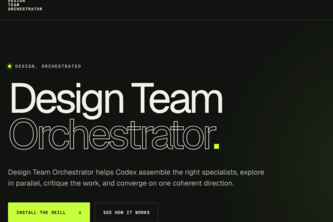
The description states that "Design Team Orchestrator" is a system that forms temporary teams of specialized AI agents around a project brief, with roles such as visual designers, content designers, interaction designers, accessibility reviewers, and design engineers. The author claims this is an evolution from single-agent AI assistants to coordinated multi-agent teams for creative workflows.
What changed: The author describes moving beyond individual AI tools to a system that coordinates multiple agents with defined roles, using a "Design Director" to synthesize outputs into coherent recommendations.
The single most important open question: Does the system actually work as described, or is this a conceptual framework without functional implementation?
This analysis is based entirely on self-reported information from the project description. No evidence of revenue, customers, traction or independent verification exists beyond what is stated by the author.
What The Product Actually Is
The description states that Design Team Orchestrator is:
- A system that forms temporary teams of specialized AI design agents
- An orchestration workflow that interprets project briefs and identifies desired outcomes
- A system that selects the smallest useful team of specialists
- A system that spawns agents with clearly defined roles and assignments
- A system that allows independent work in parallel
- A system that critiques results for clarity, accessibility, feasibility, and consistency
- A system that combines strongest ideas into one final direction
The author claims this is built using "chatgpt5.6, codex, github, imovie, sol5.6" and hosted on a website explaining the workflow.
Not evidenced: Whether any of these components actually function as described or whether they are merely conceptual elements.
Positioning & Claim Evolution
The description states:
- The product is positioned as "the future of design work is a team that forms around the problem"
- It claims to be an evolution from single AI assistants to coordinated teams
- It positions itself as a solution for creative workflows in design, research, development, content, and accessibility
- The author describes it as a way to "turn ambitious ideas into finished work"
The claim evolution shows:
- Initial inspiration: Building design teams using agent spawning with Clawbot
- Development: Creating more specialized AI teams for various workflows
- Current positioning: A system that coordinates AI agents around project briefs
Not evidenced: No evidence of prior versions, market testing or customer feedback to support the claim evolution.
Target Customer & ICP
The description states:
- The target is people working on design projects who want to "turn ambitious ideas into finished work"
- It's positioned for creative workflows in design, research, development, content, and accessibility
- Users install it as a Codex skill
Not evidenced: No specific customer segments, personas, or use cases beyond the general creative workflow context.
Business Model & Pricing Evidence
The description states:
- The system is installed as a Codex skill
- There's a website explaining how people can install and use it
- It's described as a "skill" that users can install
Not evidenced: No pricing model, monetization strategy or revenue streams are mentioned.
Technical & Delivery Signals
The description states:
- Built with chatgpt5.6, codex, github, imovie, sol5.6
- Uses an orchestration workflow
- Has a website that explains the project and workflow
- Spawns agents with clearly defined roles and assignments
- Allows independent work in parallel
- Critiques results for clarity, accessibility, feasibility, and consistency
Not evidenced: No evidence of actual technical implementation, performance metrics, or delivery capabilities beyond what is described.
Traction & Maturity Signals
The description states:
- This was submitted to the OpenAI 2026 hackathon on Devpost
- The author built it as a personal project with one team member (ChAI Community)
- It's described as a "starting point" for building specialized teams
Not evidenced: No evidence of users, customers, revenue, adoption or market traction beyond the hackathon submission.
Competitive Context
The description states:
- The author was inspired by experience building design teams using agent spawning with Clawbot
- It's positioned as an evolution from single AI assistants to coordinated teams
- It addresses workflows in design, research, development, content, and accessibility
Not evidenced: No evidence of existing competitive products or market positioning beyond the author's own claims.
Open Questions & Risks
The description states:
- The system is described as a "starting point" for building specialized teams
- It's built by one person (ChAI Community)
- It's submitted to a hackathon
- The author notes challenges in preventing overlapping work, determining team size, and convergence
- The author states that "more agents do not automatically produce a better result"
- The system is described as an orchestration workflow rather than a finished product
Open questions:
- Single-person development with no evidence of team or external support
- No revenue, customers or traction data
- Conceptual framework without demonstrated functionality
- Limited evidence of technical implementation beyond self-reported tools
- No pricing or monetization strategy
Questions the description leaves open
- What specific technical challenges have you encountered in implementing the orchestration workflow?
- How do you plan to validate that the system actually produces better results than individual AI agents?
- What is your path to market beyond the hackathon submission?
- How will you scale from one-person development to a viable product?
- What are the specific use cases where this system would be valuable versus existing tools?
Overall Assessment
The description states that this is a "starting point" for building specialized teams and was submitted to a hackathon.
Not evidenced: No evidence of commercial viability, market traction, or investment readiness beyond the author's own claims.
Confidence level: Low. The analysis is based entirely on self-reported information with no independent verification or evidence of product functionality, revenue, customers or adoption.
User Stories BotA demo video on every pull request
Get a demo video on every new feature
GitHub App that watches your pull requests and records a narrated, captioned demo.
Save time on demo prep and make informed decisions faster with a video walkthrough of every new feature.
Source
Submitted to the OpenAI 2026 hackathon on Devpost. Project home on Devpost. Back to the full gallery on Devpost.
This competitive analysis was produced by top-founders.com (opens in a new tab)
Generated by a language model from this project's public Devpost page — its tagline, the author's own write-up and any built-with tags listed there — as captured in August 2026. Short quotations are the author's words. It is an opinion on the idea as a business, not on the people behind it, and it reflects the description as published then. If the project has moved on, request a correction below. The analysis is not independent research and contains no verified traction, revenue or customer data.
An independent guide by KFG International LLC — not affiliated with, endorsed by, or connected to Devpost or OpenAI.