

Archive position — measured, not model output
0 likes on Devpost
2,263 of the 7,850 archived projects have more likes, and 5,587 share exactly 0 — so this project's #2,913 place in the like-ranked listing is a tie-break inside that group, not a ranking.
Projects (log scale)
Likes on Devpost. ▲ marks this project's group.
Show the figures
| Likes | Projects | Share of archive |
|---|---|---|
| 0 | 5,587 | 71.2% |
| 1 | 1,758 | 22.4% |
| 2 | 284 | 3.6% |
| 3–4 | 132 | 1.7% |
| 5–9 | 75 | 1.0% |
| 10+ | 14 | 0.2% |
 User Stories BotA demo video on every pull request
Get a demo video on every new feature
GitHub App that watches your pull requests and records a narrated, captioned demo.
Save time on demo prep and make informed decisions faster with a video walkthrough of every new feature.
Executive Summary
What the company appears to be
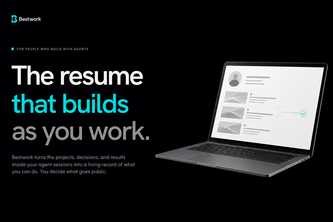
Bestwork is a self-reported tool that aims to automate portfolio building for knowledge workers by capturing work done inside agent environments (like Codex or Claude Code). It allows users to turn agent sessions into a living public portfolio, with drafts generated from conversations and artifacts within those sessions. The system supports private drafting, redaction of sensitive data, and publishing control.
What changed
The author states that the future of knowledge work will be through agents, and that current tools like GitHub or LinkedIn do not capture the full context or narrative of this new workflow. Bestwork is positioned as a solution to this gap — capturing work directly from where it happens (agent sessions), rather than relying on manual CV updates.
Single most important open question
Is there evidence of real usage, traction, or customer feedback beyond the author’s own account? The description contains no data about revenue, customers, adoption, or market validation.
This analysis is based solely on the self-reported project description provided by the author. No external verification or historical data is available.
What The Product Actually Is
The description states that Bestwork:
- Turns agent sessions into a living portfolio.
- Uses a command (
npx bestwork-mcp) to connect harnesses. - Enables users to say a natural sentence like “help me add this project to my Bestwork” to initiate capture.
- Drafts content from the agent’s understanding of the work, supplemented by user input in a micro-interview format.
- Stores evidence (e.g., screenshots) in Cloudflare R2 and uses PostgreSQL with tenant RLS for data management.
- Supports four editorially distinct templates (Ledger, Frame, Mosaic, Night).
- Includes outcome check-ins that prompt users after 14 days to update results.
- Offers provenance tiers: self-reported, artifact-linked, or attested.
This is a self-reported product description. No independent verification of functionality or performance exists.
Positioning & Claim Evolution
The author claims:
- The future of knowledge work happens through agents.
- Current tools like GitHub and LinkedIn fail to reflect the full scope of what people do in agent environments.
- Bestwork builds a CV from the source — where the work already lives.
- It avoids traditional resume-writing by automating the process via agent interaction.
The positioning evolves from:
- A tool for capturing agent-based work into a portfolio.
- To a way to build a “living” public profile that updates automatically.
- With implications for narrative control, design flexibility, and trust through transparency (provenance tiers).
These are claims made by the author; no evidence of market positioning or competitive differentiation is provided.
Target Customer & ICP
The description states:
- The target user is someone who works in agent environments.
- It’s aimed at knowledge workers, especially those in non-technical roles (e.g., the author's partner).
- Users may be job seekers or professionals looking to showcase their work without writing resumes manually.
There is no explicit segmentation beyond “knowledge workers” or “agent users.” No specific persona, job function, or industry is named.
Not evidenced: no clear ICP or customer profile beyond general description of user behavior.
Business Model & Pricing Evidence
The description does not contain any information about:
- Revenue model
- Pricing structure
- Monetization strategy
- Paid features or freemium offerings
Not evidenced: no business model or pricing data provided.
Technical & Delivery Signals
The author states:
- Built with agents during the submission window.
- Uses MCP-first architecture, where the agent is the capture surface.
- The system is model-agnostic and requires no separate API key.
- Stack includes Next.js (App Router), Neon Postgres, Drizzle, Cloudflare R2, passwordless email auth.
- Unit/integration tests and Playwright flows cover full user journey.
- Designed for “vanilla users” — tested against empty accounts and minimal setups.
These are technical claims made by the author; no independent validation or delivery performance data is available.
Traction & Maturity Signals
The description states:
- The project was submitted to the OpenAI 2026 hackathon.
- It includes a command-line interface (
npx bestwork-mcp). - Has 415 unit/integration tests and Playwright flows covering end-to-end workflows.
- Built end-to-end using agents — aligning with its own stated use case.
However, there is no mention of:
- Real users or adoption
- Customer feedback or retention metrics
- Product usage data
- Revenue or monetization
Not evidenced: no traction or maturity indicators beyond internal development and testing.
Competitive Context
The description does not reference any competitors. It implies that existing platforms like GitHub and LinkedIn do not adequately support agent-based workflows, but does not name or compare against other tools in the space.
Not evidenced: no competitive landscape or comparison data provided.
Open Questions & Risks
Inferences based on self-reporting:
- Highly speculative product-market fit: The author describes a future state of work that may not yet be widely adopted.
- No evidence of real-world usage: No customers, feedback, or adoption metrics are presented.
- Unproven scalability: The system is described as built for one person (the founder), with no indication of how it scales beyond that.
- Dependency on agent ecosystems: If agent platforms change or become less prevalent, the product may lose relevance.
- Unclear monetization path: No business model or pricing strategy is shared.
These are inferences drawn from the lack of evidence; not facts.
Questions the description leaves open
- What specific agent environments does Bestwork integrate with today?
- How many users have tried the tool beyond the founder’s own use?
- Are there any early adopters or beta testers providing feedback?
- What is the current plan for monetization and pricing?
- How does Bestwork handle edge cases in agent interactions (e.g., when agents don’t understand context)?
- What are the key assumptions about user behavior that underpin the product design?
- Has the founder considered how to onboard non-technical users effectively?
These questions aim to probe the gaps in the self-reported evidence.
Overall Assessment
The description presents Bestwork as a conceptually aligned tool for an emerging workflow, but lacks any evidence of traction, revenue, or customer validation. The author’s own account is detailed and thoughtful, but it does not constitute proof of viability or market readiness.
Not evidenced: no commercial due-diligence signals such as revenue, customers, or adoption.
Confidence Level Low
Reasoning
The entire analysis rests on a single self-reported description with no corroboration. The project is described as built for one person and submitted to a hackathon — not yet validated in the market.
User Stories BotA demo video on every pull request
Get a demo video on every new feature
GitHub App that watches your pull requests and records a narrated, captioned demo.
Save time on demo prep and make informed decisions faster with a video walkthrough of every new feature.
Source
Submitted to the OpenAI 2026 hackathon on Devpost. Project home on Devpost. Back to the full gallery on Devpost.
This competitive analysis was produced by top-founders.com (opens in a new tab)
Generated by a language model from this project's public Devpost page — its tagline, the author's own write-up and any built-with tags listed there — as captured in August 2026. Short quotations are the author's words. It is an opinion on the idea as a business, not on the people behind it, and it reflects the description as published then. If the project has moved on, request a correction below. The analysis is not independent research and contains no verified traction, revenue or customer data.
An independent guide by KFG International LLC — not affiliated with, endorsed by, or connected to Devpost or OpenAI.