

Archive position — measured, not model output
0 likes on Devpost
2,263 of the 7,850 archived projects have more likes, and 5,587 share exactly 0 — so this project's #6,839 place in the like-ranked listing is a tie-break inside that group, not a ranking.
Projects (log scale)
Likes on Devpost. ▲ marks this project's group.
Show the figures
| Likes | Projects | Share of archive |
|---|---|---|
| 0 | 5,587 | 71.2% |
| 1 | 1,758 | 22.4% |
| 2 | 284 | 3.6% |
| 3–4 | 132 | 1.7% |
| 5–9 | 75 | 1.0% |
| 10+ | 14 | 0.2% |
 User Stories BotA demo video on every pull request
Get a demo video on every new feature
GitHub App that watches your pull requests and records a narrated, captioned demo.
Save time on demo prep and make informed decisions faster with a video walkthrough of every new feature.
Executive Summary
What the company appears to be
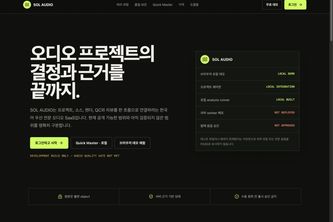
SOL AUDIO is a browser-based system for managing mix/master decisions in audio production. It emphasizes traceability, evidence collection, and human review as part of its workflow. The product does not replace a DAW or automatically approve releases; instead, it focuses on local preview rendering, manifest recording, and release gates that require explicit human action.
What changed
The project was developed as part of the OpenAI Build Week hackathon. It began as a local-development baseline and evolved into a browser-based tool with evidence-first controls, using tools like React, TypeScript, Cloudflare, and Python for validation.
Single most important open question
Is there any evidence that SOL AUDIO has been adopted by real users or integrated into actual workflows beyond the demo?
What The Product Actually Is
The description states that SOL AUDIO is a browser-local audio preview system designed to make mix/master decisions more transparent and auditable. It does not replace a DAW, choose a winning master, or automatically approve a release.
It includes:
- Browser-local WAV preview processing
- Manifest recording for source assets
- Evidence-linked listening checklists
- Role-aware human approval gates
- Immutable source sets and deterministic sealed source sets
The system is built around traceability rather than black-box mastering. It uses:
- React, TypeScript, Vite
- Web Audio API and OfflineAudioContext
- Cloudflare D1/R2 adapters and Drizzle
- Python worker for job-bound safe-metric analysis (NumPy, SciPy, SoundFile, pyloudnorm)
- AJV contracts and Playwright/axe coverage
Not evidenced: The actual functionality beyond the demo, or whether it has been used in production.
Positioning & Claim Evolution
The description states that SOL AUDIO is a Korean-first mix/master decision system. It positions itself as:
- Not replacing a DAW
- Not choosing a winning master
- Not automatically approving releases
Instead, it focuses on:
- Browser-local preview rendering
- Auditable evidence
- Human-only release gates
- Traceability of source, version, and listening decisions
The author notes that the demo was built to avoid false certainty — avoiding claims about calibrated loudness or professional mastering. The product rule is that every artifact must retain its source/version/evidence context, and every positive release state must be earned by explicit gates.
Inferred: The positioning is evidence-first and human-centric, not automation-driven.
Target Customer & ICP
The description states that SOL AUDIO is a Korean-first mix/master decision system, but does not specify the exact customer segment or ICP beyond this geographic orientation.
It targets:
- Mix/master teams
- Professionals who need to know which source, version, and human decisions sit behind an export
Not evidenced: Specific customer personas, use cases, or adoption beyond the demo.
Business Model & Pricing Evidence
The description does not provide any information about:
- Revenue model
- Pricing structure
- Monetization strategy
Not evidenced: No business model or pricing data is available.
Technical & Delivery Signals
The system uses:
- React, TypeScript, Vite for frontend
- Web Audio API and OfflineAudioContext for browser-local rendering
- Cloudflare D1/R2 adapters and Drizzle for control-plane boundary
- Python worker with NumPy, SciPy, SoundFile, pyloudnorm for analysis
- AJV contracts for validation
- Playwright/axe for coverage
It enforces:
- Strict WAV intake validation
- Stale-evidence handling
- Fail-closed release gates
- SHA-256 evidence recording for source and outputs
Inferred: The system is built with a strong focus on security, traceability, and deterministic behavior.
Traction & Maturity Signals
The description states that this project was submitted to the OpenAI 2026 hackathon, and that it began as a local-development baseline. It includes:
- Public browser tools
- Demo functionality for validating WAV files and creating previews
- Evidence-linked release gates
Not evidenced: No information on adoption, customers, revenue, or traction beyond the demo.
Competitive Context
The description does not mention any competitors or direct market context. It is unclear whether SOL AUDIO operates in a competitive space or how it compares to existing tools in audio production or mix/master workflows.
Not evidenced: No competitive analysis or positioning against other tools.
Open Questions & Risks
- No evidence of real-world adoption: The system is described as a demo and hackathon project, with no mention of users or customers.
- Limited scope: It only supports WAV files and browser-local processing — not a full DAW replacement or production-ready tool.
- Human-only decision gate: While this is a stated feature, it may limit scalability or automation potential.
- No monetization strategy: No indication of how the product would be commercialized.
Inferred: The project appears to be in early development and lacks traction or commercial viability indicators.
Questions the description leaves open
- What is the actual use case that drove this project? Was it a real pain point in your own workflow?
- Have you tested this system with real teams or clients beyond the demo?
- How do you plan to scale beyond browser-local processing and human-only gates?
- Are there any plans for integrating with existing DAWs or audio production tools?
- What is the roadmap for adding calibrated loudness, golden vectors, or QA features?
Overall Assessment
The description states that SOL AUDIO was built as part of a hackathon project and does not include evidence of:
- Revenue
- Customers
- Traction
- Commercial viability
Inferred: This is an early-stage idea with strong technical execution but no demonstrated market or business traction. It may be a promising concept for future development, but lacks the evidence to support investment or partnership at this time.
Not evidenced: No data on commercial potential, team experience, or market validation.
User Stories BotA demo video on every pull request
Get a demo video on every new feature
GitHub App that watches your pull requests and records a narrated, captioned demo.
Save time on demo prep and make informed decisions faster with a video walkthrough of every new feature.
Source
Submitted to the OpenAI 2026 hackathon on Devpost. Project home on Devpost. Back to the full gallery on Devpost.
This competitive analysis was produced by top-founders.com (opens in a new tab)
Generated by a language model from this project's public Devpost page — its tagline, the author's own write-up and any built-with tags listed there — as captured in August 2026. Short quotations are the author's words. It is an opinion on the idea as a business, not on the people behind it, and it reflects the description as published then. If the project has moved on, request a correction below. The analysis is not independent research and contains no verified traction, revenue or customer data.
An independent guide by KFG International LLC — not affiliated with, endorsed by, or connected to Devpost or OpenAI.