

Archive position — measured, not model output
0 likes on Devpost
2,263 of the 7,850 archived projects have more likes, and 5,587 share exactly 0 — so this project's #6,840 place in the like-ranked listing is a tie-break inside that group, not a ranking.
Projects (log scale)
Likes on Devpost. ▲ marks this project's group.
Show the figures
| Likes | Projects | Share of archive |
|---|---|---|
| 0 | 5,587 | 71.2% |
| 1 | 1,758 | 22.4% |
| 2 | 284 | 3.6% |
| 3–4 | 132 | 1.7% |
| 5–9 | 75 | 1.0% |
| 10+ | 14 | 0.2% |
 User Stories BotA demo video on every pull request
Get a demo video on every new feature
GitHub App that watches your pull requests and records a narrated, captioned demo.
Save time on demo prep and make informed decisions faster with a video walkthrough of every new feature.
Executive Summary
What the company appears to be
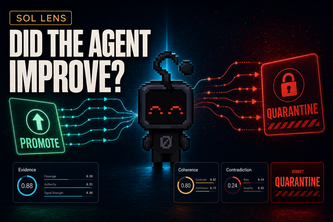
SOL Lens is a browser-local tool for inspecting agent migrations, built as a self-contained TypeScript/React application using Vite/Vinext. It represents agent traces as semantic units (Logons) and constructs deterministic evidence scores, contradiction rates, and coherence metrics to support PROMOTE, HOLD, or QUARANTINE decisions.
What changed
The project evolved from an exploration in the SOL Engine research project into a runnable product focused on agent-migration review during OpenAI Build Week. It was designed to make migration evidence visible, deterministic, portable, and independently reviewable.
Single most important open question
Is there a real-world use case or customer base for this tool beyond its demonstration context?
What The Product Actually Is
The description states that SOL Lens is a browser-local workbench for inspecting agent migrations. It represents observable traces as atomic semantic units called Logons, which can represent user requirements, tool requests/results, evidence claims, constraints, contradictions, or outputs.
It constructs typed edges between these Logons to record relationships such as support, constraint, challenge, or feedback. From this structure:
- The system validates and normalizes the trace
- Creates a deterministic semantic-graph layout
- Scores evidence, coherence, and contradiction
- Compares candidates against reference summaries
- Applies explicit promotion gates (PROMOTE, HOLD, QUARANTINE)
- Exports replayable proof packets
The product includes seven one-click teaching packets to help users understand the system without needing to learn a new file format.
Evidence
- The description states that SOL Lens "represents an observable agent trace as atomic semantic units called Logons"
- It "validates and normalizes the observable trace", "creates a deterministic semantic-graph layout", and "scores evidence, coherence, and contradiction"
- It "compares the candidate with an observable reference summary" and "applies explicit promotion gates"
- The system exports "replayable proof packets"
Inference The product is a static evaluation tool for reviewing agent behavior in migration scenarios; it does not execute or modify models.
Positioning & Claim Evolution
The author positions SOL Lens as a tool that makes agent-migration review visible, deterministic, portable, and independently reviewable. It aims to shift from subjective judgments like “the new agent feels better” to inspectable, replayable evidence.
It builds on prior work in the SOL Engine research project but focuses specifically on migration inspection during OpenAI Build Week.
Evidence
- The description states: "SOL Lens grew from a practical question: How can an engineering team inspect what changed when it replaces one agent or model with another?"
- It claims to turn observable traces into "replayable semantic graphs, deterministic evidence scores, and clear PROMOTE, HOLD, or QUARANTINE decisions"
- The author says: "Instead of requiring judges to author unfamiliar JSON, SOL Lens includes seven one-click, browser-local teaching packets"
Inference The positioning reflects a shift from abstract research toward a productized evaluation framework for AI agents.
Target Customer & ICP
The description does not name specific customers or personas. However, it implies that the target is engineering teams inspecting agent migrations — particularly those working with LLM-based systems where traceability and evidence are important.
It suggests a user base of judges or reviewers who need to evaluate whether an agent migration meets certain criteria (PROMOTE/HOLD/QUARANTINE).
Evidence
- The description says: "How can an engineering team inspect what changed when it replaces one agent or model with another?"
- It mentions “judges” and “judge-facing onboarding and video materials”
Inference The ICP likely includes developers, ML engineers, or product teams evaluating AI agents in deployment pipelines.
Business Model & Pricing Evidence
There is no evidence of a business model or pricing structure. The project is described as a self-contained browser-based tool with no mention of monetization, subscriptions, or licensing.
Evidence
- No revenue streams, pricing tiers, or commercial arrangements are mentioned
- The deployed evaluator is "credential-free and browser-local"
Inference It appears to be a research/demo product without an identified monetization path.
Technical & Delivery Signals
SOL Lens is implemented as a TypeScript/React application using Vite/Vinext. It runs entirely in the browser, with deterministic evaluation logic and replay features.
Key technical elements include:
- Packet validator
- Graph layout engine (cycle-aware)
- Trace Court for scoring and assessments
- Proof export functionality
- Manifold Replay for visualization
It uses Codex/GPT-5.6 during development but not in production.
Evidence
- The system is built with "TypeScript and React application using Vite/Vinext"
- It runs "locally in the browser"
- Includes "seven one-click, browser-local teaching packets"
- Uses "Codex powered by GPT-5.6" during development
- "The deployed evaluator is credential-free and browser-local"
Inference It's a lightweight, client-side tool with no backend or cloud dependencies.
Traction & Maturity Signals
There is no evidence of traction, customers, or adoption beyond its demonstration at OpenAI Build Week. The project has a public deployment and source code available, but no data on usage, retention, or revenue.
Evidence
- The tool is publicly deployed: https://sol-lens.onrender.com/
- Source code is hosted: https://github.com/TechmanStudios/sol-lens
- It includes 37 passing tests with zero failures
Inference It’s a prototype or proof-of-concept, not yet a mature product in production use.
Competitive Context
The description does not name competitors. However, it implies a space around agent traceability and evaluation — which overlaps with tools for LLM observability, prompt engineering, and AI agent lifecycle management.
Evidence
- The project addresses "agent migrations" and "observable traces"
- It is positioned as a tool to inspect evidence and decision-making in AI agents
Inference It likely competes or complements tools focused on AI agent monitoring, evaluation, or debugging, though no direct competitors are named.
Open Questions & Risks
- No commercial traction or customer base: The project is described only as a demo.
- Unclear market demand: No evidence of real-world use cases beyond the hackathon context.
- Limited scalability: The tool is browser-local and designed for small-scale trace inspection.
- Unproven adoption: It’s unclear whether users would adopt or integrate it into workflows.
- No monetization strategy: No indication of how the product will be sold or supported.
Evidence
- No revenue, customers, or usage data
- Only a public demo and source code are provided
Inference The risk is high that this remains a research prototype with no clear path to commercial viability.
Questions the description leaves open
- What specific workflows or teams would use SOL Lens in practice?
- How does it integrate into existing agent deployment pipelines?
- Are there any early adopters or pilot users?
- What is the plan for scaling beyond browser-local execution?
- How do you intend to monetize this tool if at all?
- What are the limitations of the current scoring model and how might it evolve?
- Is there a roadmap for expanding support for different agent types or platforms?
Overall Assessment
Not evidenced: There is no evidence of revenue, customers, traction, or commercial viability beyond its demonstration at OpenAI Build Week.
Confidence level: Low — the description is self-reported and unverified, with no independent corroboration.
Assessment summary:
SOL Lens appears to be a research prototype built during a hackathon. It has no demonstrated market traction, revenue, or customer base. While technically interesting and well-documented for its scope, it lacks commercial readiness or clear path to monetization. It is not ready for investment or partnership consideration without further evidence of real-world application or product-market fit.
User Stories BotA demo video on every pull request
Get a demo video on every new feature
GitHub App that watches your pull requests and records a narrated, captioned demo.
Save time on demo prep and make informed decisions faster with a video walkthrough of every new feature.
Source
Submitted to the OpenAI 2026 hackathon on Devpost. Project home on Devpost. Back to the full gallery on Devpost.
This competitive analysis was produced by top-founders.com (opens in a new tab)
Generated by a language model from this project's public Devpost page — its tagline, the author's own write-up and any built-with tags listed there — as captured in August 2026. Short quotations are the author's words. It is an opinion on the idea as a business, not on the people behind it, and it reflects the description as published then. If the project has moved on, request a correction below. The analysis is not independent research and contains no verified traction, revenue or customer data.
An independent guide by KFG International LLC — not affiliated with, endorsed by, or connected to Devpost or OpenAI.