

Archive position — measured, not model output
0 likes on Devpost
2,263 of the 7,850 archived projects have more likes, and 5,587 share exactly 0 — so this project's #6,842 place in the like-ranked listing is a tie-break inside that group, not a ranking.
Projects (log scale)
Likes on Devpost. ▲ marks this project's group.
Show the figures
| Likes | Projects | Share of archive |
|---|---|---|
| 0 | 5,587 | 71.2% |
| 1 | 1,758 | 22.4% |
| 2 | 284 | 3.6% |
| 3–4 | 132 | 1.7% |
| 5–9 | 75 | 1.0% |
| 10+ | 14 | 0.2% |
 User Stories BotA demo video on every pull request
Get a demo video on every new feature
GitHub App that watches your pull requests and records a narrated, captioned demo.
Save time on demo prep and make informed decisions faster with a video walkthrough of every new feature.
Executive Summary
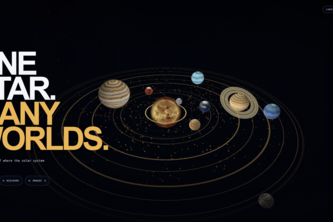
What the company appears to be: Solar Sentinel: Global Solar-System Atlas is an interactive, 3D educational platform that visualizes solar system data from multiple space agencies (NASA, ESA, JAXA, ISRO, etc.) and presents it in a cinematic, source-linked experience. It is built as a web application using Next.js, React, and Three.js.
What changed: The project was submitted to the OpenAI 2026 hackathon by one developer, Deepak Jadhav. It is described as a prototype or proof-of-concept with no evidence of revenue, customers, or product-market fit beyond its own self-description.
Single most important open question: Is there any indication that Solar Sentinel has traction, user engagement, or commercial viability beyond the hackathon submission?
What The Product Actually Is
The description states that Solar Sentinel is an interactive Solar System Atlas. It takes users through a visual journey from the Sun to Earth using:
- 3D scenes with cinematic camera transitions
- Procedural atmosphere and glow effects
- Orbital composition, planet materials, lighting
- Source-linked galleries and mission context
It uses data from:
- NASA/JPL Horizons for planetary positions
- NASA SDO for solar imagery
- NOAA SWPC for current space-weather context
- Mission references from ESA, JAXA, ISRO, UAE/MBRSC, and historical archives
The product is built with:
- Next.js, TypeScript, React, React Three Fiber, Three.js
- Codex for iterative development of scene architecture, visual materials, and data-state design
Inference: The product appears to be a web-based educational visualization tool, not a commercial SaaS or marketplace. It is described as a "cinematic, source-linked atlas" rather than a platform for business use.
Positioning & Claim Evolution
The description states that Solar Sentinel aims to create a different kind of educational experience—not a dense dashboard or simplified animation—but a cinematic, source-linked atlas that encourages curiosity and exploration.
It positions itself as:
- An educational tool, not a commercial product
- A visual journey through the solar system with scientific integrity
- A platform that makes people curious: “What am I looking at? Who observed it? And how does the Sun connect to Earth?”
The author also claims:
- The experience combines real-time and historical data from multiple space agencies.
- It separates observed data, forecasts, and educational scenarios clearly.
- Visual polish serves learning, not just aesthetics.
Inference: The positioning is educational and exploratory, with a focus on scientific accuracy and user engagement. There is no claim of monetization or B2B use.
Target Customer & ICP
The description does not name specific customers or target segments beyond general users interested in space science.
It implies:
- Educators who may want to use it for teaching
- Space enthusiasts and learners curious about solar system data
- Researchers or students seeking visualized, source-backed information
There is no evidence of:
- Specific customer personas
- Market segmentation
- Use cases beyond exploration or learning
Inference: The ICP is likely general space science learners, but the description does not define a clear or narrow target.
Business Model & Pricing Evidence
The description makes no mention of:
- Revenue streams
- Pricing models
- Monetization strategy
- Paid features or subscriptions
It describes Solar Sentinel as an educational tool and a visual journey, with no indication that it is intended for sale, licensing, or commercial use.
Inference: No business model or pricing evidence is provided. The product appears to be non-commercial in nature.
Technical & Delivery Signals
The project was built using:
- Next.js
- TypeScript
- React
- React Three Fiber
- Three.js
- Codex for development support
It uses:
- Chapter-based, scroll-snapped 3D scenes
- Cinematic camera transitions
- Procedural atmosphere and glow effects
- Source cards and interactive galleries
- Live data feeds from NASA/JPL, NASA SDO, NOAA SWPC
Inference: The technical stack is modern and web-based. It uses 3D rendering for educational visualization. There is no evidence of enterprise-grade infrastructure or scalability beyond a prototype.
Traction & Maturity Signals
The description states:
- Solar Sentinel was submitted to the OpenAI 2026 hackathon
- It is described as a prototype or proof-of-concept
- The team size is 1 person
- There is no mention of:
- Users or adoption
- Revenue or monetization
- Product-market fit
- Customer feedback or engagement
Inference: No traction or maturity signals are evident. It is a preliminary version, not a product in use.
Competitive Context
The description does not mention:
- Competitors
- Direct or indirect substitutes
- Market positioning relative to existing tools
It implies that the experience is unique because it:
- Combines data from multiple agencies
- Uses cinematic 3D visualization
- Provides source-linked galleries and mission context
Inference: The competitive landscape is unclear. It may be in a niche space of educational or scientific visualizations, but no evidence of existing players or market dynamics.
Open Questions & Risks
- No commercial traction or revenue: The product is described as a hackathon submission with no evidence of adoption.
- Single-person team: No indication of scaling or long-term development capacity.
- Unproven business model: No monetization strategy or customer base.
- Educational focus only: Not positioned for commercial use or B2B applications.
- Self-reported data sources: No independent verification of data accuracy or completeness.
Inference: The project is not yet a viable product, and there is no evidence of commercial readiness or scalability.
Questions the description leaves open
- What is the intended use case beyond educational exploration?
- Are there any plans to monetize or scale this beyond a prototype?
- How do you plan to validate scientific accuracy with real users?
- Have you considered partnerships with space agencies or educational institutions?
- What are the technical limitations of integrating live data feeds?
- Is there any interest from educators or learners in using this product?
- How do you intend to manage and update content as new missions and data become available?
Overall Assessment
Not evidenced: There is no evidence of:
- Revenue
- Customers
- Product-market fit
- Commercial traction
- Scalability or long-term strategy
The project is described as a hackathon submission, built by one developer, and focused on educational visualization. It does not appear to be a commercial product or platform with investment-ready potential.
Inference: This is a preliminary prototype with no indication of commercial viability or strategic value for investment or partnership at this time.
User Stories BotA demo video on every pull request
Get a demo video on every new feature
GitHub App that watches your pull requests and records a narrated, captioned demo.
Save time on demo prep and make informed decisions faster with a video walkthrough of every new feature.
Source
Submitted to the OpenAI 2026 hackathon on Devpost. Project home on Devpost. Back to the full gallery on Devpost.
This competitive analysis was produced by top-founders.com (opens in a new tab)
Generated by a language model from this project's public Devpost page — its tagline, the author's own write-up and any built-with tags listed there — as captured in August 2026. Short quotations are the author's words. It is an opinion on the idea as a business, not on the people behind it, and it reflects the description as published then. If the project has moved on, request a correction below. The analysis is not independent research and contains no verified traction, revenue or customer data.
An independent guide by KFG International LLC — not affiliated with, endorsed by, or connected to Devpost or OpenAI.