

Archive position — measured, not model output
0 likes on Devpost
2,263 of the 7,850 archived projects have more likes, and 5,587 share exactly 0 — so this project's #6,838 place in the like-ranked listing is a tie-break inside that group, not a ranking.
Projects (log scale)
Likes on Devpost. ▲ marks this project's group.
Show the figures
| Likes | Projects | Share of archive |
|---|---|---|
| 0 | 5,587 | 71.2% |
| 1 | 1,758 | 22.4% |
| 2 | 284 | 3.6% |
| 3–4 | 132 | 1.7% |
| 5–9 | 75 | 1.0% |
| 10+ | 14 | 0.2% |
 User Stories BotA demo video on every pull request
Get a demo video on every new feature
GitHub App that watches your pull requests and records a narrated, captioned demo.
Save time on demo prep and make informed decisions faster with a video walkthrough of every new feature.
Executive Summary
What the company appears to be
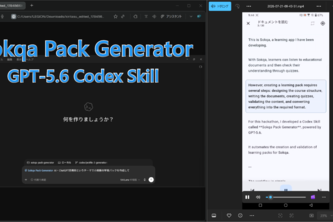
The project described by the caller is Sokqa Pack Generator, a self-reported Codex Skill built using GPT-5.6, designed to automate the creation of educational content for the Sokqa learning application. It is presented as a reusable tool that transforms learning topics into complete, import-ready learning packs.
What changed
The author states they built this tool in response to the challenge of creating high-quality educational content that goes beyond simple AI text generation. The project introduces a structured workflow involving AI generation and deterministic validation steps, aiming for reliability and reusability.
Single most important open question — the commercial due-diligence read
Is there any evidence of actual usage or adoption of this tool by learners, educators, or within Sokqa’s ecosystem? The description does not indicate whether the tool has been used beyond its development phase or integrated into a product or service offering.
What The Product Actually Is
The description states that Sokqa Pack Generator is a reusable Codex Skill powered by GPT-5.6, designed to generate, validate, and export learning packs ready for import into the Sokqa learning application.
It performs the following actions:
- Designs a course blueprint
- Generates structured lesson documents
- Creates four-choice quizzes
- Generates Japanese TTS-ready content
- Builds the learning pack manifest
- Validates JSON Schema
- Verifies quiz consistency
- Detects duplicate content
- Produces an import-ready Sokqa learning pack
The system is described as orchestrating a structured pipeline using Codex, with GPT-5.6 handling generation tasks and custom Python tools performing validation.
Evidence
- The author describes the tool as a "reusable Codex Skill"
- It uses GPT-5.6 for educational planning, lesson generation, quiz creation, and TTS content
- It integrates JSON Schema validation, quiz consistency checks, duplicate detection, and manifest integrity checks
- It is built using Python, YAML, Markdown, JSON Schema, GitHub, and Codex
Inference The tool appears to be a developmental prototype, not yet a product or service in production.
Positioning & Claim Evolution
The author positions Sokqa Pack Generator as:
- A Codex Skill that automates the full workflow of educational content creation
- More than a simple AI content generator — it combines AI generation with deterministic validation
- Designed for reusability, scalability, and integration into Sokqa’s ecosystem
The author claims:
- The tool is built to produce learning packs that are "immediately usable in the Sokqa learning application"
- It separates creative AI generation from objective quality verification
- It supports multilingual content (specifically Japanese TTS-ready)
- It is designed for complete educational content production, not isolated prompts
Evidence
- The author describes it as a “reusable Codex Skill”
- It is built to produce import-ready learning packs
- It includes validation tools and TTS support
Inference The positioning suggests the tool is intended for educational content creators or platforms, but no evidence of market traction, customer feedback, or adoption exists.
Target Customer & ICP
The description states that the tool is designed to generate learning packs ready for import into Sokqa, implying:
- The primary users are likely educators or content creators working within the Sokqa ecosystem
- It may also be used by learning platform developers or language-learning app teams
There is no explicit mention of:
- Specific customer segments (e.g., K12, corporate training, higher education)
- End-user personas
- Use cases beyond Sokqa
Evidence
- The tool is built to generate content for the Sokqa learning application
- It supports Japanese TTS-ready content, suggesting a language-learning focus
Inference The ICP appears to be educational content creators or developers working within the Sokqa platform, but no evidence of actual customers or user groups is provided.
Business Model & Pricing Evidence
There is no information in the description about:
- How the tool will be monetized
- Whether it will be sold as a SaaS product, a service, or integrated into another platform
- Any pricing model or revenue streams
Evidence
- No mention of pricing, subscriptions, or commercial use cases
- The project is described as a hackathon submission, not a commercial offering
Inference The business model remains unknown. It is unclear if the tool will be offered for free, sold to Sokqa, or monetized in another way.
Technical & Delivery Signals
The author states:
- The tool is built using Codex, GPT-5.6, Python, YAML, Markdown, JSON Schema, and GitHub
- It uses a structured pipeline to orchestrate AI generation and validation
- Custom Python validation tools are used for schema compliance, quiz consistency, TTS quality, manifest integrity, duplicate detection, and fact-checking
Evidence
- The tool is implemented as a Codex Skill
- It uses GPT-5.6 for content generation
- It includes deterministic validation steps using Python scripts
Inference The technical approach shows a modular, pipeline-based system, but no evidence of production deployment or scalability beyond the hackathon context.
Traction & Maturity Signals
There is no evidence of:
- Revenue
- Customers
- Product adoption
- Usage metrics
- Product maturity beyond prototype stage
Evidence
- The project was submitted to a hackathon
- It is described as a self-contained tool, not integrated into a larger product or service
- No mention of user feedback, testing, or real-world usage
Inference The tool appears to be at the prototype or proof-of-concept stage, with no evidence of traction or commercial viability.
Competitive Context
There is no mention in the description of:
- Competitors
- Market positioning
- Existing tools for educational content generation or packaging
Evidence
- No reference to similar tools or platforms
- No indication of competitive landscape or differentiation
Inference The competitive context is unknown. It is unclear how this tool compares to existing AI-powered educational content tools.
Open Questions & Risks
Key risks and open questions based on the description:
- No evidence of real-world usage or adoption
- Unverified claims: The author states the tool produces “reliable” learning packs, but no validation data is provided
- Prototype-only status: Submitted to a hackathon, not yet in production or commercial use
- No pricing or monetization model
- No customer feedback or user testing
- Limited evidence of scalability or integration beyond the described pipeline
Inference The tool lacks any commercial viability indicators. It is presented as a concept, not a product.
Questions the description leaves open
- Has this tool been used in real-world educational settings?
- What is the current status of integration with Sokqa or other platforms?
- Are there any customers or users actively using the tool?
- How does the tool handle multilingual content beyond Japanese?
- Is there a plan to monetize or scale this tool beyond its current prototype stage?
- What are the specific validation criteria used in the Python tools, and how reliable are they?
- Has the author tested the tool with actual learners or educators?
Overall Assessment
Assessment The project described is a self-reported hackathon submission, not a commercial product or service. There is no evidence of revenue, customers, traction, or adoption.
Confidence Level Very low. The description provides no verifiable data on usage, performance, or market fit.
Recommendation
This tool should be considered a conceptual prototype with no commercial due-diligence value at this stage. Further investigation would require evidence of real-world usage, integration, or product development beyond the hackathon submission.
User Stories BotA demo video on every pull request
Get a demo video on every new feature
GitHub App that watches your pull requests and records a narrated, captioned demo.
Save time on demo prep and make informed decisions faster with a video walkthrough of every new feature.
Source
Submitted to the OpenAI 2026 hackathon on Devpost. Project home on Devpost. Back to the full gallery on Devpost.
This competitive analysis was produced by top-founders.com (opens in a new tab)
Generated by a language model from this project's public Devpost page — its tagline, the author's own write-up and any built-with tags listed there — as captured in August 2026. Short quotations are the author's words. It is an opinion on the idea as a business, not on the people behind it, and it reflects the description as published then. If the project has moved on, request a correction below. The analysis is not independent research and contains no verified traction, revenue or customer data.
An independent guide by KFG International LLC — not affiliated with, endorsed by, or connected to Devpost or OpenAI.