

Archive position — measured, not model output
0 likes on Devpost
2,263 of the 7,850 archived projects have more likes, and 5,587 share exactly 0 — so this project's #6,834 place in the like-ranked listing is a tie-break inside that group, not a ranking.
Projects (log scale)
Likes on Devpost. ▲ marks this project's group.
Show the figures
| Likes | Projects | Share of archive |
|---|---|---|
| 0 | 5,587 | 71.2% |
| 1 | 1,758 | 22.4% |
| 2 | 284 | 3.6% |
| 3–4 | 132 | 1.7% |
| 5–9 | 75 | 1.0% |
| 10+ | 14 | 0.2% |
 User Stories BotA demo video on every pull request
Get a demo video on every new feature
GitHub App that watches your pull requests and records a narrated, captioned demo.
Save time on demo prep and make informed decisions faster with a video walkthrough of every new feature.
Executive Summary
What the company appears to be
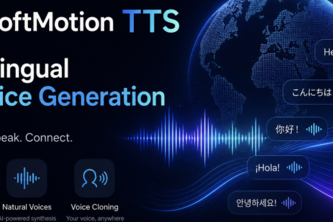
SoftMotion TTS is a self-reported multilingual text-to-speech (TTS) platform that integrates OpenAI-powered translation with AI voice generation. It allows users to input text in one language and generate natural-sounding speech in another, using a simple web interface. The product was built as part of the OpenAI 2026 hackathon.
What changed
The project is described as a working prototype or proof-of-concept developed over a short timeframe (likely a hackathon). It has no evidence of prior development, revenue, customers, or commercial traction beyond its submission to a hackathon.
Single most important open question
Is there any evidence that the product has moved beyond a prototype stage, or that it is being used by anyone outside of its creator?
What The Product Actually Is
The description states that SoftMotion TTS:
- Combines OpenAI-powered translation with AI voice generation
- Allows users to enter text, select a target language, and generate downloadable audio
- Uses Cloudflare Workers, D1, R2, and OpenAI APIs for backend functionality
- Is built with HTML, CSS, JavaScript
Inference The product is a web-based tool that automates the process of converting text into speech across languages. It is not described as a SaaS offering or an API service at this stage.
Not evidenced No information on whether it supports voice cloning, mobile apps, or developer APIs beyond what is mentioned in the "What's next" section.
Positioning & Claim Evolution
The author states:
- The product was inspired by the desire to simplify multilingual speech generation
- It aims to make AI voice technology easier for creators, educators, businesses, and global communicators
- It removes complexity from using multiple tools for translation and voice generation
Claim
The platform positions itself as a simplified, unified solution for multilingual TTS.
Inference The positioning is based on ease-of-use and integration of two complex AI functions (translation + speech synthesis) into one workflow.
Not evidenced No evidence of market research, user feedback, or competitive differentiation beyond the hackathon context.
Target Customer & ICP
The description states:
- The intended audience includes creators, educators, businesses, and global communicators
- It is designed for anyone who wants to generate multilingual speech easily
Inference The target customer segment appears broad but not deeply defined. The ICP seems to be individuals or small teams seeking a simple way to produce multilingual audio content.
Not evidenced No evidence of specific personas, use cases, or customer segments beyond general categories.
Business Model & Pricing Evidence
The description does not mention:
- Any pricing model
- Revenue streams
- Monetization strategy
- Subscription plans or usage-based billing
Inference The project is described as a prototype or hackathon submission with no indication of commercial viability or monetization.
Not evidenced No business model, pricing, or monetization details are provided.
Technical & Delivery Signals
The description states:
- Built using OpenAI API for translation and voice generation
- Backend uses Cloudflare Workers, D1, R2
- Frontend built with HTML, CSS, JavaScript
- Secure handling of translation, authentication, speech generation, and audio storage
Inference The technical stack suggests a serverless architecture leveraging AI APIs and cloud infrastructure.
Not evidenced No information on scalability, performance metrics, or production deployment details beyond the hackathon context.
Traction & Maturity Signals
The description states:
- It was built for the OpenAI 2026 hackathon
- It is a working multilingual AI speech platform
- It integrates OpenAI translation into a real workflow
- It has a clean and responsive web application
Inference The product exists as a prototype or demo, not yet in production use.
Not evidenced
- No user base or adoption data
- No revenue or monetization metrics
- No customer testimonials or feedback
- No evidence of growth or usage beyond the hackathon
Competitive Context
The description does not mention:
- Competitors
- Market positioning relative to existing TTS or translation services
- Differentiation from other platforms offering similar functionality
Inference The author does not provide competitive analysis or awareness.
Not evidenced No evidence of market research, competitor benchmarking, or differentiation strategy.
Open Questions & Risks
- Prototype-only status: The product is described as a hackathon submission with no evidence of commercial traction.
- Single founder: Team size is listed as one person (Hiroko Karino), which may limit execution capacity.
- Dependency on third-party APIs: Heavy reliance on OpenAI and Cloudflare services introduces risk if those services change or become unavailable.
- No monetization strategy: No indication of how the product will generate revenue or sustain itself.
- Unproven market demand: No evidence of user validation or market testing beyond the author’s own claims.
Questions the description leaves open
- What is the current status of SoftMotion TTS? Is it in production, or still a prototype?
- Have you tested the product with real users or customers?
- How do you plan to monetize this platform?
- What are your plans for scaling beyond the hackathon version?
- Are there any legal or compliance considerations related to voice cloning or multilingual content generation?
- How do you intend to compete with existing TTS and translation platforms?
Overall Assessment
Not evidenced No data on financials, traction, or commercial viability is available.
Inference Based on the self-reported description alone, SoftMotion TTS appears to be a hackathon prototype with no demonstrated commercial potential. It lacks evidence of revenue, customers, or product-market fit.
Confidence level Low — this analysis is based entirely on unverified self-reporting and does not reflect any independent validation or market data.
User Stories BotA demo video on every pull request
Get a demo video on every new feature
GitHub App that watches your pull requests and records a narrated, captioned demo.
Save time on demo prep and make informed decisions faster with a video walkthrough of every new feature.
Source
Submitted to the OpenAI 2026 hackathon on Devpost. Project home on Devpost. Back to the full gallery on Devpost.
This competitive analysis was produced by top-founders.com (opens in a new tab)
Generated by a language model from this project's public Devpost page — its tagline, the author's own write-up and any built-with tags listed there — as captured in August 2026. Short quotations are the author's words. It is an opinion on the idea as a business, not on the people behind it, and it reflects the description as published then. If the project has moved on, request a correction below. The analysis is not independent research and contains no verified traction, revenue or customer data.
An independent guide by KFG International LLC — not affiliated with, endorsed by, or connected to Devpost or OpenAI.