

Archive position — measured, not model output
0 likes on Devpost
2,263 of the 7,850 archived projects have more likes, and 5,587 share exactly 0 — so this project's #2,910 place in the like-ranked listing is a tie-break inside that group, not a ranking.
Projects (log scale)
Likes on Devpost. ▲ marks this project's group.
Show the figures
| Likes | Projects | Share of archive |
|---|---|---|
| 0 | 5,587 | 71.2% |
| 1 | 1,758 | 22.4% |
| 2 | 284 | 3.6% |
| 3–4 | 132 | 1.7% |
| 5–9 | 75 | 1.0% |
| 10+ | 14 | 0.2% |
 User Stories BotA demo video on every pull request
Get a demo video on every new feature
GitHub App that watches your pull requests and records a narrated, captioned demo.
Save time on demo prep and make informed decisions faster with a video walkthrough of every new feature.
Executive Summary
What the company appears to be
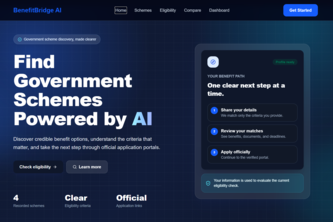
BenefitBridge AI is a self-reported AI-assisted web application designed to help users discover government welfare schemes they are eligible for through personalized recommendations. It allows users to input personal details and receive tailored scheme suggestions, eligibility information, required documents, and official application links.
What changed
The project was built as a solo effort by one developer (Raghav Pachisia) in the context of an OpenAI 2026 hackathon submission. The author describes it as a full-stack platform deployed using Next.js, FastAPI, and other technologies, with AI tools like GPT-5.6 and Codex used for development assistance.
Single most important open question
Is there any evidence of real-world usage or traction beyond the solo developer’s own demonstration? The description states no revenue, customers, or adoption data exist — all claims are self-reported and unverified.
What The Product Actually Is
The description states that BenefitBridge AI is an AI-assisted web application. It enables users to enter personal information such as age, income, education level, occupation, state, gender, and category. Based on this data, the platform evaluates against a curated dataset of government schemes stored in structured JSON files.
It provides:
- Personalized recommendations
- Eligibility explanations
- Benefit details
- Required documents
- Match scores
- Official application links
The system also supports side-by-side scheme comparison and generates downloadable PDF reports. The backend uses FastAPI and Python; the frontend is built with Next.js, React, TypeScript, and Tailwind CSS.
Inference This appears to be a proof-of-concept or prototype rather than a production-grade service, given its solo development and lack of verified user engagement.
Positioning & Claim Evolution
The author positions BenefitBridge AI as a tool that removes complexity from accessing government welfare schemes, aiming to make them more accessible by consolidating information into one place. The platform claims to offer:
- AI-powered personalized recommendations
- Clear explanations of why users qualify or don’t qualify for certain schemes
- Direct access to official portals
It is described as a solution to the problem of fragmented, confusing, and hard-to-navigate government portal systems.
Inference The positioning reflects a social impact mission focused on improving access to public benefits. However, there is no evidence of actual market testing or user feedback beyond the developer’s own experience.
Target Customer & ICP
The description states that the target audience includes individuals who:
- Are unaware of available government schemes
- Find eligibility criteria confusing
- Want to simplify their search for benefits
It implies a broad demographic across age, income, education, and geographic regions within India (based on mention of "state" and "government schemes").
Inference The ICP is likely low-income households or first-time applicants seeking government assistance. However, no specific segmentation or customer validation data is provided.
Business Model & Pricing Evidence
There is no evidence in the description of a business model or pricing strategy. The author does not mention monetization plans, subscription models, partnerships with governments or NGOs, or any revenue-generating mechanisms.
Inference The project appears to be non-commercial at this stage — possibly a prototype or hackathon submission without a defined path to monetization.
Technical & Delivery Signals
The platform was built using:
- Frontend: Next.js, React, TypeScript, Tailwind CSS
- Backend: FastAPI, Python
- Deployment: Vercel (frontend), Render (backend)
- AI tools used: GPT-5.6 and Codex for development support
It is described as modular and scalable, allowing easy addition of new schemes or categories.
Inference The architecture shows some thoughtfulness in design but lacks independent verification of performance, scalability, or robustness in real-world conditions.
Traction & Maturity Signals
There is no evidence of traction, users, customers, or adoption beyond the developer’s own account. No metrics such as active users, signups, usage frequency, or retention are mentioned.
The project was submitted to a hackathon and deployed online, but no data on real-world engagement exists.
Inference This is likely an early-stage prototype with no measurable traction or maturity indicators.
Competitive Context
No mention of existing competitors or market players in the space of government benefit discovery platforms. The author does not reference similar products or services, nor does the description indicate awareness of prior art.
Inference There is insufficient evidence to assess competitive positioning or differentiation from other potential solutions.
Open Questions & Risks
- Solo development: One-person team raises concerns about scalability, maintenance, and long-term viability.
- Unverified data sources: The curated dataset of government schemes is not independently validated.
- No commercialization strategy: No evidence of how the platform will generate revenue or sustain operations.
- AI dependency: Heavy reliance on GPT-5.6 and Codex suggests limited human oversight in final implementation.
- Lack of real-world testing: No user feedback, usage data, or performance metrics are reported.
Inference The project is at a very early stage with significant uncertainty around execution, sustainability, and scalability.
Questions the description leaves open
- What is the source of the government scheme data? Is it accurate, up-to-date, and verified?
- How does the platform ensure compliance with privacy regulations when handling personal user data?
- Are there any plans to partner with government agencies or NGOs for content curation and validation?
- Has the platform undergone any form of usability testing or feedback collection from target users?
- What is the roadmap for monetization, if any? How will it scale beyond a single developer?
- Can you provide examples of how the AI recommendation engine works in practice?
- What are the technical limitations of the current architecture that could hinder expansion?
Overall Assessment
Not evidenced.
There is no evidence of revenue, customers, traction, or commercial viability beyond the solo developer’s own description. The project appears to be a conceptual prototype, possibly submitted for a hackathon, with no demonstrated market demand or business model.
Given the lack of verified data and the absence of any measurable impact or adoption, this is not a viable investment or partnership opportunity at this time. Any future potential would depend on significant development, validation, and scaling beyond its current state.
Confidence Level Low
Reasoning
The entire description is self-reported and unverified; no third-party corroboration exists for any of the stated features, outcomes, or capabilities.
User Stories BotA demo video on every pull request
Get a demo video on every new feature
GitHub App that watches your pull requests and records a narrated, captioned demo.
Save time on demo prep and make informed decisions faster with a video walkthrough of every new feature.
Source
Submitted to the OpenAI 2026 hackathon on Devpost. Project home on Devpost. Back to the full gallery on Devpost.
This competitive analysis was produced by top-founders.com (opens in a new tab)
Generated by a language model from this project's public Devpost page — its tagline, the author's own write-up and any built-with tags listed there — as captured in August 2026. Short quotations are the author's words. It is an opinion on the idea as a business, not on the people behind it, and it reflects the description as published then. If the project has moved on, request a correction below. The analysis is not independent research and contains no verified traction, revenue or customer data.
An independent guide by KFG International LLC — not affiliated with, endorsed by, or connected to Devpost or OpenAI.