

Archive position — measured, not model output
0 likes on Devpost
2,263 of the 7,850 archived projects have more likes, and 5,587 share exactly 0 — so this project's #6,836 place in the like-ranked listing is a tie-break inside that group, not a ranking.
Projects (log scale)
Likes on Devpost. ▲ marks this project's group.
Show the figures
| Likes | Projects | Share of archive |
|---|---|---|
| 0 | 5,587 | 71.2% |
| 1 | 1,758 | 22.4% |
| 2 | 284 | 3.6% |
| 3–4 | 132 | 1.7% |
| 5–9 | 75 | 1.0% |
| 10+ | 14 | 0.2% |
 User Stories BotA demo video on every pull request
Get a demo video on every new feature
GitHub App that watches your pull requests and records a narrated, captioned demo.
Save time on demo prep and make informed decisions faster with a video walkthrough of every new feature.
Executive Summary
Company: Software Genome AI
Self-reported purpose: To help developers understand the impact of code changes before merging by visualizing dependencies and risks in a GitHub repository.
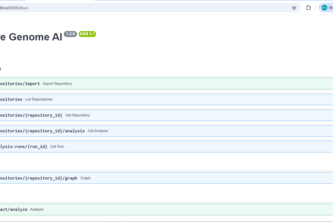
Key commercial insight: The product appears to be a developer tool for change impact analysis, built during a hackathon. It imports public repositories, creates dependency graphs, and shows direct and transitive impacts of file changes.
What changed: The project evolved from a prototype into a more complete tool with secure repository import, background analysis jobs, persisted graph snapshots, and interactive visualizations.
Most important open question: Is there a viable market for this type of developer tool, and does it address a real pain point that developers are willing to pay for?
What The Product Actually Is
The description states that Software Genome AI is a tool that:
- Imports public GitHub repositories
- Analyzes their structure using Python AST parsing, JavaScript/TypeScript parsing, and Git-based import
- Turns the repository into an explainable dependency graph
- Allows developers to select a file and see:
- Direct dependents
- Transitive blast radius
- Visual dependency map
- Evidence explaining why each affected component is included
- Repository-level statistics for files, classes, functions, and imports
The backend was built with FastAPI, SQLite, Python, Git, and graph persistence. The frontend uses Next.js, React, TypeScript, and interactive SVG visualization.
Inference: It is a developer tool focused on impact analysis in codebases, not a general-purpose code understanding platform.
Positioning & Claim Evolution
The description states that the inspiration came from making software easier to understand like a biological genome — a connected map of relationships, risks, and dependencies.
The product is positioned as a way to answer the question: "what else could this change break?" It aims to make code changes safer by showing developers the impact before merging.
Inference: The tool evolved from a hackathon prototype into something more complete with background jobs, visualizations, and explainable results. However, it remains self-reported and unverified.
Target Customer & ICP
The description states that the tool is for developers who need to change code they did not write and want to understand the impact of those changes.
It targets users working in complex software systems where a small change can have hidden effects across modules.
Inference: The target customer is likely individual developers or engineering teams working on large, unfamiliar codebases. No specific ICP is defined beyond this general audience.
Business Model & Pricing Evidence
Not evidenced.
The description does not mention any pricing model, monetization strategy, or business model. It only describes the tool's functionality and how it was built.
Technical & Delivery Signals
The product was built with:
- Backend: FastAPI, SQLite, Python AST parsing, Git-based import, graph persistence
- Frontend: Next.js, React, TypeScript, SVG visualization
- AI tools used: Codex and GPT-5.6 (during the hackathon)
- Features implemented:
- Secure GitHub repository import
- Background analysis jobs with status updates
- Persisted graph snapshots
- Structural analysis for Python, TypeScript, JavaScript
- Direct and transitive dependency impact analysis
- Human-readable evidence for every result
- Interactive graph visualization
Inference: The tool is built with a focus on reliability and explainability. It uses deterministic traversal over AI claims to maintain trustworthiness.
Traction & Maturity Signals
Not evidenced.
There is no mention of revenue, customers, usage metrics, or adoption data. The project was submitted as part of a hackathon and has no evidence of being used beyond the prototype phase.
Competitive Context
Not evidenced.
The description does not reference any competitors or existing tools in this space. No market analysis or competitive positioning is provided.
Open Questions & Risks
- No traction or revenue: The tool is a hackathon project with no evidence of real-world usage or monetization.
- Unverified claims: All features and functionality are self-reported, with no independent validation.
- Limited scope: It only works with public GitHub repositories and does not appear to support private repos or enterprise environments.
- No pricing or business model: No indication of how the tool would be monetized or whether there is a viable market for it.
- Founder team size: Only one member (Anusha Errabelli), which may limit execution capacity.
Questions the description leaves open
- What specific problem are you solving, and how do you know developers care about it?
- Have you validated the need for this tool with real users or engineering teams?
- How would you monetize this product if you were to build a business around it?
- Are there any existing tools in this space that you're aware of?
- What is your plan for scaling beyond the hackathon prototype?
- Do you have plans to support private repositories or enterprise environments?
Overall Assessment
Not evidenced.
There is no evidence of revenue, customers, traction, or a clear path to monetization. The project is described as a hackathon submission with no indication of commercial viability or market demand. Any investment or partnership potential would require further due diligence into real-world usage and market validation.
User Stories BotA demo video on every pull request
Get a demo video on every new feature
GitHub App that watches your pull requests and records a narrated, captioned demo.
Save time on demo prep and make informed decisions faster with a video walkthrough of every new feature.
Source
Submitted to the OpenAI 2026 hackathon on Devpost. Project home on Devpost. Back to the full gallery on Devpost.
This competitive analysis was produced by top-founders.com (opens in a new tab)
Generated by a language model from this project's public Devpost page — its tagline, the author's own write-up and any built-with tags listed there — as captured in August 2026. Short quotations are the author's words. It is an opinion on the idea as a business, not on the people behind it, and it reflects the description as published then. If the project has moved on, request a correction below. The analysis is not independent research and contains no verified traction, revenue or customer data.
An independent guide by KFG International LLC — not affiliated with, endorsed by, or connected to Devpost or OpenAI.