

Archive position — measured, not model output
0 likes on Devpost
2,263 of the 7,850 archived projects have more likes, and 5,587 share exactly 0 — so this project's #6,835 place in the like-ranked listing is a tie-break inside that group, not a ranking.
Projects (log scale)
Likes on Devpost. ▲ marks this project's group.
Show the figures
| Likes | Projects | Share of archive |
|---|---|---|
| 0 | 5,587 | 71.2% |
| 1 | 1,758 | 22.4% |
| 2 | 284 | 3.6% |
| 3–4 | 132 | 1.7% |
| 5–9 | 75 | 1.0% |
| 10+ | 14 | 0.2% |
 User Stories BotA demo video on every pull request
Get a demo video on every new feature
GitHub App that watches your pull requests and records a narrated, captioned demo.
Save time on demo prep and make informed decisions faster with a video walkthrough of every new feature.
Executive Summary
What the company appears to be
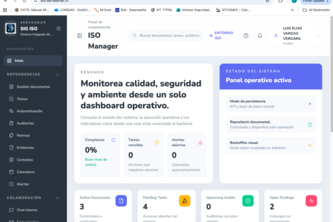
ISO Manager is a self-reported software platform designed for organizations in critical infrastructure, ports, logistics, security, and maritime operations. It aims to centralize compliance management through document tracking, audit scheduling, task follow-up, real-time chat, role-based access control (RBAC), and AI-assisted support.
What changed
The author states that ISO Manager emerged from personal professional experience observing how organizations still manage compliance using isolated spreadsheets, emails, and untracked processes. The project was developed as a monorepo with React frontend, NestJS backend, MongoDB persistence, and real-time communication via Socket.IO. It includes sandboxed AI features and an early-stage automation engine.
Single most important open question
Is there evidence of actual traction or customer validation beyond the author's own development work?
Note: This analysis is based entirely on the self-reported description provided by the author — no external verification, revenue data, customer names, or adoption metrics are available. All claims are treated as stated by the author and not proven facts.
What The Product Actually Is
The description states that ISO Manager is a software platform for managing compliance in critical infrastructure sectors such as ports, logistics, maritime operations, and security. It integrates:
- Document management and traceability.
- Audit scheduling and tracking.
- Management of findings and evidence.
- Task and deadline tracking.
- Contract and obligation management.
- Internal communications (individual/group chat).
- Role-based access control (RBAC).
- Auditable activity logs.
- Preventive automation rules.
- AI assistance for document analysis, procedure drafting, summaries, and contextual suggestions.
It is described as a multi-tenant system built with React, NestJS, MongoDB, and Socket.IO. The author notes that the AI layer currently operates in a sandboxed environment before production integration.
Claim: The product is a compliance management platform.
Evidence: Author's own description.
Inference: It supports critical infrastructure industries based on stated use case.
Positioning & Claim Evolution
The author positions ISO Manager as a digital transformation tool for organizations that currently rely on fragmented, manual methods of managing compliance. The core claim is to move from reactive, pre-audit compliance work to continuous, preventive, and traceable processes.
It evolves from a basic document repository into a collaborative, automated, and AI-enhanced system. The author describes it as evolving toward becoming a "copilot" for compliance management in critical infrastructure.
Claim: ISO Manager transforms compliance from reactive to proactive.
Evidence: Author's own description.
Inference: This evolution implies a shift from traditional tools to a more integrated solution.
Target Customer & ICP
The author states that the initial target audience includes organizations involved in:
- Critical infrastructure.
- Ports.
- Logistics.
- Security.
- Maritime operations.
These industries are characterized by needing robust compliance frameworks and audit readiness. The platform is designed for users without technical expertise, aiming to simplify complex administrative tasks.
Claim: Target customers are in critical infrastructure, ports, logistics, security, and maritime sectors.
Evidence: Author's own description.
Inference: The ICP is likely mid-to-large enterprises requiring compliance documentation and audit support.
Business Model & Pricing Evidence
No information about pricing, monetization strategy, or business model is provided in the author’s description. The project appears to be a personal development effort rather than a commercial product with a defined revenue stream.
Claim: No pricing or business model described.
Evidence: Author's own description.
Inference: Likely not yet monetized or sold; possibly an open-source or prototype version.
Technical & Delivery Signals
The author reports the following technical stack and delivery approach:
- Built as a monorepo using pnpm.
- Frontend: React, TypeScript, Vite, Tailwind CSS, TanStack Query, Zustand.
- Backend: NestJS, TypeScript, MongoDB, Mongoose, Socket.IO.
- Authentication via Clerk.
- Multi-tenant architecture with RBAC and session validation.
- Real-time chat using Socket.IO.
- AI layer implemented in sandbox mode.
- Automation engine based on rule prioritization logic (impact × urgency).
- Deployment across Vercel (frontend) and Docker (backend).
- CI/CD practices mentioned.
Claim: The platform uses modern tech stack with multi-tenancy, RBAC, real-time chat, and sandboxed AI.
Evidence: Author's own description.
Inference: Indicates technical maturity and scalability planning.
Traction & Maturity Signals
There is no evidence of traction, customers, revenue, or adoption beyond the author’s development effort. The project was submitted to a hackathon and appears to be a personal prototype.
Claim: No traction or customer validation.
Evidence: Author's own description.
Inference: Lack of external validation suggests early-stage product.
Competitive Context
The author does not mention competitors or direct market comparisons. However, the described functionality overlaps with tools in compliance management, document control, audit tracking, and enterprise collaboration platforms (e.g., SharePoint, ServiceNow, Jira, Confluence). The AI integration may differentiate it from traditional systems.
Claim: No competitive landscape mentioned.
Evidence: Author's own description.
Inference: Likely competes with niche compliance or ERP tools in critical infrastructure.
Open Questions & Risks
- No commercial traction or revenue: The platform is described as a personal project, not yet monetized.
- Unproven AI integration: AI is currently sandboxed; real-world deployment remains untested.
- Limited scalability assumptions: No mention of performance testing or large-scale deployments.
- Single developer team: Only one member listed (the author), which may limit execution capacity.
- Unclear path to market: No indication of go-to-market strategy, sales funnel, or customer acquisition plans.
Claim: Risk factors include lack of traction, untested AI, limited team size, and unclear commercialization plan.
Evidence: Author's own description.
Inference: These suggest a high-risk, early-stage product with uncertain viability.
Questions the description leaves open
- What specific problems in compliance management did you observe that led to this solution?
- Have you validated the platform with any real users or organizations?
- How do you plan to monetize this tool beyond personal development?
- What are your plans for integrating the AI layer into production?
- Are there any existing partnerships or pilot programs with target customers?
- What is the timeline for scaling beyond a single developer?
- How will you ensure data isolation and security in multi-tenant environments?
Note: These questions aim to uncover gaps in the self-reported narrative.
Overall Assessment
Not evidenced — There is no evidence of revenue, customers, or traction to support an investment or partnership decision. The project appears to be a personal prototype developed for a hackathon, with no indication of commercial viability or market validation.
Claim: No basis for investment or partnership.
Evidence: Author's own description.
Inference: Early-stage idea with potential but unproven execution and traction.
User Stories BotA demo video on every pull request
Get a demo video on every new feature
GitHub App that watches your pull requests and records a narrated, captioned demo.
Save time on demo prep and make informed decisions faster with a video walkthrough of every new feature.
Source
Submitted to the OpenAI 2026 hackathon on Devpost. Project home on Devpost. Back to the full gallery on Devpost.
This competitive analysis was produced by top-founders.com (opens in a new tab)
Generated by a language model from this project's public Devpost page — its tagline, the author's own write-up and any built-with tags listed there — as captured in August 2026. Short quotations are the author's words. It is an opinion on the idea as a business, not on the people behind it, and it reflects the description as published then. If the project has moved on, request a correction below. The analysis is not independent research and contains no verified traction, revenue or customer data.
An independent guide by KFG International LLC — not affiliated with, endorsed by, or connected to Devpost or OpenAI.