

Archive position — measured, not model output
1 like on Devpost
505 of the 7,850 archived projects have more likes, and 1,758 share exactly 1 — so this project's #948 place in the like-ranked listing is a tie-break inside that group, not a ranking.
Projects (log scale)
Likes on Devpost. ▲ marks this project's group.
Show the figures
| Likes | Projects | Share of archive |
|---|---|---|
| 0 | 5,587 | 71.2% |
| 1 | 1,758 | 22.4% |
| 2 | 284 | 3.6% |
| 3–4 | 132 | 1.7% |
| 5–9 | 75 | 1.0% |
| 10+ | 14 | 0.2% |
 User Stories BotA demo video on every pull request
Get a demo video on every new feature
GitHub App that watches your pull requests and records a narrated, captioned demo.
Save time on demo prep and make informed decisions faster with a video walkthrough of every new feature.
Executive Summary
What the company appears to be
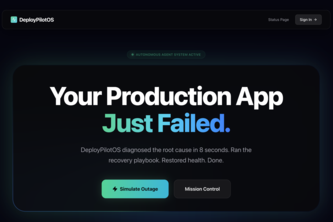
DeployPilotOS: Autonomous AI SRE is described as an autonomous AI DevOps agent that monitors production systems, diagnoses incidents using GPT-5.6, and auto-executes recovery runbooks. It claims to be the first of its kind, aiming to eliminate human intervention in incident response during outages.
What changed
The project was submitted as part of the OpenAI 2026 hackathon. The author states it is a proof-of-concept built with Next.js and React, simulating a real-time production environment for demonstration purposes. It uses OpenAI APIs including GPT-5.6, Structured Outputs, Embeddings API, and Realtime API.
Single most important open question
Is there any evidence of actual deployment or use in production environments beyond the simulated sandbox? The description makes no claims about traction, revenue, or customer adoption — only a self-reported vision.
What The Product Actually Is
The description states that DeployPilotOS is an autonomous AI SRE agent designed to monitor production systems and automatically respond to incidents. It includes:
- Real-time diagnosis using GPT-5.6 with Chain-of-Thought reasoning.
- Autonomous execution of pre-defined YAML runbooks via semantic matching.
- A voice war room powered by OpenAI’s Realtime API for hands-free command during outages.
It is built as a dashboard UI using Next.js, React, and TailwindCSS, with simulated telemetry and log analysis to mimic real-time behavior in a sandbox environment.
Inference The product appears to be a prototype or hackathon submission focused on demonstrating AI-driven incident response capabilities. It does not appear to have been deployed into live production systems at this time.
Positioning & Claim Evolution
The author positions DeployPilotOS as the world’s first autonomous AI DevOps agent, designed to eliminate the need for engineers to wake up during outages. The core claim is that it moves beyond alerting tools like Datadog or PagerDuty by taking action autonomously.
Inference This positioning reflects a vision of AI-powered SRE automation, but lacks evidence of prior market traction or competitive differentiation in real-world use cases.
Target Customer & ICP
The description implies that DeployPilotOS targets DevOps engineers and SREs who are responsible for monitoring and maintaining production systems. These users are likely dealing with high-stakes incidents where MTTR (Mean Time to Recover) is critical.
Inference There is no explicit segmentation or targeting beyond “engineers” — no indication of whether the tool targets enterprise customers, startups, or specific industries.
Business Model & Pricing Evidence
No information is provided about pricing, monetization strategy, or business model. The project is described as a hackathon submission with no mention of commercialization plans or revenue streams.
Not evidenced
Technical & Delivery Signals
The system is built using:
- Frontend: Next.js 14, React, TailwindCSS
- AI Stack: GPT-5.6, Structured Outputs, Embeddings API, Realtime API
- Simulated Environment: Custom hooks and interval math to simulate live telemetry
- Core Functionality: Incident detection, diagnosis via AI, runbook execution
The author mentions challenges in transitioning from conversational chatbot to deterministic execution engine, requiring prompt engineering and structured outputs.
Inference Technical architecture suggests a prototype built for demonstration rather than production deployment. The use of simulated data implies the system has not yet been integrated with live infrastructure.
Traction & Maturity Signals
There is no evidence of traction, customers, or adoption beyond the hackathon submission. The project is described as a sandbox simulation and lacks any mention of real-world usage, performance metrics, or user feedback.
Not evidenced
Competitive Context
The author references existing tools such as Datadog and PagerDuty, which send alerts but require human intervention. DeployPilotOS positions itself as an evolution of these tools by automating the response phase.
However, no competitive analysis is provided — no mention of how it compares to other AI-powered DevOps or SRE platforms (if any exist), nor whether similar concepts have been explored in industry.
Not evidenced
Open Questions & Risks
- Unproven automation: The system is described as a prototype with simulated telemetry; there is no evidence of real-world deployment.
- Over-reliance on proprietary APIs: Heavy dependence on OpenAI’s GPT-5.6 and other APIs may pose scalability or cost risks if not properly managed.
- Lack of clarity around safety mechanisms: While the system maps root causes to runbooks, there is no mention of safeguards against unintended actions in production.
- No commercial viability stated: No indication of how this would be monetized or scaled beyond a hackathon demo.
Questions the description leaves open
- What specific types of incidents does DeployPilotOS currently support?
- How are runbooks defined and validated? Are they customizable by users?
- Has the system been tested in any real-world environments, even partially?
- What is the plan for integrating with actual infrastructure (e.g., Kubernetes, GitHub Actions)?
- How does the system handle edge cases or ambiguous incidents where AI diagnosis fails?
- Is there a roadmap for moving from simulation to live execution?
Overall Assessment
The project is described as a hackathon submission and lacks any evidence of traction, revenue, customers, or commercial viability. It represents an ambitious idea in the space of autonomous AI SRE but remains unproven in practice.
Confidence Level Low
Assessment Not ready for investment or partnership consideration without further development, proof-of-concept validation, and demonstration of real-world utility.
User Stories BotA demo video on every pull request
Get a demo video on every new feature
GitHub App that watches your pull requests and records a narrated, captioned demo.
Save time on demo prep and make informed decisions faster with a video walkthrough of every new feature.
Source
Submitted to the OpenAI 2026 hackathon on Devpost. Project home on Devpost. Back to the full gallery on Devpost.
This competitive analysis was produced by top-founders.com (opens in a new tab)
Generated by a language model from this project's public Devpost page — its tagline, the author's own write-up and any built-with tags listed there — as captured in August 2026. Short quotations are the author's words. It is an opinion on the idea as a business, not on the people behind it, and it reflects the description as published then. If the project has moved on, request a correction below. The analysis is not independent research and contains no verified traction, revenue or customer data.
An independent guide by KFG International LLC — not affiliated with, endorsed by, or connected to Devpost or OpenAI.