

Archive position — measured, not model output
1 like on Devpost
505 of the 7,850 archived projects have more likes, and 1,758 share exactly 1 — so this project's #947 place in the like-ranked listing is a tie-break inside that group, not a ranking.
Projects (log scale)
Likes on Devpost. ▲ marks this project's group.
Show the figures
| Likes | Projects | Share of archive |
|---|---|---|
| 0 | 5,587 | 71.2% |
| 1 | 1,758 | 22.4% |
| 2 | 284 | 3.6% |
| 3–4 | 132 | 1.7% |
| 5–9 | 75 | 1.0% |
| 10+ | 14 | 0.2% |
 User Stories BotA demo video on every pull request
Get a demo video on every new feature
GitHub App that watches your pull requests and records a narrated, captioned demo.
Save time on demo prep and make informed decisions faster with a video walkthrough of every new feature.
Executive Summary
What the company appears to be
DenialDecoder is a self-reported tool designed to decode unreadable health insurance denial letters and draft appeals. It was submitted as a project for the OpenAI 2026 hackathon, built using AI and document processing technologies.
What changed
The project was submitted to a hackathon; no evidence of prior development or commercial activity is provided.
The single most important open question
Is there any evidence of traction, revenue, customer adoption, or product-market fit beyond the hackathon submission?
What The Product Actually Is
The description states that DenialDecoder "decodes" health insurance denial letters and "drafts your appeal." It was built using a range of technologies including GPT-5, PyMuPDF, Tesseract OCR, and React. The author declares it as a hackathon project submitted to the OpenAI 2026 hackathon.
Evidence
- The description states DenialDecoder decodes denial letters and drafts appeals.
- It was built using AI and document processing tools such as GPT-5, PyMuPDF, Tesseract OCR, and React.
- It is a project submitted to the OpenAI 2026 hackathon.
Not evidenced
- No details on how the tool works beyond its function.
- No information about whether it's a web app, API, or standalone tool.
- No evidence of user interface, data flow, or integration points.
Positioning & Claim Evolution
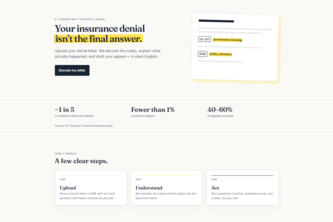
The tagline claims: “1 in 5 health claims get denied. Fewer than 1% get appealed — because denial letters are unreadable.” This is a positioning statement about a problem and an implied solution. The description does not state whether this claim has been validated or tested.
Evidence
- The tagline positions the tool as solving a problem with unreadable denial letters.
- It implies that appeals are rare due to complexity of denial letters.
Not evidenced
- No evidence that the claim about 1 in 5 claims being denied is verified.
- No evidence that fewer than 1% of denials are appealed.
- No evidence of prior validation or testing of this positioning.
Target Customer & ICP
The description implies a target customer: individuals who receive health insurance denial letters and need to appeal them. However, no explicit identification of the ICP is provided.
Evidence
- The tool is aimed at people who receive health insurance denials.
- It is designed to help draft appeals for those denials.
Not evidenced
- No stated customer segment (e.g., individual consumers, healthcare providers, insurers).
- No evidence of a defined persona or buyer journey.
- No indication of whether the product targets end-users or intermediaries.
Business Model & Pricing Evidence
There is no information in the description about pricing, monetization, or business model. The project is described as a hackathon submission with no indication of commercial intent or structure.
Evidence
- The project is a hackathon submission.
- No mention of revenue streams, pricing tiers, or monetization strategy.
Not evidenced
- No evidence of a business model.
- No evidence of pricing or monetization approach.
- No indication of whether it's intended for sale, subscription, or freemium.
Technical & Delivery Signals
The project is built using a range of technologies including GPT-5, PyMuPDF, Tesseract OCR, React, and FastAPI. It was submitted to the OpenAI 2026 hackathon.
Evidence
- Technologies used include GPT-5, PyMuPDF, Tesseract OCR, React, FastAPI.
- It is a hackathon project.
Not evidenced
- No evidence of scalability or production-grade architecture.
- No information on deployment, hosting, or delivery method.
- No indication of performance, reliability, or security features.
Traction & Maturity Signals
There is no evidence of traction, adoption, or product maturity beyond the hackathon submission. The team size is listed as 2, and there is no mention of users, customers, or usage metrics.
Evidence
- The project was submitted to a hackathon.
- Team size is 2.
Not evidenced
- No evidence of user base or adoption.
- No evidence of revenue or customer engagement.
- No indication of product iteration or development beyond the hackathon.
Competitive Context
The description does not provide any information about competitors or market context. It does not state whether similar tools exist, nor how DenialDecoder differentiates from them.
Evidence
- No mention of existing tools or competitive landscape.
Not evidenced
- No evidence of competitive analysis.
- No indication of differentiation or unique value proposition.
- No reference to prior art or market players.
Open Questions & Risks
The project is a hackathon submission with no evidence of traction, revenue, or customer validation. It lacks any commercial or product-market fit signals.
Inferences
- The lack of evidence for adoption or monetization raises questions about viability.
- The tool’s scope and maturity are unclear beyond the hackathon context.
- No team experience or prior product history is evident.
Questions the description leaves open
- What problem are you solving, and how did you validate that it exists?
- How does DenialDecoder work in practice? Can you walk us through a typical use case?
- Have you tested the tool with real users or insurance providers?
- Is there any plan to monetize this tool, and if so, what is your business model?
- What are the technical limitations of the current version, and how do you plan to scale it?
Overall Assessment
Not evidenced.
The project is a hackathon submission with no evidence of traction, revenue, or product-market fit. The description does not provide sufficient information to assess commercial viability or investment potential.
Confidence Low.
Reasoning
The entire basis for this analysis is self-reported and unverified. No evidence of customers, revenue, adoption, or even a clear product definition beyond the hackathon submission exists.
User Stories BotA demo video on every pull request
Get a demo video on every new feature
GitHub App that watches your pull requests and records a narrated, captioned demo.
Save time on demo prep and make informed decisions faster with a video walkthrough of every new feature.
Source
Submitted to the OpenAI 2026 hackathon on Devpost. Project home on Devpost. Back to the full gallery on Devpost.
This competitive analysis was produced by top-founders.com (opens in a new tab)
Generated by a language model from this project's public Devpost page — its tagline and any built-with tags listed there, since the author published no write-up — as captured in August 2026. Short quotations are the author's words. It is an opinion on the idea as a business, not on the people behind it, and it reflects the description as published then. If the project has moved on, request a correction below. The analysis is not independent research and contains no verified traction, revenue or customer data.
An independent guide by KFG International LLC — not affiliated with, endorsed by, or connected to Devpost or OpenAI.