

Archive position — measured, not model output
0 likes on Devpost
2,263 of the 7,850 archived projects have more likes, and 5,587 share exactly 0 — so this project's #5,238 place in the like-ranked listing is a tie-break inside that group, not a ranking.
Projects (log scale)
Likes on Devpost. ▲ marks this project's group.
Show the figures
| Likes | Projects | Share of archive |
|---|---|---|
| 0 | 5,587 | 71.2% |
| 1 | 1,758 | 22.4% |
| 2 | 284 | 3.6% |
| 3–4 | 132 | 1.7% |
| 5–9 | 75 | 1.0% |
| 10+ | 14 | 0.2% |
 User Stories BotA demo video on every pull request
Get a demo video on every new feature
GitHub App that watches your pull requests and records a narrated, captioned demo.
Save time on demo prep and make informed decisions faster with a video walkthrough of every new feature.
Executive Summary
What the company appears to be
Melmac-DataAI is a self-reported AI-powered analytical control plane designed for small and medium-sized businesses (SMBs). It structures analytics around "Business Cases" rather than ad-hoc queries or dashboards, aiming to automate repetitive analytical execution while maintaining human accountability through deterministic workflows, semantic rules, bounded evidence, approval gates, and audit trails. The system is built using LangGraph as a control plane, integrates with BigQuery and PostgreSQL, and supports model providers like OpenAI-compatible endpoints.
What changed
The author describes an evolution from an early Telegram-based agent system (OpenClaw) to a more structured, governed system using LangGraph and modern AI tools. The current version is presented as a prototype built during a hackathon, with ambitions to become a scalable solution for SMBs seeking to reduce reliance on traditional data analysts.
Single most important open question
Is there sufficient evidence of traction or early validation that this product concept can be meaningfully scaled beyond a single developer's prototype?
Note: All claims and descriptions are self-reported by the author, unverified, and based solely on the project description provided. No external data, revenue figures, customer names, or performance metrics are available.
What The Product Actually Is
The description states that Melmac-DataAI is a system designed to organize work around Business Cases rather than chats, dashboards, or agent activity. It includes:
- A Business Case Board, which shows what needs attention, why it is blocked, what evidence exists, and what should happen next.
- An AI Curator that preserves typed, cited Investigation proposals; confirming them creates scope but does not silently authorize a query.
- A deterministic LangGraph control plane that validates Workplans, semantic contracts, source scope, SQL safety, cost ceilings, evidence requirements, and exact effect authority.
- A recorded approved warehouse read, collecting only bounded aggregate evidence. The execution is replay-safe, and the full result table was not persisted.
- An Evidence Packet that keeps immutable revisions, hashes, provenance, reconciliation, and limitations.
- An Audit trail that records every implemented transition so the system cannot quietly turn a proposal into a business fact.
The demo stops before Human Evidence Review and a business Decision because those authoritative write paths are not yet active in the deployed prototype. BI publication, materialization, autonomous decisions, and background monitoring are also not presented as live.
Inference: The product is described as an analytical control plane with governance features, not a general-purpose AI copilot or dashboard tool. It is built for structured workflows where AI handles execution while humans manage intent, ambiguity resolution, and final decisions.
Positioning & Claim Evolution
The author positions Melmac-DataAI as a system that moves analytics from being a "scarce craft" available only to larger companies into an operating capability. The ambition is to make analytics more accessible by removing parts of established job descriptions while creating demand for a new kind of specialist—an AI engineer-operator who can configure systems, supervise their work, and remain accountable across departments.
Key claims include:
- AI will remove parts of traditional roles but create demand for a different kind of expert.
- The shift is analogous to calculators moving value away from manual arithmetic toward framing problems, checking assumptions, and interpreting results.
- The product is not an analytics copilot; it's designed for AI to perform most repeatable analytical execution while humans set business intent, resolve ambiguity, approve consequential effects, and own the final decision.
Claim: This is a deliberate move away from traditional data analyst roles toward a hybrid human-AI workflow.
Inference: The positioning reflects an attempt to reframe analytics as a shared responsibility between AI and domain experts, not just a tool for specialists.
Target Customer & ICP
The description states that Melmac-DataAI targets small and medium-sized companies (SMBs) where data analytics feels like a luxury department due to cost, specialization, and difficulty of understanding. These companies often suffer from:
- Expensive, specialized roles.
- Repeated context transfer.
- Inconsistent definitions.
- Growing backlogs of unasked questions.
The author believes that AI can break open the old monopoly of narrow specialization, allowing non-numerical experts (like those with qualitative backgrounds) to contribute meaningfully to analytics.
Claim: SMBs with repeatable cross-source workloads are the primary target.
Inference: The ICP likely includes decision-makers in mid-sized organizations who want to reduce reliance on data analysts but still need structured, auditable outputs.
Business Model & Pricing Evidence
There is no evidence of pricing, business model, or monetization strategy in the description. The author mentions a planning model estimating 42–55% nominal steady-state savings for suitable SMBs when traditional capacity is retired or avoided, but this is described as a hypothesis to be validated through paid pilots—not a claim of current revenue or pricing.
Not evidenced: No mention of subscription tiers, usage-based pricing, or any commercial structure.
Technical & Delivery Signals
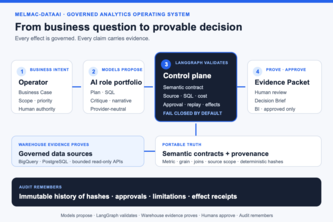
The architecture separates five kinds of authority:
- Models propose.
- LangGraph validates.
- Warehouse evidence proves.
- Humans approve.
- Audit remembers.
Key technical components include:
- Built with: BigQuery, Codex, cryptography, CSS3, Docker, FastAPI, GitHub Actions, Google Cloud, GPT-5.6, HTML5, JavaScript, LangGraph, OpenAPI, OpenModel, OpenRouter, PostgreSQL, Pydantic, pytest, Python, Railway, SQLGlot.
- Uses LangGraph as the deterministic control plane for routing, validation, checkpoints, and approval boundaries.
- PostgreSQL stores durable control-plane state, immutable artifact revisions, and audit history.
- BigQuery is used through bounded metadata, dry-run, and approval-bound aggregate-read boundaries.
- SQLGlot supports deterministic SQL analysis before a warehouse effect is allowed.
- A bilingual (English/Ukrainian) operator console exposes Business Cases, Investigations, Evidence, source health, documentation, model-provider settings, and audit.
- Provider settings support governed profiles for OpenModel, OpenRouter, direct-compatible, and explicit self-hosted endpoints.
Claim: The system uses a multi-layered architecture to ensure deterministic workflows, semantic contracts, bounded evidence, and audit trails.
Inference: This suggests a strong focus on governance, security, and reproducibility—key signals for enterprise-grade systems.
Traction & Maturity Signals
The description states that:
- The product is a deployed prototype built during a hackathon.
- Release 0.12.14 is deployed, with passing local, private CI, and hosted-Linux isolation checks.
- A bilingual Business Case supervision console (English/Ukrainian) is included.
- The system supports typed Analytical Workplans, deterministic validation, and approval-bound BigQuery aggregate evidence collection.
- It includes immutable Evidence Packet history with deterministic hashes and provenance.
However, there is no evidence of actual customers, revenue, or adoption beyond the author’s own development efforts. The demo stops before Human Evidence Review and a business Decision because those paths are not yet active in the prototype.
Not evidenced: No customer data, usage metrics, or real-world pilot results.
Competitive Context
The description does not provide any information about competitors or market positioning relative to existing tools such as Superset, Metabase, or other BI platforms. The author notes that open-source BI tools like Superset and Metabase do not remove the hard parts of analytics—source reconciliation, metric ownership, evidence quality, review, and audit still require a control plane.
Not evidenced: No competitive landscape analysis, no mention of direct or indirect competitors.
Open Questions & Risks
Several potential risks and open questions are implied by the self-reported nature of the description:
- The system is described as a prototype, not a production-ready product.
- There is no evidence of traction or pilot customers.
- The author’s background is in qualitative analysis, not numerical analytics—this raises questions about whether they have sufficient domain expertise to build a scalable solution.
- The system does not yet support human review or decision-making, which are core functions for any analytics platform.
- The product is built by a single person (the author), raising concerns about scalability and team capacity.
- No mention of security, compliance, or data privacy beyond basic protections like encrypted credentials.
Inference: The risk of misalignment between the vision and real-world needs is high without external validation or user feedback.
Questions the description leaves open
- What specific SMB use cases have you identified that would benefit from this system?
- How do you plan to validate the 50%+ cost-saving hypothesis through paid pilots?
- Are there any early adopters or pilot customers who are willing to share feedback?
- What is your roadmap for enabling human review and decision-making in the current prototype?
- How do you intend to scale beyond a single developer’s involvement?
- What are the key technical challenges that remain unresolved before production deployment?
- Do you have any plans for integrating with existing BI tools or platforms (e.g., Superset, Metabase)?
- What is your approach to ensuring data privacy and compliance in multi-tenant environments?
Overall Assessment
Confidence Level: Low
Melmac-DataAI presents a compelling conceptual framework for governing AI-driven analytics workflows in SMBs. However, the entire description is self-reported and unverified, with no evidence of traction, revenue, or customer validation. The system remains a prototype built by one individual, lacking real-world testing or commercialization signals.
Assessment: Not ready for investment or partnership at this stage. A clear demonstration of early traction, pilot results, or a validated business model would be required before considering further due diligence.
User Stories BotA demo video on every pull request
Get a demo video on every new feature
GitHub App that watches your pull requests and records a narrated, captioned demo.
Save time on demo prep and make informed decisions faster with a video walkthrough of every new feature.
Source
Submitted to the OpenAI 2026 hackathon on Devpost. Project home on Devpost. Back to the full gallery on Devpost.
This competitive analysis was produced by top-founders.com (opens in a new tab)
Generated by a language model from this project's public Devpost page — its tagline, the author's own write-up and any built-with tags listed there — as captured in August 2026. Short quotations are the author's words. It is an opinion on the idea as a business, not on the people behind it, and it reflects the description as published then. If the project has moved on, request a correction below. The analysis is not independent research and contains no verified traction, revenue or customer data.
An independent guide by KFG International LLC — not affiliated with, endorsed by, or connected to Devpost or OpenAI.