

Archive position — measured, not model output
0 likes on Devpost
2,263 of the 7,850 archived projects have more likes, and 5,587 share exactly 0 — so this project's #5,239 place in the like-ranked listing is a tie-break inside that group, not a ranking.
Projects (log scale)
Likes on Devpost. ▲ marks this project's group.
Show the figures
| Likes | Projects | Share of archive |
|---|---|---|
| 0 | 5,587 | 71.2% |
| 1 | 1,758 | 22.4% |
| 2 | 284 | 3.6% |
| 3–4 | 132 | 1.7% |
| 5–9 | 75 | 1.0% |
| 10+ | 14 | 0.2% |
 User Stories BotA demo video on every pull request
Get a demo video on every new feature
GitHub App that watches your pull requests and records a narrated, captioned demo.
Save time on demo prep and make informed decisions faster with a video walkthrough of every new feature.
Executive Summary
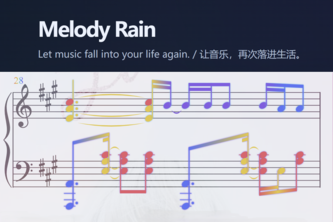
What the company appears to be: Melody Rain is a local-first web application that transforms traditional sheet music into animated visual performances using MusicXML, MIDI, and MP3 files. It renders notes as falling elements synchronized with audio playback and exports them as portrait-format MP4 videos.
What changed: The project was submitted as part of the OpenAI 2026 hackathon. No evidence suggests prior commercial activity or product development beyond this submission.
Single most important open question: Is there any evidence of traction, revenue, or customer adoption beyond the author's own description?
What The Product Actually Is
The description states that Melody Rain is a local-first React and TypeScript application built with Vite and SCSS. It uses OpenSheetMusicDisplay to render MusicXML as SVG sheet music, @tonejs/midi for MIDI timing, and integrates audio playback with score movement and note animation.
It synchronizes MusicXML notation, MIDI timing, and MP3 audio on one timeline so that notes "fall" toward the score in sync with musical events. The system supports customization of background, colors, transparency, animation style, score layout, title, and playback speed.
The application can export complete performances as 9:16 MP4 videos in standard or high quality using a local pipeline involving Playwright, FFmpeg, and Chrome/Edge browsers.
Evidence: Self-reported by author; no third-party verification. The description claims the product is built with specific technologies but does not provide functional screenshots, user data, or performance metrics.
Positioning & Claim Evolution
The author positions Melody Rain as a tool that brings emotional depth to sheet music visualization — not just a functional timeline but an expressive experience that reconnects users with music. The tagline "Notes fall like rain. Music comes alive." reflects this emotional framing.
It is described as a small doorway back into the feeling of music, especially for those who no longer practice instruments but still enjoy looking at sheet music. The goal is not to replace learning or performing an instrument, but to offer a way for people who have drifted away from music to see it again and perhaps return to playing.
Inference: This positioning implies a niche audience focused on nostalgia, emotional connection, and accessibility rather than performance or education tools.
Target Customer & ICP
The description does not explicitly state target customers or personas. However, the author's personal motivation — studying piano as a child, stopping due to life busyness, and wanting to reconnect with music — suggests an audience of former musicians or music enthusiasts who are nostalgic for their relationship with music.
It may appeal to individuals interested in sharing musical experiences through short-form video platforms where portrait-format content is popular.
Inference: The ICP likely includes people who value emotional engagement with music, have access to sheet music files, and want to create or consume visually engaging musical content without needing technical skills or cloud services.
Business Model & Pricing Evidence
There is no evidence of a business model or pricing structure in the description. The project is presented as a hackathon submission and does not mention monetization strategies, subscription plans, freemium tiers, or any commercial offerings.
Not evidenced: No indication of how revenue would be generated or what users might pay for access to Melody Rain.
Technical & Delivery Signals
Melody Rain is built using React, TypeScript, Vite, SCSS, Express.js, Playwright, FFmpeg, and tone.js-midi. It uses a deterministic state model to ensure consistency between preview and export functions.
The system maps MIDI events back to visible score elements and computes every falling, landing, and resting state from an absolute timeline. Video export is handled locally using Playwright to launch a browser instance and pipe PNG frames to FFmpeg for MP4 creation.
Codex (GPT-5.6) was used as an active development collaborator throughout the project, helping with implementation planning, code generation, debugging, testing, and documentation.
Evidence: The description provides technical details about architecture, tooling, and workflows, but no evidence of production deployment, scalability issues, or performance benchmarks.
Traction & Maturity Signals
There is no evidence of traction, revenue, customers, or adoption beyond the author's own account. The project was submitted to a hackathon and has no recorded usage statistics, user feedback, or market presence.
Not evidenced: No data on downloads, active users, customer retention, or product usage patterns.
Competitive Context
The description does not mention competitors or similar products. It focuses solely on the unique emotional experience it aims to deliver rather than comparing itself to existing tools in the music visualization space.
Not evidenced: No information about competing solutions, market size, or competitive positioning.
Open Questions & Risks
- No commercial traction: The project is presented as a hackathon submission with no evidence of prior product development or user base.
- Limited scalability: The local-first approach and browser-based export pipeline may limit performance for large-scale use cases.
- Dependency on AI tooling: While Codex was used during development, the application itself does not call OpenAI APIs at runtime — this raises questions about whether future versions will introduce such dependencies.
- Niche appeal: The emotional positioning suggests a narrow target market, which could limit growth potential.
Questions the description leaves open
- What is the intended path from hackathon prototype to commercial product?
- Are there any plans for monetization or business model development beyond the current scope?
- Has the team explored how users might interact with or share these videos outside of the platform?
- How does the local-first architecture scale, especially when handling large files or batch processing?
- What are the long-term technical and design goals for Melody Rain beyond the current features?
Overall Assessment
There is insufficient evidence to assess whether Melody Rain represents a viable investment opportunity or partnership candidate. The project is described as a hackathon submission with no commercial activity, revenue, or customer data.
Confidence level: Low — based entirely on self-reported information without corroboration.
Conclusion: The description indicates a creative and emotionally resonant concept but lacks any evidence of traction, market validation, or business viability. Further due diligence would require access to actual product usage data, financials, or user feedback.
User Stories BotA demo video on every pull request
Get a demo video on every new feature
GitHub App that watches your pull requests and records a narrated, captioned demo.
Save time on demo prep and make informed decisions faster with a video walkthrough of every new feature.
Source
Submitted to the OpenAI 2026 hackathon on Devpost. Project home on Devpost. Back to the full gallery on Devpost.
This competitive analysis was produced by top-founders.com (opens in a new tab)
Generated by a language model from this project's public Devpost page — its tagline, the author's own write-up and any built-with tags listed there — as captured in August 2026. Short quotations are the author's words. It is an opinion on the idea as a business, not on the people behind it, and it reflects the description as published then. If the project has moved on, request a correction below. The analysis is not independent research and contains no verified traction, revenue or customer data.
An independent guide by KFG International LLC — not affiliated with, endorsed by, or connected to Devpost or OpenAI.