

Archive position — measured, not model output
1 like on Devpost
505 of the 7,850 archived projects have more likes, and 1,758 share exactly 1 — so this project's #1,315 place in the like-ranked listing is a tie-break inside that group, not a ranking.
Projects (log scale)
Likes on Devpost. ▲ marks this project's group.
Show the figures
| Likes | Projects | Share of archive |
|---|---|---|
| 0 | 5,587 | 71.2% |
| 1 | 1,758 | 22.4% |
| 2 | 284 | 3.6% |
| 3–4 | 132 | 1.7% |
| 5–9 | 75 | 1.0% |
| 10+ | 14 | 0.2% |
 User Stories BotA demo video on every pull request
Get a demo video on every new feature
GitHub App that watches your pull requests and records a narrated, captioned demo.
Save time on demo prep and make informed decisions faster with a video walkthrough of every new feature.
Executive Summary
What the company appears to be
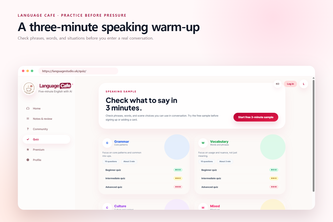
Language Café is an AI-powered English speaking practice platform built as a web application for individual learners. The product enables users to engage in short, structured voice conversations with an AI assistant around real-life scenarios (e.g., daily life, work, travel), save those conversations as personal notes, and then review their own sentences in a focused three-minute session.
What changed
The project was submitted to the OpenAI 2026 hackathon. It represents a self-reported prototype or early-stage product built by one developer (Juoongmin Choi) using open-source tools and APIs such as OpenAI Realtime API, Cloudflare Workers, Supabase, and React.
Single most important open question
Is there evidence of user engagement or adoption beyond the author’s own use? The description does not indicate any external users, revenue, or measurable usage metrics — only a self-reported build process and intended functionality.
Note: This analysis is based entirely on the self-reported project description provided by the author. No independent verification, archived data, or third-party sources are available. All claims are labeled as “the description states” and should be treated as unverified assertions.
What The Product Actually Is
The description states that Language Café is an AI-powered English speaking service built around short, practical conversations. It allows users to:
- Select a real-life scene (e.g., daily life, work, travel).
- Start a five-minute voice conversation where the AI asks the first question.
- Speak naturally and receive spoken AI responses.
- Follow the conversation through a live transcript.
- Save useful conversations as personal speaking notes.
- Review their own sentences in a focused three-minute session.
- See how many words they spoke and how many times they answered.
- Check frequently used words from saved conversations.
- Record a sentence again and check clarity of understanding.
It also includes original expression notes and practical examples, allowing learners to read an expression, use it as the topic of an AI conversation, and then return to their own sentences for review.
Inference: The product is designed to bridge the gap between reading vocabulary and speaking practice by integrating conversation, reflection, and repetition into a single loop. It uses voice-based interaction with real-time transcription and feedback.
Positioning & Claim Evolution
The description states that Language Café aims to make speaking practice feel approachable and playful while still providing meaningful learning feedback.
It was built to connect activities like reading, speaking, feedback, and review in one simple learning loop:
“Read a useful expression → Speak with AI for five minutes → Save the conversation → Review your own sentences in three minutes”
The author claims this helps learners move from knowing an expression to actually using it in a conversation.
They also state that they learned the importance of beginning speaking practice before correction, and that product copy must match real features precisely — e.g., statistics are based only on saved conversations.
Inference: The positioning is centered on accessibility and gamification of language learning through conversational AI. It positions itself as a tool for self-directed learners who want to practice speaking without formal instruction or structured lessons.
Target Customer & ICP
The description states that the product targets English learners who understand vocabulary and grammar but struggle with speaking fluency in real-time situations.
It is designed for users who lack opportunities to turn what they already know into actual conversation — not necessarily those seeking formal instruction or certification.
Inference: The primary user persona appears to be an individual learner at an intermediate level, likely self-motivated and looking for low-pressure, repeatable speaking practice. The focus on mobile responsiveness suggests a broad audience including casual users.
Business Model & Pricing Evidence
The description does not provide any information about pricing models, monetization strategies, or business model assumptions.
There is no mention of subscriptions, freemium tiers, paid features, or revenue streams.
Not evidenced: No evidence of how the product intends to generate value or sustain itself commercially.
Technical & Delivery Signals
The description states that:
- The frontend was built with React, TypeScript, Vite, and Tailwind CSS.
- Real-time voice conversations use OpenAI Realtime API with WebRTC.
- A Cloudflare Worker handles secure token creation for short-lived credentials.
- Supabase is used for authentication; PostgreSQL stores conversation data.
- The app is hosted on Cloudflare Pages and auto-deploys via GitHub.
It also mentions challenges such as:
- Making the experience feel like a real conversation (multi-turn roleplay).
- Securing Realtime API access without exposing permanent keys.
- Turning conversations into learning by extracting user speech for review.
- Reducing navigation and cognitive load through unified sections.
Inference: The technical stack suggests a modern, lightweight web application built with open-source tools and cloud infrastructure. The use of WebRTC and secure token handling indicates attention to UX and security concerns.
Traction & Maturity Signals
The description states that this is a hackathon submission (OpenAI 2026) and that the team consists of one member, Juoongmin Choi.
There is no evidence of:
- Users or customer base
- Revenue or monetization
- Product usage metrics
- Growth trends
- Adoption beyond the creator
Not evidenced: No traction data or maturity indicators are provided. The project appears to be in early development stage.
Competitive Context
The description does not reference competitors or existing solutions in the English learning space.
It does not describe how Language Café differentiates from other AI language tools, apps, or platforms.
Not evidenced: No competitive landscape or differentiation strategy is described.
Open Questions & Risks
- No user data or adoption metrics: The project has no demonstrated traction or real-world usage.
- Single-person team: Limited capacity for scaling, iteration, or marketing.
- Unverified claims: All features and outcomes are self-reported; no external validation exists.
- Lack of commercial viability: No indication of monetization strategy or path to revenue.
- Technical complexity assumptions: The use of WebRTC, secure API handling, and voice interaction implies significant engineering effort that may not be fully realized in this prototype.
Inference: While the concept is promising, the lack of evidence for user engagement, product-market fit, or business model makes it a high-risk, unproven venture.
Questions the description leaves open
- What are your actual goals for this project beyond the hackathon?
- Have you tested the product with real English learners? If so, what were the results?
- How do you plan to scale beyond a single developer?
- Are there any plans to monetize or build a sustainable business model?
- What specific improvements are needed before launching publicly?
- Do you have any data on how often users return to review saved conversations?
Overall Assessment
The description states that Language Café is a hackathon project submitted to the OpenAI 2026 hackathon and built by one developer.
There is no evidence of:
- Revenue or monetization
- Customers or user base
- Product traction or usage metrics
- Commercial viability or scalability
Assessment: This is an unproven, self-reported prototype with no demonstrated commercial traction. It lacks the foundational signals required for investment or partnership consideration at this stage.
User Stories BotA demo video on every pull request
Get a demo video on every new feature
GitHub App that watches your pull requests and records a narrated, captioned demo.
Save time on demo prep and make informed decisions faster with a video walkthrough of every new feature.
Source
Submitted to the OpenAI 2026 hackathon on Devpost. Project home on Devpost. Back to the full gallery on Devpost.
This competitive analysis was produced by top-founders.com (opens in a new tab)
Generated by a language model from this project's public Devpost page — its tagline, the author's own write-up and any built-with tags listed there — as captured in August 2026. Short quotations are the author's words. It is an opinion on the idea as a business, not on the people behind it, and it reflects the description as published then. If the project has moved on, request a correction below. The analysis is not independent research and contains no verified traction, revenue or customer data.
An independent guide by KFG International LLC — not affiliated with, endorsed by, or connected to Devpost or OpenAI.