

Archive position — measured, not model output
1 like on Devpost
505 of the 7,850 archived projects have more likes, and 1,758 share exactly 1 — so this project's #1,317 place in the like-ranked listing is a tie-break inside that group, not a ranking.
Projects (log scale)
Likes on Devpost. ▲ marks this project's group.
Show the figures
| Likes | Projects | Share of archive |
|---|---|---|
| 0 | 5,587 | 71.2% |
| 1 | 1,758 | 22.4% |
| 2 | 284 | 3.6% |
| 3–4 | 132 | 1.7% |
| 5–9 | 75 | 1.0% |
| 10+ | 14 | 0.2% |
 User Stories BotA demo video on every pull request
Get a demo video on every new feature
GitHub App that watches your pull requests and records a narrated, captioned demo.
Save time on demo prep and make informed decisions faster with a video walkthrough of every new feature.
Executive Summary
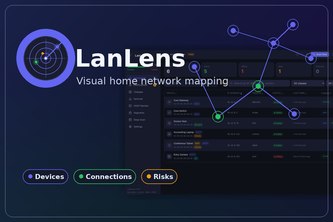
LanLens is a self-reported tool that scans home and enterprise networks to visualize device connections and risks, hosted in a Docker container with a web interface. The author states it was built using ChatGPT Codex and aims to automate network documentation and visualization. It is described as open-source and free to use.
The project has no verified revenue, customers, or traction data beyond the author’s own claims. The tool appears to be in early development, with no evidence of a formal product-market fit, pricing model, or competitive positioning. The single most important open question is whether LanLens has achieved any meaningful adoption or usage beyond the author's personal home-lab use case.
What The Product Actually Is
The description states that LanLens:
- Scans networks for devices using multiple approaches
- Visualizes network topology and device relationships
- Runs in a Docker container with a web interface
- Detects changes and new devices, sending notifications through three channels
- Was built using SDD and OpenClaw, with extensive use of ChatGPT Codex
It is described as an automatic detection and visualization tool for local infrastructure, intended to make network understanding "understandable at a glance."
Evidence: The author's own write-up.
Positioning & Claim Evolution
The author states that LanLens was created to solve the problem of not knowing which IP addresses were taken when setting up virtual machines in their home lab. It evolved into an automatic network documentation and visualization tool, with a focus on ease-of-use through a clean web dashboard.
The project is positioned as a solution for people who want to understand their local network without manual documentation or complex tools.
Evidence: The author's own write-up, including the "Inspiration" and "What it does" sections.
Target Customer & ICP
The description states that LanLens is intended for users with home-lab setups or enterprise networks, but no specific customer segments are identified. The author mentions using it in both home-labs and enterprise networks, but does not define a clear ICP or target persona.
Evidence: The author's own write-up, including the "Challenges" and "What's next" sections.
Business Model & Pricing Evidence
There is no evidence of a business model or pricing structure. The author states that LanLens will remain open-source and free to use and fork forever.
Evidence: The author's own write-up, specifically the "What's next for LanLens" section.
Technical & Delivery Signals
The project is built using:
- Docker
- FastAPI
- Python
- SDD and OpenClaw
- ChatGPT Codex
It is described as hosted in a Docker container with a clean webview. The author notes that balancing detail with clarity was a challenge, especially when dealing with many protocols and security considerations.
Evidence: The author's own write-up, including the "How we built it" section.
Traction & Maturity Signals
The author states that LanLens has a huge userbase, which they are proud of. However, there is no further detail on:
- Number of users
- Usage metrics
- Customer feedback
- Product adoption beyond personal use
There is also no evidence of revenue, ARR, or any commercial traction.
Evidence: The author's own write-up, specifically the "Accomplishments that we're proud of" and "What's next for LanLens" sections.
Competitive Context
There is no evidence of a competitive landscape. The description does not mention any competitors or similar tools in the market.
Evidence: Not evidenced.
Open Questions & Risks
- No verified traction or revenue: The project is described as personal use, with no evidence of commercial adoption.
- Unverified claims: All statements are self-reported and unverified.
- Lack of business model clarity: No pricing or monetization strategy is evident.
- No formal product-market fit: The tool appears to be a personal solution, not a scalable product.
- Open-source and free: This may limit future monetization opportunities.
Evidence: Self-reported claims, absence of commercial data.
Questions the description leaves open
- What is the actual user base beyond your own home-lab?
- How many distinct networks have been scanned with LanLens?
- Are there any plans to monetize or scale the product beyond open-source?
- What are the specific technical challenges in scaling across different network types?
- How does LanLens handle security and privacy concerns in enterprise environments?
Inference: Based on the lack of verified data, these questions aim to uncover real-world usage and scalability.
Overall Assessment
There is no evidence of a viable business model, revenue, or customer traction. The project appears to be a personal tool with no commercial validation. It is described as open-source and free to use, with no indication of monetization plans.
The author's claims are self-reported and unverified. There is no evidence of product-market fit, pricing, or any commercial viability beyond the author’s own use case.
Inference: The project does not appear to be a viable investment or partnership opportunity at this stage, due to lack of verified traction or business model.
User Stories BotA demo video on every pull request
Get a demo video on every new feature
GitHub App that watches your pull requests and records a narrated, captioned demo.
Save time on demo prep and make informed decisions faster with a video walkthrough of every new feature.
Source
Submitted to the OpenAI 2026 hackathon on Devpost. Project home on Devpost. Back to the full gallery on Devpost.
This competitive analysis was produced by top-founders.com (opens in a new tab)
Generated by a language model from this project's public Devpost page — its tagline, the author's own write-up and any built-with tags listed there — as captured in August 2026. Short quotations are the author's words. It is an opinion on the idea as a business, not on the people behind it, and it reflects the description as published then. If the project has moved on, request a correction below. The analysis is not independent research and contains no verified traction, revenue or customer data.
An independent guide by KFG International LLC — not affiliated with, endorsed by, or connected to Devpost or OpenAI.