

Archive position — measured, not model output
0 likes on Devpost
2,263 of the 7,850 archived projects have more likes, and 5,587 share exactly 0 — so this project's #5,240 place in the like-ranked listing is a tie-break inside that group, not a ranking.
Projects (log scale)
Likes on Devpost. ▲ marks this project's group.
Show the figures
| Likes | Projects | Share of archive |
|---|---|---|
| 0 | 5,587 | 71.2% |
| 1 | 1,758 | 22.4% |
| 2 | 284 | 3.6% |
| 3–4 | 132 | 1.7% |
| 5–9 | 75 | 1.0% |
| 10+ | 14 | 0.2% |
 User Stories BotA demo video on every pull request
Get a demo video on every new feature
GitHub App that watches your pull requests and records a narrated, captioned demo.
Save time on demo prep and make informed decisions faster with a video walkthrough of every new feature.
Executive Summary
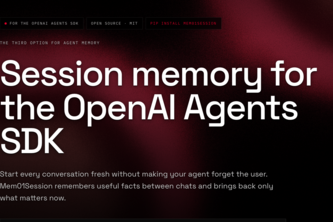
What the company appears to be: Mem01Session is a self-reported developer tool that integrates with the OpenAI Agents SDK to provide long-term belief memory for AI agents. It allows developers to maintain durable, user-scoped beliefs in Postgres while preserving short-term conversation history in SQLite.
What changed: The author states they built this during an OpenAI Build Week hackathon, using Codex and GPT-5.6. They describe it as a native Session implementation that combines short-term conversation history with long-term belief memory.
Single most important open question: Is there any evidence of actual usage or adoption beyond the demo? The description contains no information about revenue, customers, or real-world deployment.
What The Product Actually Is
The description states: "Mem01Session is a custom Session implementation for the OpenAI Agents SDK."
It implements two distinct memory layers:
- SDK's SQLiteSession preserves raw history of current conversation
- Embedded memory runtime stores durable, user-scoped beliefs in Postgres with pgvector
The system orchestrates both paths in application code; the model does not decide whether to call a memory tool.
Positioning & Claim Evolution
The description states: "I wanted another option: preserve the raw history of the current conversation while automatically recalling only the relevant, durable beliefs from earlier conversations."
It positions itself as an alternative to three existing approaches:
- Start fresh session and lose access to facts shared previously
- Reuse one session and continue replaying increasingly large transcript
- Add a separate memory tool and rely on model to decide when to call it
The author claims this creates "two distinct memory layers" with lifecycle, provenance, and clean per-conversation history.
Target Customer & ICP
The description states: "Mem01Session is a custom Session implementation for the OpenAI Agents SDK."
Target customer appears to be developers building AI agents using the OpenAI Agents SDK. The system is described as a "developer tool" built around the SDK's Session protocol.
Business Model & Pricing Evidence
Not evidenced. The description contains no information about pricing, revenue streams, or business model.
Technical & Delivery Signals
The description states:
- Built against official OpenAI Agents SDK Session protocol
- Uses SQLiteSession for normal conversation operations (get_items, add_items, pop_item, clear_session)
- Session-input callback captures user query
- Model-input filter performs query-aware recall before model call
- Memory engine runs in-process without separate server or Docker service
- Durable beliefs and embeddings remain in developer's Postgres database
- GPT-5.6 powers agent-answering path and belief-extraction path
Traction & Maturity Signals
Not evidenced. The description contains no information about customers, revenue, usage metrics, or product adoption.
Competitive Context
The description states: "The OpenAI Agents SDK provides a strong Session abstraction for preserving conversation history."
It describes three existing approaches developers face:
- Start fresh session and lose access to facts
- Reuse one session and replay large transcript
- Add separate memory tool and rely on model to decide when to call it
Mem01Session positions itself as an alternative that combines these approaches.
Open Questions & Risks
- The description is entirely self-reported with no independent verification
- No evidence of revenue, customers or traction
- Project appears to be a hackathon submission (OpenAI 2026)
- Only one team member listed (FNU Solomon Mithra)
- No information about scalability, performance, or production readiness
- The system is described as "intentionally focused on the OpenAI Agents SDK, OpenAI models, and Postgres with pgvector" - this may limit market appeal
Questions the description leaves open
- What is the actual usage or adoption of this tool beyond the demo?
- How does it handle edge cases in memory lifecycle management?
- What are the performance implications for large-scale deployments?
- Are there any production use cases or customer references?
- How does it integrate with other AI agent frameworks beyond OpenAI Agents SDK?
- What is the roadmap for expanding beyond the current technical stack?
Overall Assessment
Not evidenced. The description contains no information about funding, valuation, or investment interest. No evidence of commercial traction or market validation exists in the provided materials.
User Stories BotA demo video on every pull request
Get a demo video on every new feature
GitHub App that watches your pull requests and records a narrated, captioned demo.
Save time on demo prep and make informed decisions faster with a video walkthrough of every new feature.
Source
Submitted to the OpenAI 2026 hackathon on Devpost. Project home on Devpost. Back to the full gallery on Devpost.
This competitive analysis was produced by top-founders.com (opens in a new tab)
Generated by a language model from this project's public Devpost page — its tagline, the author's own write-up and any built-with tags listed there — as captured in August 2026. Short quotations are the author's words. It is an opinion on the idea as a business, not on the people behind it, and it reflects the description as published then. If the project has moved on, request a correction below. The analysis is not independent research and contains no verified traction, revenue or customer data.
An independent guide by KFG International LLC — not affiliated with, endorsed by, or connected to Devpost or OpenAI.