

Archive position — measured, not model output
1 like on Devpost
505 of the 7,850 archived projects have more likes, and 1,758 share exactly 1 — so this project's #1,314 place in the like-ranked listing is a tie-break inside that group, not a ranking.
Projects (log scale)
Likes on Devpost. ▲ marks this project's group.
Show the figures
| Likes | Projects | Share of archive |
|---|---|---|
| 0 | 5,587 | 71.2% |
| 1 | 1,758 | 22.4% |
| 2 | 284 | 3.6% |
| 3–4 | 132 | 1.7% |
| 5–9 | 75 | 1.0% |
| 10+ | 14 | 0.2% |
 User Stories BotA demo video on every pull request
Get a demo video on every new feature
GitHub App that watches your pull requests and records a narrated, captioned demo.
Save time on demo prep and make informed decisions faster with a video walkthrough of every new feature.
Executive Summary
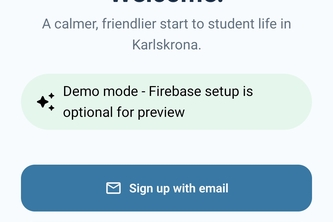
Landed is a self-reported AI-guided companion app for international students, built as a hackathon project. The description states it provides arrival guides, local deals, housing info, events, and community features, starting with a university in Karlskrona, Sweden. It uses an on-device AI model (Gemma 3n) and is built with Kotlin and Supabase.
The author claims the app was designed to solve confusion around small but daily issues for international students, by centralizing information into one trusted place. The team focused on shipping a small, useful product rather than a sprawling feature set.
Key commercial due-diligence read: The project is in early development and lacks evidence of traction, revenue, or customer adoption. It is unclear whether the app has been used by real students or if it has achieved any meaningful user engagement. The single most important open question is: Has Landed been tested with actual users, and does it have a path to sustainable growth beyond a single university?
What The Product Actually Is
The description states that Landed is an AI-guided companion app for international students at a university in Karlskrona, Sweden (BTH). It provides:
- Arrival guides
- Local deals
- Housing information
- City events
- Community features
It is built as an Android app using Kotlin and Jetpack Compose, with Supabase for authentication and data. The AI companion runs fully on-device using a Gemma 3n model with tool calling and server-side retrieval.
Inference: The product appears to be a mobile application designed to support international students in navigating their new environment through curated information and AI assistance.
Positioning & Claim Evolution
The author states that moving abroad for university means “the small stuff is confusing, not the big stuff,” and that answers are often scattered across group chats instead of in one trusted place.
They claim Landed addresses this by offering a single, AI-guided source of information for students.
Inference: The positioning appears to be centered on trust and curation over feature count. The team emphasizes learning from real usage rather than building a large product that no one uses.
Target Customer & ICP
The description states that Landed targets international students at BTH (first), with plans to expand city by city.
Inference: The initial customer is international students at one university. The team intends to scale the model to other cities and universities, but no evidence of prior adoption or expansion exists.
Business Model & Pricing Evidence
No business model or pricing information is provided in the description.
Not evidenced
Technical & Delivery Signals
The app is built with:
- Kotlin and Jetpack Compose (Android)
- Supabase for auth and data
- On-device Gemma 3n AI model with tool calling and server-side retrieval
The team mentions challenges with reliable tool calling from a phone-sized model, and that they cut their feature list to five items to ship something real.
Inference: The technical approach is focused on lightweight, on-device AI for privacy and performance. The team prioritized scope control over feature richness.
Traction & Maturity Signals
The description states:
- Landed was built as a hackathon project
- It is being tested with students at BTH (first)
- The next step is to “prove the loop in Karlskrona, then repeat the same template city by city”
There is no evidence of revenue, customer adoption, or user engagement beyond the initial test.
Not evidenced
Competitive Context
No competitive landscape or market positioning is described. The author does not mention any existing solutions for international student support or how Landed differentiates from them.
Not evidenced
Open Questions & Risks
- Unproven market: No evidence of adoption or usage beyond a single university.
- Limited scope: The app is built for one university and one city, with no clear path to scale.
- Unclear monetization: No business model or pricing strategy described.
- AI implementation risk: On-device AI may be limited in capability or accuracy.
- No traction data: No evidence of user feedback, retention, or engagement.
Questions the description leaves open
- Has Landed been tested with real students at BTH? What was the feedback?
- How is the AI model trained or curated to provide relevant information?
- What are the plans for scaling beyond Karlskrona and BTH?
- Are there any partnerships or institutional support from BTH or local organizations?
- Is there a plan for monetization, or is this a purely educational project?
Overall Assessment
The description states that Landed is a hackathon project with no evidence of traction, revenue, or customer adoption. It is unclear whether the app has been used by real students or if it has achieved any meaningful user engagement.
Assessment: Not evidenced. The project is in early development and lacks commercial viability signals. Further due diligence would require evidence of user testing, feedback, and a clear path to growth beyond one university.
User Stories BotA demo video on every pull request
Get a demo video on every new feature
GitHub App that watches your pull requests and records a narrated, captioned demo.
Save time on demo prep and make informed decisions faster with a video walkthrough of every new feature.
Source
Submitted to the OpenAI 2026 hackathon on Devpost. Project home on Devpost. Back to the full gallery on Devpost.
This competitive analysis was produced by top-founders.com (opens in a new tab)
Generated by a language model from this project's public Devpost page — its tagline, the author's own write-up and any built-with tags listed there — as captured in August 2026. Short quotations are the author's words. It is an opinion on the idea as a business, not on the people behind it, and it reflects the description as published then. If the project has moved on, request a correction below. The analysis is not independent research and contains no verified traction, revenue or customer data.
An independent guide by KFG International LLC — not affiliated with, endorsed by, or connected to Devpost or OpenAI.