

Archive position — measured, not model output
0 likes on Devpost
2,263 of the 7,850 archived projects have more likes, and 5,587 share exactly 0 — so this project's #7,201 place in the like-ranked listing is a tie-break inside that group, not a ranking.
Projects (log scale)
Likes on Devpost. ▲ marks this project's group.
Show the figures
| Likes | Projects | Share of archive |
|---|---|---|
| 0 | 5,587 | 71.2% |
| 1 | 1,758 | 22.4% |
| 2 | 284 | 3.6% |
| 3–4 | 132 | 1.7% |
| 5–9 | 75 | 1.0% |
| 10+ | 14 | 0.2% |
 User Stories BotA demo video on every pull request
Get a demo video on every new feature
GitHub App that watches your pull requests and records a narrated, captioned demo.
Save time on demo prep and make informed decisions faster with a video walkthrough of every new feature.
Executive Summary
What the company appears to be
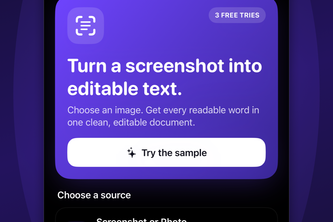
Text Unlocked is a self-reported iOS utility app that converts text from screenshots and photos into editable text—entirely on-device, without requiring an account, upload, analytics, or server-side processing.
What changed
The author reports building a complete native iOS product in one primary task using Codex and GPT-5.6 Sol during OpenAI Build Week. The app includes an Action extension, lifetime purchase model, privacy protections, and support for multiple input methods.
Single most important open question
Is there evidence of any real-world usage or customer feedback beyond the author’s own development experience?
What The Product Actually Is
The description states that Text Unlocked is a utility app that converts printed or on-screen words in screenshots and photos into clean, editable documents. It supports multiple input paths including:
- Sharing a screenshot directly to the Unlock Text Action extension
- Choosing an image from Photos or Files
- Pasting an image
- Scanning with the camera
- Using a built-in sample
Recognition happens entirely on-device using VisionKit and Vision APIs. The result opens in an editor where it can be corrected, copied, or shared.
The app includes three free conversions followed by an optional $7.99 lifetime unlock. It has no account, subscription, advertising, analytics SDK, or server-side image processing.
Evidence
- The author describes the functionality and workflow.
- Technology stack is declared: Swift 6, SwiftUI, VisionKit, Vision, StoreKit 2, codex, gpt-5.6-sol.
Inference
- The app uses a single developer (Dean Balaes) and was built in one primary task using AI tools.
- It targets iOS users who need to extract text from images without uploading or sharing data.
Positioning & Claim Evolution
The author positions Text Unlocked as a trustworthy utility that reads screenshots without tracking, requiring no account, upload, or analytics. The core claim is:
“Turn trapped screen text into editable text—on device.”
This is framed not just as a technical capability but as a privacy promise.
Evidence
- The inspiration section explicitly states: “I wanted one unusually useful transformation: image in, editable text out.”
- The app is described as having no account, subscription, advertising, analytics SDK, or server-side processing.
- Privacy is emphasized throughout the write-up.
Inference
- The positioning reflects a niche market need for privacy-focused OCR tools.
- The product is positioned as a simple, no-frills utility rather than a platform or enterprise offering.
Target Customer & ICP
The description does not name specific customer segments or personas. However, it implies:
- Users who frequently encounter screenshots with text they want to reuse
- iOS users seeking privacy-preserving tools
- People who value minimalism and do not want subscriptions or tracking
Evidence
- The app supports multiple input methods (camera, paste, file picker, etc.)
- It is designed for on-device processing without requiring permissions beyond what iOS allows.
Inference
- Likely early adopters of iOS tools, privacy-conscious individuals, or professionals needing quick text extraction.
- Not explicitly defined as B2B or consumer-facing; could be either.
Business Model & Pricing Evidence
The app uses a one-time purchase model:
- Three free conversions
- Optional $7.99 lifetime unlock
There is no mention of subscriptions, freemium tiers, or recurring revenue models.
Evidence
- The author states: “It has no account, subscription, advertising, analytics SDK, or server-side image processing.”
- Pricing is explicitly described as a one-time purchase.
Inference
- This suggests a direct-to-consumer model with low friction for users.
- No evidence of monetization beyond the lifetime unlock.
Technical & Delivery Signals
The app was built using:
- Swift 6 and SwiftUI
- VisionKit and Vision APIs
- StoreKit 2 for managing purchases and restores
- Codex and GPT-5.6 Sol for development automation
It includes:
- An iOS Action extension
- Shared app group state between main app and extension
- Privacy shielding when the app leaves the foreground
- Automated tests, App Store metadata, support and privacy website
Evidence
- The author describes how each component was implemented.
- Mention of unit/OCR/access tests and end-to-end UI test.
Inference
- The use of AI tools like Codex and GPT suggests rapid prototyping and delivery.
- The architecture appears focused on performance, privacy, and usability.
Traction & Maturity Signals
There is no evidence of:
- Revenue
- Customers
- User engagement metrics
- App Store presence or downloads
- Feedback from users beyond the author’s own experience
Evidence
- The project was submitted to a hackathon.
- No mention of launch, reviews, or usage data.
Inference
- The product is in early development stage.
- It may not yet be available on the App Store.
Competitive Context
The description does not reference competitors. However, it implies a space where:
- OCR tools exist (e.g., Apple’s built-in Vision API, third-party apps)
- Privacy-focused alternatives are rare or underdeveloped
Evidence
- The author emphasizes that the app avoids analytics and uploads.
- No mention of existing solutions in the market.
Inference
- This may be a niche opportunity for privacy-conscious users.
- Lack of competitive analysis makes it hard to assess positioning.
Open Questions & Risks
- No real-world usage or feedback: The app is described as a prototype built during a hackathon with no evidence of actual customers or user testing.
- Single developer team: Only one person (Dean Balaes) is involved, which raises concerns about scalability and long-term maintenance.
- Unclear monetization strategy: While there’s a one-time purchase model, it's unclear how this will scale or attract users.
- Limited visibility into product-market fit: No evidence of traction, growth, or customer validation beyond the author’s own claims.
Evidence
- The app is described as being built in one task during a hackathon.
- No mention of any launch, reviews, or user engagement.
Inference
- Risk of low adoption due to lack of marketing or distribution channels.
- Potential technical limitations if real-world OCR accuracy varies significantly from the demo.
Questions the description leaves open
- Has the app been released on the App Store yet?
- What is the expected conversion rate for users upgrading to the lifetime unlock?
- How does the app handle edge cases like low-quality images, handwriting, or non-Latin scripts?
- Are there plans to expand beyond iOS or add features like cloud sync or export formats?
- What are the actual costs of building and maintaining this product at scale?
Overall Assessment
Not evidenced.
There is no evidence of revenue, customers, traction, or financial performance. The project is described as a prototype built during a hackathon by one developer. No indication exists that it has moved beyond the experimental phase.
The author claims to have turned an idea into a complete product in one task using AI tools, but there is no independent verification of this or any evidence of real-world usage.
Confidence Level Very low
Next Steps
If the app is live, seek user feedback and engagement metrics. If not, consider whether this represents a viable commercial opportunity or just an interesting proof-of-concept.
User Stories BotA demo video on every pull request
Get a demo video on every new feature
GitHub App that watches your pull requests and records a narrated, captioned demo.
Save time on demo prep and make informed decisions faster with a video walkthrough of every new feature.
Source
Submitted to the OpenAI 2026 hackathon on Devpost. Project home on Devpost. Back to the full gallery on Devpost.
This competitive analysis was produced by top-founders.com (opens in a new tab)
Generated by a language model from this project's public Devpost page — its tagline, the author's own write-up and any built-with tags listed there — as captured in August 2026. Short quotations are the author's words. It is an opinion on the idea as a business, not on the people behind it, and it reflects the description as published then. If the project has moved on, request a correction below. The analysis is not independent research and contains no verified traction, revenue or customer data.
An independent guide by KFG International LLC — not affiliated with, endorsed by, or connected to Devpost or OpenAI.