

Archive position — measured, not model output
0 likes on Devpost
2,263 of the 7,850 archived projects have more likes, and 5,587 share exactly 0 — so this project's #6,713 place in the like-ranked listing is a tie-break inside that group, not a ranking.
Projects (log scale)
Likes on Devpost. ▲ marks this project's group.
Show the figures
| Likes | Projects | Share of archive |
|---|---|---|
| 0 | 5,587 | 71.2% |
| 1 | 1,758 | 22.4% |
| 2 | 284 | 3.6% |
| 3–4 | 132 | 1.7% |
| 5–9 | 75 | 1.0% |
| 10+ | 14 | 0.2% |
 User Stories BotA demo video on every pull request
Get a demo video on every new feature
GitHub App that watches your pull requests and records a narrated, captioned demo.
Save time on demo prep and make informed decisions faster with a video walkthrough of every new feature.
Executive Summary
The description states that Simproof is a tool intended to detect incorrect physics in AI-generated STEM simulations before they are presented to students. The project was submitted by one person, Nick Sawinyh, as part of the OpenAI 2026 hackathon. It uses Codex for generation and includes bundled examples for testing. No evidence of revenue, customers, or traction is provided.
What changed: This appears to be a hackathon submission with no demonstrated commercial progress or product-market fit beyond initial prototyping.
Single most important open question: Is there any evidence that the tool has moved beyond prototype stage, or that it addresses a real market need?
What The Product Actually Is
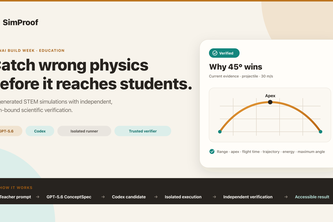
The description states that Simproof is a tool designed to "catch wrong physics" in AI-generated STEM simulations. It is built using Codex and includes bundled examples for testing purposes. The project was submitted to the OpenAI 2026 hackathon.
- The product is described as a library or tool for validating physics in simulations.
- It supports local testing without requiring OpenAI credentials, but live generation requires judge-supplied provider credentials.
- The repository includes previews, data views, and reports related to projectile and pendulum examples.
Not evidenced: No information on how the validation works technically, whether it is a standalone tool or integrated into other systems, or if there are any APIs or user interfaces beyond what's described in the README.
Positioning & Claim Evolution
The author states that Simproof aims to "Catch wrong physics before AI-generated STEM simulations reach students." This positions the product as a quality control mechanism for educational AI tools.
- The positioning is focused on preventing errors in STEM education.
- It implies a role in ensuring accuracy and reliability of AI-generated content in academic settings.
- There is no indication of broader market expansion or evolution beyond this initial claim.
Not evidenced: No evidence of how the product differentiates from existing physics validation methods, nor any indication of prior versions or changes in positioning over time.
Target Customer & ICP
The description states that Simproof targets students who are exposed to AI-generated STEM simulations. The author implies a focus on educational institutions or platforms that use AI for teaching science.
- The primary customer is likely educators or institutions using AI tools in STEM education.
- It may also target developers or content creators who produce AI simulations for learning environments.
- No specific customer segments, personas, or usage scenarios are detailed.
Not evidenced: No evidence of actual customers, user types, or institutional adoption. No indication of whether the tool is aimed at K-12, higher education, or corporate training.
Business Model & Pricing Evidence
The description does not provide any information on pricing, monetization, or business model.
- There is no mention of licensing, subscriptions, or revenue streams.
- The project appears to be a hackathon submission with no indication of commercial viability or pricing structure.
Not evidenced: No evidence of how the product would be sold or who would pay for it.
Technical & Delivery Signals
The description indicates that Simproof was built using Codex and includes bundled examples for testing. It supports local setup via compose.local-test.yaml and requires external credentials for live generation.
- The tool appears to be a software library or framework.
- It is designed to integrate with AI generation systems, particularly those involving STEM simulations.
- It includes support for previews, data views, and reports.
- Testing can be done locally without an OpenAI credential, but live functionality requires judge-supplied credentials.
Not evidenced: No information on scalability, deployment models, or integration capabilities beyond what is described in the README.
Traction & Maturity Signals
The description states that this project was submitted to the OpenAI 2026 hackathon and includes bundled examples for testing. There is no evidence of traction, adoption, or product maturity beyond the initial prototype stage.
- The project is a hackathon submission.
- It includes example simulations but does not indicate any real-world usage or feedback.
- No evidence of user engagement, customer acquisition, or product iteration.
Not evidenced: No data on users, customers, revenue, or product development history.
Competitive Context
The description does not provide information about competitors or the competitive landscape.
- It is unclear whether there are existing tools for validating physics in AI-generated simulations.
- No mention of similar products, market gaps, or differentiation strategies.
Not evidenced: No evidence of competitive analysis or positioning relative to other tools in the space.
Open Questions & Risks
The description indicates that Simproof is a hackathon submission with no demonstrated traction or commercial viability. The lack of evidence for any real-world application raises several concerns:
- Prototype-only status: The tool appears to be an early-stage prototype, not a product ready for market.
- Limited scope: It only includes projectile and pendulum examples; no indication of broader applicability.
- Dependency on external systems: Live generation requires judge-supplied credentials, suggesting limited independence or scalability.
- No commercialization path: No evidence of pricing, monetization, or business model.
Not evidenced: No evidence of any risk mitigation strategies or plans for scaling beyond the prototype stage.
Questions the description leaves open
- What is the intended use case for Simproof beyond the hackathon submission?
- How does the tool validate physics in simulations? Is it rule-based, machine learning-driven, or a hybrid approach?
- Are there any real-world partners or institutions currently using this tool?
- What are the plans for commercialization or product development beyond the prototype?
- How does Simproof compare to existing tools or methods of validating STEM content?
Overall Assessment
The description states that Simproof is a hackathon submission by one individual, Nick Sawinyh. There is no evidence of traction, revenue, customers, or product-market fit.
- Confidence level: Very low — based entirely on self-reported information.
- Assessment: Not ready for investment or partnership consideration at this stage.
- Next steps: If the founders wish to advance the project, they should provide evidence of prototype testing, early adoption, or a clear path to commercialization.
Not evidenced: No indication of any funding, partnerships, or traction that would support further diligence.
User Stories BotA demo video on every pull request
Get a demo video on every new feature
GitHub App that watches your pull requests and records a narrated, captioned demo.
Save time on demo prep and make informed decisions faster with a video walkthrough of every new feature.
Source
Submitted to the OpenAI 2026 hackathon on Devpost. Project home on Devpost. Back to the full gallery on Devpost.
This competitive analysis was produced by top-founders.com (opens in a new tab)
Generated by a language model from this project's public Devpost page — its tagline, the author's own write-up and any built-with tags listed there — as captured in August 2026. Short quotations are the author's words. It is an opinion on the idea as a business, not on the people behind it, and it reflects the description as published then. If the project has moved on, request a correction below. The analysis is not independent research and contains no verified traction, revenue or customer data.
An independent guide by KFG International LLC — not affiliated with, endorsed by, or connected to Devpost or OpenAI.