

Archive position — measured, not model output
0 likes on Devpost
2,263 of the 7,850 archived projects have more likes, and 5,587 share exactly 0 — so this project's #6,715 place in the like-ranked listing is a tie-break inside that group, not a ranking.
Projects (log scale)
Likes on Devpost. ▲ marks this project's group.
Show the figures
| Likes | Projects | Share of archive |
|---|---|---|
| 0 | 5,587 | 71.2% |
| 1 | 1,758 | 22.4% |
| 2 | 284 | 3.6% |
| 3–4 | 132 | 1.7% |
| 5–9 | 75 | 1.0% |
| 10+ | 14 | 0.2% |
 User Stories BotA demo video on every pull request
Get a demo video on every new feature
GitHub App that watches your pull requests and records a narrated, captioned demo.
Save time on demo prep and make informed decisions faster with a video walkthrough of every new feature.
Executive Summary
What the company appears to be
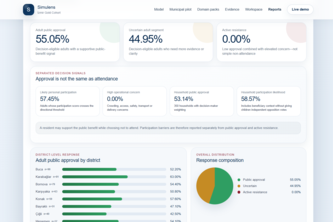
Simulens is a self-reported synthetic society simulation tool designed for municipal decision-making. The project claims to stress-test public policies against a traceable synthetic cohort before real-world rollout.
What changed
The author states that Simulens was built as a working PHP and MySQL web application with GPT-5.6 integration, intended to support public policy decisions by modeling citizen behavior through synthetic personas.
The single most important open question
Is there evidence of any actual municipal adoption or use of this system beyond the hackathon demo?
Note
This analysis is based entirely on the self-reported description provided by the author. No independent verification, traction data, revenue figures, or customer information are available. All claims in this report are derived from the project description and should be treated as unverified statements made by the author.
What The Product Actually Is
The description states that Simulens is:
- An evidence-grounded synthetic society laboratory for stress-testing municipal decisions
- A working PHP and MySQL web application
- Built with: PHP, MySQL, GPT-5.6, Codex, Apache, API, CSS3, HTML5, JavaScript, OpenAI, data, decision, explainable, intelligence, synthetic
- Capable of generating 1,000 synthetic personas, 372 synthetic households, and 19,821 traceable persona trait records
- Designed to evaluate decisions across multiple signals (approval, participation, concern, resistance, uncertainty)
- Integrated with GPT-5.6 for scenario optimization but does not accept AI recommendations automatically
- Includes a deterministic simulation engine, domain-specific decision rules, and explainable report generation
Inference The product appears to be a prototype or proof-of-concept built for a hackathon, not yet proven in production use.
Positioning & Claim Evolution
The author claims:
- Simulens is not meant to replace surveys, public consultation, or expert judgment
- It provides an additional decision-support layer that helps identify risks and expose assumptions
- The system preserves an inspectable chain from evidence to persona traits to simulation responses
- GPT-5.6 can propose revisions but these must be re-tested against the same cohort before acceptance
- The tool supports public transport, events, pricing, digital accessibility, pilot design, and social access domains
Inference Simulens positions itself as a risk-mitigation tool for public policy rather than a replacement for traditional consultation methods.
Target Customer & ICP
The description states:
- Primary users are municipal teams making public decisions
- The first validated model is the İzmir Gold Cohort Generation 2
- Domains covered include public transport, events, pricing, digital accessibility, and social access
Not evidenced No specific customer segments beyond "municipal teams" or evidence of actual municipal engagement.
Business Model & Pricing Evidence
The description states:
- No pricing information is provided
- The system is presented as a demo-only tool for the OpenAI 2026 hackathon
- There is no mention of monetization, licensing, or subscription models
Not evidenced No evidence of any business model or pricing structure.
Technical & Delivery Signals
The description states:
- Built with PHP and MySQL
- Uses GPT-5.6 for scenario optimization
- Includes a deterministic simulation engine
- Has domain-specific decision rules
- Features explainable report generation
- Supports PDF exports
- Uses Codex for release engineering and QA
- Locks original comparison seeds to ensure fair evaluation
- Preserves deterministic scoring rules
Inference The technical stack suggests a prototype built for demonstration purposes, not scalable infrastructure.
Traction & Maturity Signals
The description states:
- It is a working system rather than a concept or presentation
- A public demo exists (password-free Build Week demo)
- Demonstrated ability to reject GPT-5.6 revisions when they perform worse than baseline
- The İzmir municipal model is the first working vertical of a broader platform
- Future expansions require dedicated evidence, persona traits, and validation frameworks
Not evidenced No data on usage frequency, user feedback, or adoption beyond the hackathon.
Competitive Context
The description states:
- No direct competitors are named
- The tool focuses on municipal decision-making with synthetic cohorts
- It integrates GPT-5.6 within a deterministic validation loop
- It emphasizes explainability and traceability over opaque AI scoring
Not evidenced No competitive landscape or market positioning beyond the author’s own claims.
Open Questions & Risks
The description states:
- Risk of becoming an opaque AI score generator if not carefully managed
- Need to maintain clear boundaries between evidence, assumptions, and GPT interpretations
- Ensuring fair comparison between baseline and revised scenarios
- Modeling household behavior accurately (children vs. adults)
Inference The tool may face challenges in scaling beyond the İzmir model due to high customization requirements per domain.
Questions the description leaves open
- What evidence supports the accuracy of the synthetic cohort?
- How does Simulens validate that its persona traits reflect real-world demographics?
- Has there been any external testing or validation of the simulation outcomes?
- Are there plans to commercialize this beyond hackathon demos?
- What are the specific requirements for adding new domains (e.g., time, cost, expertise)?
- How does Simulens ensure consistency in GPT-5.6 outputs across different use cases?
Overall Assessment
The description states:
- Simulens is a working prototype built for a hackathon
- It has not demonstrated any commercial traction or adoption
- The tool is presented as a proof-of-concept with potential for expansion into other sectors
Not evidenced No indication of investment interest, partnership opportunities, or market readiness.
Inference At this stage, Simulens appears to be a promising concept with limited evidence of real-world utility or scalability. It may warrant further exploration if the founder can demonstrate early traction or pilot use cases.
User Stories BotA demo video on every pull request
Get a demo video on every new feature
GitHub App that watches your pull requests and records a narrated, captioned demo.
Save time on demo prep and make informed decisions faster with a video walkthrough of every new feature.
Source
Submitted to the OpenAI 2026 hackathon on Devpost. Project home on Devpost. Back to the full gallery on Devpost.
This competitive analysis was produced by top-founders.com (opens in a new tab)
Generated by a language model from this project's public Devpost page — its tagline, the author's own write-up and any built-with tags listed there — as captured in August 2026. Short quotations are the author's words. It is an opinion on the idea as a business, not on the people behind it, and it reflects the description as published then. If the project has moved on, request a correction below. The analysis is not independent research and contains no verified traction, revenue or customer data.
An independent guide by KFG International LLC — not affiliated with, endorsed by, or connected to Devpost or OpenAI.