

Archive position — measured, not model output
0 likes on Devpost
2,263 of the 7,850 archived projects have more likes, and 5,587 share exactly 0 — so this project's #6,716 place in the like-ranked listing is a tie-break inside that group, not a ranking.
Projects (log scale)
Likes on Devpost. ▲ marks this project's group.
Show the figures
| Likes | Projects | Share of archive |
|---|---|---|
| 0 | 5,587 | 71.2% |
| 1 | 1,758 | 22.4% |
| 2 | 284 | 3.6% |
| 3–4 | 132 | 1.7% |
| 5–9 | 75 | 1.0% |
| 10+ | 14 | 0.2% |
 User Stories BotA demo video on every pull request
Get a demo video on every new feature
GitHub App that watches your pull requests and records a narrated, captioned demo.
Save time on demo prep and make informed decisions faster with a video walkthrough of every new feature.
Executive Summary
What the company appears to be
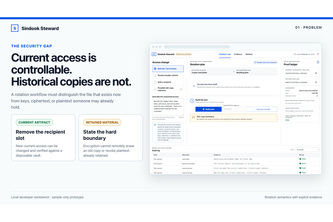
Sindook Steward is a local workbench for managing access control decisions on encrypted files, using AI to interpret threats and guide cryptographic operations. It is built as a prototype for an OpenAI hackathon and includes a deterministic policy engine, a React interface, and a Docker-based judge path.
What changed
The project evolved from a standalone open-source encryption tool (Sindook) into a new workbench (Sindook Steward), which adds a decision layer using GPT-5.6 for threat classification and integrates with the original CLI tool for execution.
Single most important open question
Is there any evidence of traction, revenue, or adoption beyond the author’s own prototype? The description states no such data exists, and all claims are self-reported.
What The Product Actually Is
The description states that Sindook Steward is a local workbench for handling access events on encrypted files. It supports four actions: adding a recipient, routine key hygiene, removing a recipient, and responding to escaped ciphertext copies.
It uses:
- A pinned version of the Sindook CLI (v0.3.0)
- GPT-5.6 for classifying risk signals
- A deterministic policy engine
- A React-based UI
- A Docker judge path for testing
The system is designed to not execute commands directly but instead guide operators through a reviewable workflow that includes:
- Describing the access change and threat
- Using GPT-5.6 to classify risk signals
- Checking against deterministic policy
- Reviewing exact recipients, cost, guarantees, and remaining risk
- Typing literal approval "ROTATE" before execution
Execution is performed via a pinned binary against a disposable sample vault, with an evidence ledger showing what changed.
Inference The product is not a production-ready service but a prototype for a hackathon submission. It does not appear to support real-world file encryption or key management beyond local testing.
Positioning & Claim Evolution
The author states that Sindook Steward was built as a decision layer over the Sindook CLI, which they describe as an open-source file-encryption tool named after the Bengali word for "strongbox".
The positioning is:
- A local workbench, not a cloud service
- Focused on threat-aware access control
- Designed to avoid false promises about what can be undone or controlled
The claim evolution shows:
- The original Sindook project was a public encryption tool.
- Sindook Steward adds an AI-driven decision layer for managing access events.
- It emphasizes that the AI does not execute commands, and that security decisions are authoritative.
Inference The positioning is defensive — it avoids overpromising on what AI can do in a security context, but this also limits its commercial appeal or scalability.
Target Customer & ICP
The description states:
- The system is designed for operators managing access to encrypted files
- It supports local workflows, not cloud-based services
- It is built for security professionals or developers who need to manage access control decisions
It does not state:
- Who the end users are beyond operators
- Whether it targets enterprise, individual developers, or internal teams
- If there’s a defined persona or ICP
Inference The target customer is likely technical users with security responsibilities, but no clear segmentation or persona is described.
Business Model & Pricing Evidence
The description states:
- The project is a hackathon submission
- It is built as a local prototype
- No pricing, monetization, or business model is mentioned
- The system uses open-source tools and a Docker judge path for testing
There is no evidence of:
- Revenue streams
- Pricing models
- Customer acquisition plans
- Monetization strategy
Inference There is no business model or pricing evidence. The project appears to be a proof-of-concept, not a commercial offering.
Technical & Delivery Signals
The description states:
- Built with Go, React, Docker, and GPT-5.6
- Uses a deterministic policy engine that overrides AI decisions
- GPT-5.6 is used only for interpreting threats, not for executing commands
- The system includes a sample vault, tests, and a judge path
- It supports fast rotation (without re-encryption) and deep rotation (with new key)
- The interface shows residual risk before approval
It also states:
- The project was built using Codex for coding and debugging
- The author used ChatGPT Work for documentation and editing
- No real secrets or keys are passed to the AI model
Inference The technical stack is functional but limited to a local prototype. The use of deterministic policy and clear separation from AI execution suggests a strong emphasis on security, but not scalability.
Traction & Maturity Signals
The description states:
- This is a hackathon submission
- It is a local prototype
- No revenue, customers, or adoption data are provided
- The author built the system in one week (Build Week)
- The repository includes a dated baseline and commit history
There is no evidence of:
- Customers
- Revenue
- Product usage
- Market traction
- Product maturity beyond prototype stage
Inference No traction or maturity signals exist. This is a very early-stage prototype.
Competitive Context
The description does not mention:
- Competitors
- Existing tools in the access control or encryption space
- How this differs from other solutions
It only states that the author built it to avoid false promises and to help interpret security decisions without allowing AI to control them.
Inference No competitive context is provided. The project appears to be unique in its approach but lacks any comparison to existing tools or markets.
Open Questions & Risks
- No commercial traction or revenue: This is a prototype, not a product with users.
- Limited scope and maturity: Built for a hackathon, not production use.
- AI role is minimal and controlled: The AI does not execute commands — this may limit its utility in real-world applications.
- No security review or production-ready features: The author notes that it would need an external security review to be production-ready.
- Self-reported only: All claims are unverified, and no third-party data is available.
Inference The project is not ready for commercial use. It may be a useful concept but lacks any evidence of viability or scalability.
Questions the description leaves open
- What is the intended path to production readiness?
- Are there plans to expand beyond local execution and support real-world file encryption?
- How would this product integrate with existing enterprise access control systems?
- Has the author considered how to handle edge cases or adversarial inputs in the AI model?
- Is there any plan for external security review or compliance validation?
- What is the long-term vision for monetization or commercial adoption?
Overall Assessment
Not evidenced.
The description states that this is a hackathon submission, not a commercial product. There is no evidence of:
- Revenue
- Customers
- Traction
- Product-market fit
- Commercial viability
It is a local prototype with a clear security-focused design, but it does not appear to be ready for investment or partnership at this stage.
Inference This project is not suitable for investment or partnership unless there are plans to scale beyond the prototype stage. It may be of interest as a concept or proof-of-concept, but no commercial due-diligence case can be made from the provided evidence.
User Stories BotA demo video on every pull request
Get a demo video on every new feature
GitHub App that watches your pull requests and records a narrated, captioned demo.
Save time on demo prep and make informed decisions faster with a video walkthrough of every new feature.
Source
Submitted to the OpenAI 2026 hackathon on Devpost. Project home on Devpost. Back to the full gallery on Devpost.
This competitive analysis was produced by top-founders.com (opens in a new tab)
Generated by a language model from this project's public Devpost page — its tagline, the author's own write-up and any built-with tags listed there — as captured in August 2026. Short quotations are the author's words. It is an opinion on the idea as a business, not on the people behind it, and it reflects the description as published then. If the project has moved on, request a correction below. The analysis is not independent research and contains no verified traction, revenue or customer data.
An independent guide by KFG International LLC — not affiliated with, endorsed by, or connected to Devpost or OpenAI.