

Archive position — measured, not model output
0 likes on Devpost
2,263 of the 7,850 archived projects have more likes, and 5,587 share exactly 0 — so this project's #6,718 place in the like-ranked listing is a tie-break inside that group, not a ranking.
Projects (log scale)
Likes on Devpost. ▲ marks this project's group.
Show the figures
| Likes | Projects | Share of archive |
|---|---|---|
| 0 | 5,587 | 71.2% |
| 1 | 1,758 | 22.4% |
| 2 | 284 | 3.6% |
| 3–4 | 132 | 1.7% |
| 5–9 | 75 | 1.0% |
| 10+ | 14 | 0.2% |
 User Stories BotA demo video on every pull request
Get a demo video on every new feature
GitHub App that watches your pull requests and records a narrated, captioned demo.
Save time on demo prep and make informed decisions faster with a video walkthrough of every new feature.
Executive Summary
Project: SingLink
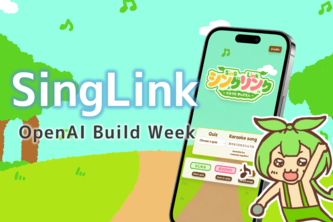
Author's Self-Reported Purpose: A tool that uses Japanese onomatopoeia to teach vocabulary through a karaoke-style quiz experience, where learners answer questions and hear correct sentences sung by Zundamon-style vocals with timing synchronized to the lyrics.
What Changed: During OpenAI Build Week, the author added dynamic score generation, five selectable melodies, 335 new learning records with English support, and improved UI/subtitle auditing. The app now supports both local Windows execution (with VOICEVOX) and a public demo (using pre-generated samples).
Single Most Important Open Question: Is there any evidence of user engagement or adoption beyond the author’s own development and demo?
This analysis is based entirely on the self-reported, unverified description provided by the project author. No revenue, customer data, traction metrics or third-party validation are available.
What The Product Actually Is
The description states that SingLink is a quiz-to-karaoke learning tool for Japanese onomatopoeia. It involves:
- Learners answering four fill-in-the-blank questions.
- Correct answers being used to generate a short song (a "Score") using pre-written example sentences.
- A local VOICEVOX instance synthesizing the singing voice.
- Karaoke-style timing derived from Score note frames, not fixed timers.
- Support for both Japanese and English modes.
The app uses technologies including fastify, React, TypeScript, Vite, VOICEVOX, and OpenAI Codex (but no runtime API calls).
Not evidenced: whether the tool is used by others beyond the author, or how many users it supports.
Positioning & Claim Evolution
The project description positions SingLink as a learning tool that makes Japanese onomatopoeia review more engaging through gamified karaoke-style interaction. It claims to:
- Turn vocabulary learning into an interactive quiz-to-karaoke experience.
- Use Zundamon-style singing for example sentences.
- Offer both Japanese and English modes with meanings and examples.
The author notes that the app existed before OpenAI Build Week, but the hackathon submission focused on enhancing functionality such as dynamic score generation, melody selection, and English support.
Inferred: The positioning is aimed at language learners or educators who want to use gamification for vocabulary retention. No evidence of market positioning beyond self-reporting.
Target Customer & ICP
The description does not state a specific target customer or ICP (Ideal Customer Profile). It implies the app is for:
- Japanese language learners.
- Users interested in interactive, karaoke-style learning tools.
- Educators or students using onomatopoeia as part of language study.
Not evidenced: No explicit target audience, usage patterns, or customer segmentation data.
Business Model & Pricing Evidence
There is no evidence in the description of a business model or pricing structure. The app appears to be a personal project, possibly for educational or hobbyist use, with no indication of monetization.
Inferred: If commercialized, it might target learners or educators through freemium or subscription models, but this is speculative.
Technical & Delivery Signals
The author reports that the app uses:
- Fastify and React for backend/frontend.
- VOICEVOX for voice synthesis.
- OpenAI Codex (not API calls at runtime) for development support.
- Vite, TypeScript, vitest for tooling.
- A local Windows setup is required for full functionality, with a public demo using pre-generated samples.
Not evidenced: No information on scalability, deployment infrastructure, or performance metrics.
Traction & Maturity Signals
The description states:
- The app was submitted to the OpenAI 2026 hackathon.
- A public demo exists, but it uses pre-generated samples.
- Full functionality is available only in a local Windows environment.
- The project has one team member (Mamoru Yaegashi).
Not evidenced: No user data, engagement metrics, or adoption indicators. No evidence of growth, retention, or usage beyond the author’s own development and demo.
Competitive Context
The description does not mention any direct competitors. It is unclear whether similar tools exist in the market for language learning through karaoke or gamified vocabulary review.
Inferred: The app may compete with other language-learning apps or tools that use gamification, but no competitive landscape is described.
Open Questions & Risks
- No traction or user data: The project appears to be a personal development effort without evidence of adoption.
- Limited scope: Functionality is restricted to local Windows execution; public demo uses pre-generated content.
- Single-person team: No indication of team size, support structure, or scalability.
- Unverified claims: All features and functionality are self-reported with no external validation.
Questions the description leaves open
- What is the intended user base for SingLink?
- Are there any plans to expand beyond the current local Windows setup?
- How does the author envision monetizing or scaling this tool?
- Has the app been tested with actual users, and what feedback was received?
- What are the technical limitations of the current implementation that might affect scalability?
Overall Assessment
Not evidenced: No data on financials, market opportunity, or commercial viability.
Inferred: The project is a personal development effort with no clear evidence of traction or commercial potential. It may be an early-stage prototype or proof-of-concept. Without further information on user engagement, scalability, or monetization plans, it is difficult to assess investment or partnership interest.
The author states that the app was submitted to a hackathon and that the demo is reproducible but not fully functional in public mode. This suggests a low-maturity, non-commercial product at this stage.
User Stories BotA demo video on every pull request
Get a demo video on every new feature
GitHub App that watches your pull requests and records a narrated, captioned demo.
Save time on demo prep and make informed decisions faster with a video walkthrough of every new feature.
Source
Submitted to the OpenAI 2026 hackathon on Devpost. Project home on Devpost. Back to the full gallery on Devpost.
This competitive analysis was produced by top-founders.com (opens in a new tab)
Generated by a language model from this project's public Devpost page — its tagline, the author's own write-up and any built-with tags listed there — as captured in August 2026. Short quotations are the author's words. It is an opinion on the idea as a business, not on the people behind it, and it reflects the description as published then. If the project has moved on, request a correction below. The analysis is not independent research and contains no verified traction, revenue or customer data.
An independent guide by KFG International LLC — not affiliated with, endorsed by, or connected to Devpost or OpenAI.