

Archive position — measured, not model output
0 likes on Devpost
2,263 of the 7,850 archived projects have more likes, and 5,587 share exactly 0 — so this project's #2,794 place in the like-ranked listing is a tie-break inside that group, not a ranking.
Projects (log scale)
Likes on Devpost. ▲ marks this project's group.
Show the figures
| Likes | Projects | Share of archive |
|---|---|---|
| 0 | 5,587 | 71.2% |
| 1 | 1,758 | 22.4% |
| 2 | 284 | 3.6% |
| 3–4 | 132 | 1.7% |
| 5–9 | 75 | 1.0% |
| 10+ | 14 | 0.2% |
 User Stories BotA demo video on every pull request
Get a demo video on every new feature
GitHub App that watches your pull requests and records a narrated, captioned demo.
Save time on demo prep and make informed decisions faster with a video walkthrough of every new feature.
Executive Summary
AudioVoxtar — Manuscript-to-Cast Prep is a self-reported platform for audiobook casting preparation that integrates manuscript analysis with human review. The author states it bridges the gap between manuscript parsing and audition workflow by producing deterministic evidence packages, then offering AI-generated creative suggestions that are strictly validated and human-reviewed. It does not claim to be a full product or production-ready system.
The description states this is a vertical slice built for an OpenAI hackathon, with no database or project records written during the demo. It is not independently verified, and there is no evidence of revenue, customers, or traction beyond the author’s own account.
Key open question
What is the actual commercial viability of a platform that requires human review at every step of casting prep, especially when the AI-generated suggestions are only used as creative input?
What The Product Actually Is
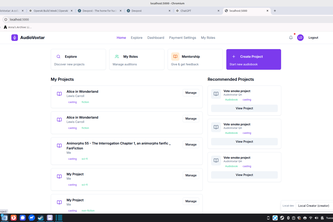
The description states that AudioVoxtar — Manuscript-to-Cast Prep is a human-reviewed bridge between manuscript analysis and audiobook audition workflow. It begins with a deterministic evidence package from a separate "AudioVoxtar Book Analyzer" and then presents four casting and performance profiles linked to source evidence.
It allows creators to:
- inspect the source evidence behind each suggestion;
- edit creative casting and performance guidance;
- approve, reject, or leave profiles unresolved;
- preserve ambiguous speaker lines instead of forcing an assignment;
- prepare an approved-only audition-ready preview;
- download a deterministic, redacted decision artifact.
The system visually separates:
- Source facts;
- Creator-supplied character identity;
- Deterministic Analyzer conclusions;
- AI-generated creative suggestions;
- Creator decisions.
It also includes a strict validation process that prevents silent assignment of unknown speakers and excludes unresolved lines from audition recommendations.
Not evidenced: whether this is a standalone product or part of a larger platform, or if it has any integration with existing audiobook production systems.
Positioning & Claim Evolution
The description states the author’s inspiration was to fill a gap in audiobook production workflow: turning manuscripts into castable roles and audition lines without relying on generative AI to silently invent evidence or assign uncertain speakers.
It positions itself as a human-reviewed, evidence-grounded solution that:
- Prioritizes deterministic speaker attribution;
- Uses AI only for creative suggestions;
- Preserves uncertainty in the process;
- Ensures human approval before anything moves toward production.
The author also notes that this is not a full product but a vertical slice, built for a hackathon, and does not claim beta or production readiness.
Inferred: The product is positioned as a tool for creators who want to maintain control over casting decisions while using AI to assist in the process. It emphasizes trust, transparency, and human oversight.
Target Customer & ICP
The description states that AudioVoxtar — Manuscript-to-Cast Prep is designed for audiobook creators, particularly those involved in organizing characters, auditions, casting decisions, and downstream production work.
It is not clear from the description whether this targets:
- Independent authors;
- Publishers;
- Audiobook studios;
- Voice actors or casting directors;
The author also notes that the system is built to support a creator review interface, suggesting that the primary user is someone who creates content and makes decisions about how it should be cast.
Not evidenced: The exact customer segment, size of target market, or whether there are existing users or customers beyond the author.
Business Model & Pricing Evidence
The description does not state anything about a business model or pricing structure. It is unclear if this is intended to be sold as a SaaS product, a tool for internal use, or part of a larger platform.
It also does not mention any revenue streams, subscription tiers, or monetization strategy.
Inferred: If this were to become a product, it would likely be monetized through access to the AI tools and human review features, but no such details are provided.
Not evidenced: Any commercial model, pricing, or monetization strategy.
Technical & Delivery Signals
The description states that the system was built using:
- api, codex, express.js, gpt-5.6, json, node.js, openai, playwright, postgresql, pytest, python, react, responses, schema, typescript, zod
It includes:
- A versioned JSON contract for cast prep;
- Deterministic package export and golden fixture;
- Strict recursive validation in AudioVoxtar;
- An OpenAI Responses API service using GPT-5.6 with structured output;
- Post-generation evidence and guardrail validation;
- A validated cached fallback;
- Authenticated creator review interface;
- Approved-only decision-artifact contract;
- Unit, privacy, and Playwright tests;
- Provenance, fallback-preflight, and human-demo evidence.
It also notes that Codex was used as an engineering partner during development.
Inferred: The system is built with a focus on validation, transparency, and human-in-the-loop design. It uses AI for creative suggestions but ensures those are not treated as truth without human review.
Not evidenced: Whether this system has been scaled beyond the demo, or if it has been integrated into any production workflows.
Traction & Maturity Signals
The description states that this is a vertical slice built for a hackathon, and does not claim to be a full product, beta, or production-ready. No database or project records are written by the demo.
It also notes that:
- The system does not claim full-product, beta, or production readiness;
- It was built in nine bounded commits across two repositories;
- It uses a clearly labeled, independently validated cached proposal instead of live structured generation.
Not evidenced: Any traction, revenue, customers, or adoption data. No evidence of usage beyond the demo.
Competitive Context
The description does not mention any direct competitors or market context. It is unclear whether there are existing tools for audiobook casting or manuscript-to-cast preparation in the market.
Inferred: The product appears to address a niche within audiobook production, where creators need both deterministic analysis and creative AI assistance, but without sacrificing control or introducing false evidence.
Not evidenced: Any competitive landscape, market size, or existing solutions.
Open Questions & Risks
- No commercial traction or revenue: The system is not claimed to be in production or used by customers.
- Limited scope: It is a vertical slice for a hackathon and does not claim full product readiness.
- Human-in-the-loop dependency: If the human review step becomes a bottleneck, it could limit scalability.
- AI fallback as primary feature: The demo uses a cached result instead of live structured generation, which may raise questions about AI performance or reliability.
- No pricing or monetization model: No indication of how this would be sold or monetized.
Inferred: If the product were to scale, it would need to balance human review with automation and find a sustainable business model.
Questions the description leaves open
- What is the current state of the AudioVoxtar Book Analyzer? Is it a separate product or part of this system?
- How does the human review process scale, especially for large manuscripts or high-volume production?
- What are the plans for monetization and pricing if this were to become a commercial product?
- Are there any existing users or partners who have expressed interest in this workflow?
- How is the AI-generated creative suggestion validated beyond the demo? Is there a feedback loop?
- What is the long-term vision for integrating this with broader audiobook production workflows?
Overall Assessment
The description states that this is a vertical slice built for an OpenAI hackathon, and does not claim to be a full product or production-ready system.
It is not evidenced whether there is any commercial traction, revenue, or customer adoption. The system appears to be in early-stage development with no indication of scalability or monetization strategy.
Assessment: Not ready for investment or partnership at this stage. It is a proof-of-concept that demonstrates a clear design philosophy around human review and AI assistance but lacks evidence of market demand or commercial viability.
Inferred: If the author intends to build on this, further development would be needed to demonstrate traction, scalability, and a clear path to monetization.
User Stories BotA demo video on every pull request
Get a demo video on every new feature
GitHub App that watches your pull requests and records a narrated, captioned demo.
Save time on demo prep and make informed decisions faster with a video walkthrough of every new feature.
Source
Submitted to the OpenAI 2026 hackathon on Devpost. Project home on Devpost. Back to the full gallery on Devpost.
This competitive analysis was produced by top-founders.com (opens in a new tab)
Generated by a language model from this project's public Devpost page — its tagline, the author's own write-up and any built-with tags listed there — as captured in August 2026. Short quotations are the author's words. It is an opinion on the idea as a business, not on the people behind it, and it reflects the description as published then. If the project has moved on, request a correction below. The analysis is not independent research and contains no verified traction, revenue or customer data.
An independent guide by KFG International LLC — not affiliated with, endorsed by, or connected to Devpost or OpenAI.