

Archive position — measured, not model output
0 likes on Devpost
2,263 of the 7,850 archived projects have more likes, and 5,587 share exactly 0 — so this project's #4,757 place in the like-ranked listing is a tie-break inside that group, not a ranking.
Projects (log scale)
Likes on Devpost. ▲ marks this project's group.
Show the figures
| Likes | Projects | Share of archive |
|---|---|---|
| 0 | 5,587 | 71.2% |
| 1 | 1,758 | 22.4% |
| 2 | 284 | 3.6% |
| 3–4 | 132 | 1.7% |
| 5–9 | 75 | 1.0% |
| 10+ | 14 | 0.2% |
 User Stories BotA demo video on every pull request
Get a demo video on every new feature
GitHub App that watches your pull requests and records a narrated, captioned demo.
Save time on demo prep and make informed decisions faster with a video walkthrough of every new feature.
Executive Summary
Company: KANKAKU Frame
Self-reported basis: The analysis is based entirely on the author’s own description of the project as submitted to the OpenAI 2026 hackathon on Devpost. No external verification or historical data are available.
Confidence level: Very low — this is a single-authored, self-reported, pre-revenue prototype with no evidence of traction, customers, or commercial activity.
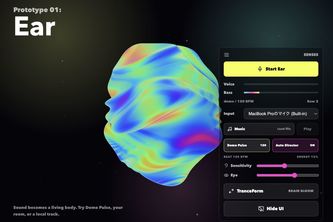
KANKAKU Frame is described as a browser-based visual instrument that translates sound into 3D animated organisms. The author states it uses local audio processing and does not upload data. It was built during a hackathon, with no indication of prior development or product-market fit. The project appears to be an experimental tool for personal or performance use, not a commercial offering.
Single most important open question: Is there any evidence that this concept has traction beyond the author’s own use case, or that it is being used in any form by others?
What The Product Actually Is
The description states:
- KANKAKU Frame is a browser-based visual instrument.
- It listens to sound (microphone, local music file, or generated pulse) and turns it into 3D organisms that respond in real time with breathing, color, surface, and silhouette changes.
- It uses local processing only, with no data upload.
- It includes five distinct ray-marched organisms that react differently to the same sound.
- It supports Demo Pulse, a 120 BPM generated pattern, and beat-onset detection.
- It features an Auto Director choreography that moves through organisms in time with the sound.
Inference: The product is a browser-based audio-reactive visualization tool, likely for artistic or performance use. It is not described as a commercial product or platform.
Positioning & Claim Evolution
The description states:
- The author built it to be immediate enough for a visitor to understand in seconds, but expressive enough to leave running during a performance.
- It aims to be different from existing music visualizers, which the author says either require setup, ask for uploads, or feel like utilities.
Inference: The positioning is that of an experimental, private, and immediate audio-reactive visualization tool. It does not appear to claim market dominance or scalability beyond its own use case.
Target Customer & ICP
The description states:
- It is designed for visitors to understand in seconds, suggesting a personal or performance-oriented audience.
- It supports local audio input, implying it’s intended for individuals using their own sound sources.
- The author mentions no microphone permission is required, which may appeal to users concerned with privacy.
Inference: The target customer appears to be individuals interested in personal or performance-based audio-reactive visualizations, possibly artists, musicians, or developers exploring creative tools. No evidence of a defined ICP beyond the author’s own use case.
Business Model & Pricing Evidence
The description states:
- It is a browser-based tool with no mention of monetization.
- It uses local processing only, and does not upload data.
- The author built it as part of a hackathon submission.
Inference: There is no evidence of a business model or pricing structure. The project appears to be experimental, not commercial.
Technical & Delivery Signals
The description states:
- Built with codex, GPT-5.6, javascript, three.js, web-audio-api, webgl, glsl.
- Uses ray-marched organisms, audio analysis pipeline, and beat-onset detection.
- Includes responsive controls, reduced-motion support, and testing instructions.
- The author used AI tools to inspect prototypes, design shaders, and test layouts.
Inference: The technical stack is modern and browser-based, with a focus on audio-reactive 3D visualization. It shows some level of engineering sophistication but no evidence of production-grade delivery or scalability.
Traction & Maturity Signals
The description states:
- It was built during a hackathon, with an earlier version existing before the submission.
- The author rebuilt it as a standalone v3 and extended it meaningfully.
- It includes demo instructions, automated checks, and a change record.
Inference: There is no evidence of user traction, adoption, or revenue. It is described as a prototype or experimental tool, not a product in use by others.
Competitive Context
The description states:
- Existing music visualizers either require setup, ask for uploads, or feel like utilities.
- KANKAKU Frame aims to be immediate and private.
Inference: The project is positioned as a novel approach to audio-reactive visualization, but there is no evidence of market analysis, competitive positioning, or comparison with existing tools.
Open Questions & Risks
- No commercial traction or revenue: The tool is described only as a hackathon submission.
- Single author: The team size is listed as one, suggesting limited development capacity.
- No evidence of user feedback or adoption: No mention of users, customers, or usage beyond the author’s own.
- Experimental nature: The project is described as a creative exploration, not a scalable commercial offering.
Questions the description leaves open
- What is the intended use case beyond personal or performance use?
- Has there been any user feedback or testing outside of the author’s own use?
- Are there plans to monetize or scale this beyond a prototype?
- How does the tool handle different audio formats or sources in practice?
- Is there any interest from third parties (e.g., artists, developers) in using or collaborating on this?
Overall Assessment
Assessment: Not evidenced.
The project is described as an experimental, single-authored hackathon submission with no evidence of commercial traction, users, or revenue. It does not appear to be a product ready for investment or partnership at this stage. The author’s own description indicates it is a personal creative tool, not a scalable business.
User Stories BotA demo video on every pull request
Get a demo video on every new feature
GitHub App that watches your pull requests and records a narrated, captioned demo.
Save time on demo prep and make informed decisions faster with a video walkthrough of every new feature.
Source
Submitted to the OpenAI 2026 hackathon on Devpost. Project home on Devpost. Back to the full gallery on Devpost.
This competitive analysis was produced by top-founders.com (opens in a new tab)
Generated by a language model from this project's public Devpost page — its tagline, the author's own write-up and any built-with tags listed there — as captured in August 2026. Short quotations are the author's words. It is an opinion on the idea as a business, not on the people behind it, and it reflects the description as published then. If the project has moved on, request a correction below. The analysis is not independent research and contains no verified traction, revenue or customer data.
An independent guide by KFG International LLC — not affiliated with, endorsed by, or connected to Devpost or OpenAI.