

Archive position — measured, not model output
0 likes on Devpost
2,263 of the 7,850 archived projects have more likes, and 5,587 share exactly 0 — so this project's #4,759 place in the like-ranked listing is a tie-break inside that group, not a ranking.
Projects (log scale)
Likes on Devpost. ▲ marks this project's group.
Show the figures
| Likes | Projects | Share of archive |
|---|---|---|
| 0 | 5,587 | 71.2% |
| 1 | 1,758 | 22.4% |
| 2 | 284 | 3.6% |
| 3–4 | 132 | 1.7% |
| 5–9 | 75 | 1.0% |
| 10+ | 14 | 0.2% |
 User Stories BotA demo video on every pull request
Get a demo video on every new feature
GitHub App that watches your pull requests and records a narrated, captioned demo.
Save time on demo prep and make informed decisions faster with a video walkthrough of every new feature.
Executive Summary
What the company appears to be
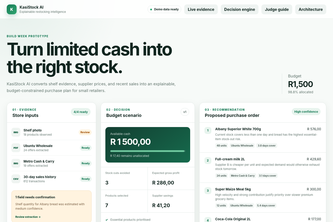
KasiStock AI is a self-reported AI-assisted restocking application for small retailers in South Africa who operate with limited cash and fragmented business information. It processes unstructured inputs like shelf photos, supplier documents, and sales data to produce budget-conscious purchasing recommendations.
What changed
The author states that this project was built as an incremental solution to a personal problem faced by a small retailer — the challenge of making informed restocking decisions with limited funds and no access to enterprise systems. It is described as a standalone Next.js/TypeScript application using AI for evidence extraction and deterministic logic for financial calculations.
Single most important open question
Is there any evidence that this product has been used by actual small retailers or tested in real-world conditions beyond the author's own experience?
Note: All claims are self-reported and unverified. No revenue, customer data, traction, or third-party validation is provided.
What The Product Actually Is
The description states that KasiStock AI is an AI-assisted restocking and purchasing application designed for cash-constrained retailers in South Africa. It allows merchants to upload:
- photographs of shelves or stockrooms;
- supplier price lists (in image or PDF format);
- recent sales history (CSV);
- a maximum budget.
It then guides the merchant through a controlled workflow involving:
- Evidence extraction using GPT-5.6 on multimodal inputs.
- Human verification of AI outputs before proceeding.
- Product identity reconciliation across different naming conventions.
- Restocking calculations, including average daily sales, days of stock cover, and reorder requirements.
- Budget optimisation based on deterministic code that selects combinations of products within budget constraints.
- Approval and purchasing, generating purchase orders, WhatsApp messages, and audit timelines.
The system is described as a standalone Next.js/TypeScript application built with React 19, OpenAI Responses API (GPT-5.6), Zod for validation, PostgreSQL schemas, and Vercel deployment.
Claim: The product is an AI-powered decision support tool for small retailers.
Evidence: Author’s own write-up.
Positioning & Claim Evolution
The author positions KasiStock AI as a solution to a specific problem faced by informal retailers — turning limited cash into the right stock. It is framed not as a general-purpose chatbot but as an application performing a "specific, economically meaningful task" that produces an "immediate business outcome."
Key positioning elements include:
- Focus on small businesses without enterprise infrastructure.
- Emphasis on using existing tools (smartphones, WhatsApp, documents).
- AI used to interpret fragmented data rather than replace human judgment.
- Deterministic financial logic ensures trustworthiness and auditability.
Claim: The product aims to democratize access to advanced decision-making tools for small retailers.
Evidence: Author’s own write-up.
Target Customer & ICP
The target customer is described as:
- Small retailers in South Africa;
- Operating with limited cash flow;
- Using informal methods like handwritten notes, WhatsApp, and basic spreadsheets;
- Lacking access to integrated inventory systems or ERP software.
The ideal customer profile (ICP) appears to be:
- A small shop owner or manager;
- Who has a smartphone and access to supplier documents and sales records;
- Who needs help prioritizing purchases under budget constraints.
Claim: The product targets informal retail shops in South Africa.
Evidence: Author’s own write-up.
Business Model & Pricing Evidence
No explicit business model or pricing information is provided. The author does not state whether the application will be sold, offered as a SaaS subscription, or monetized through other means.
Claim: Not evidenced.
Evidence: None provided.
Technical & Delivery Signals
The system is built using:
- Next.js 16
- React 19
- TypeScript
- OpenAI Responses API (GPT-5.6)
- Zod for structured outputs
- Vitest and Playwright for testing
- PDF generation capabilities
- PostgreSQL-compatible schemas
- Vercel deployment
It includes features such as:
- Multimodal input handling (JPEG, PNG, WebP, PDF, CSV)
- Schema-constrained AI outputs
- Deterministic financial engine using integer arithmetic to avoid floating-point errors
- Immutable evidence snapshots and approval records with SHA256 hashing and signing
- Workflow states ensuring unresolved data cannot proceed
Claim: The product uses a hybrid architecture combining AI interpretation and deterministic logic.
Evidence: Author’s own write-up.
Traction & Maturity Signals
There is no evidence of traction, adoption, or usage beyond the author's personal experience. No customers, revenue figures, user feedback, or market validation are mentioned.
Claim: Not evidenced.
Evidence: None provided.
Competitive Context
No mention of competitors or competitive landscape is made in the description. The author does not reference similar tools or platforms that might address the same problem space.
Claim: Not evidenced.
Evidence: None provided.
Open Questions & Risks
- Unproven market fit: No evidence of real-world usage or customer validation.
- AI dependency without transparency: GPT-5.6 is used for interpretation, but the system's performance in production is unknown.
- Limited scalability assumptions: The product is described as a single-person project with no indication of team size or scalability plans.
- No monetization strategy: No business model or pricing details are shared.
- Self-reported accuracy claims: Accuracy metrics (e.g., 91.67%) are based on internal testing and not external validation.
Inference: The lack of traction, customers, or third-party verification raises concerns about viability and commercial potential.
Evidence: Author’s own write-up.
Questions the description leaves open
- Have you tested this product with actual small retailers? If so, what were the results?
- What is your plan for scaling beyond a single developer?
- How do you intend to monetize or sustain the product?
- Can you provide evidence of how well GPT-5.6 performs in real-world scenarios outside of controlled testing?
- Are there any regulatory or compliance considerations related to handling financial data from small businesses?
Inference: These questions aim to uncover gaps in the self-reported narrative.
Evidence: Author’s own write-up.
Overall Assessment
There is insufficient evidence to assess commercial viability, traction, or scalability. The product is described as a proof-of-concept built by one person, with no indication of market validation, revenue, or customer adoption.
Claim: Not ready for investment or partnership.
Evidence: Author’s own write-up; absence of external data.
User Stories BotA demo video on every pull request
Get a demo video on every new feature
GitHub App that watches your pull requests and records a narrated, captioned demo.
Save time on demo prep and make informed decisions faster with a video walkthrough of every new feature.
Source
Submitted to the OpenAI 2026 hackathon on Devpost. Project home on Devpost. Back to the full gallery on Devpost.
This competitive analysis was produced by top-founders.com (opens in a new tab)
Generated by a language model from this project's public Devpost page — its tagline, the author's own write-up and any built-with tags listed there — as captured in August 2026. Short quotations are the author's words. It is an opinion on the idea as a business, not on the people behind it, and it reflects the description as published then. If the project has moved on, request a correction below. The analysis is not independent research and contains no verified traction, revenue or customer data.
An independent guide by KFG International LLC — not affiliated with, endorsed by, or connected to Devpost or OpenAI.