

Archive position — measured, not model output
0 likes on Devpost
2,263 of the 7,850 archived projects have more likes, and 5,587 share exactly 0 — so this project's #4,761 place in the like-ranked listing is a tie-break inside that group, not a ranking.
Projects (log scale)
Likes on Devpost. ▲ marks this project's group.
Show the figures
| Likes | Projects | Share of archive |
|---|---|---|
| 0 | 5,587 | 71.2% |
| 1 | 1,758 | 22.4% |
| 2 | 284 | 3.6% |
| 3–4 | 132 | 1.7% |
| 5–9 | 75 | 1.0% |
| 10+ | 14 | 0.2% |
 User Stories BotA demo video on every pull request
Get a demo video on every new feature
GitHub App that watches your pull requests and records a narrated, captioned demo.
Save time on demo prep and make informed decisions faster with a video walkthrough of every new feature.
Executive Summary
What the company appears to be
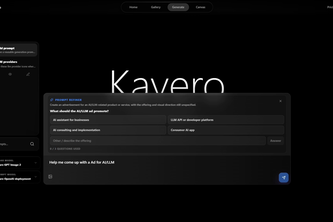
Kavero Studio is a self-reported open design workspace for the AI era, built by one founder (Redwan Hossain Arnob). It combines a familiar editable canvas with AI-assisted image generation and structured canvas actions, allowing users to bring their own AI providers, own their files, and use AI within real design workflows without platform lock-in.
What changed
During the OpenAI Build Week hackathon, the founder extended Kavero’s AI foundation by integrating Codex, GPT-5.6, and GPT Image 2. This included modular model-provider boundaries around LiteLLM, support for multiple AI providers (OpenAI, Azure), and improved credential handling and local deployment workflows.
The single most important open question
Is there any evidence of user adoption or product-market fit beyond the founder’s own development efforts?
What The Product Actually Is
The description states that Kavero is “the open design workspace for the AI era.” It combines a familiar, editable canvas with:
- AI-assisted image generation
- Canvas Copilot and structured canvas actions
- Automatic image segmentation
- Standalone image generation
- Generated-image history and galleries
- Multiple AI providers and configurable models
- Bring-your-own-key support
- Google Drive and managed storage options
- Local and Docker-based deployment
It uses Fabric.js for the canvas, Next.js, React, TypeScript, Supabase, PostgreSQL, and integrates with tools like Codex, GPT-5.6, LiteLLM, and OpenAI API.
Inference The product appears to be a design tool that allows users to create compositions using text, shapes, images, layers, and uploaded assets, while enabling AI to operate within the canvas as part of an editable workflow rather than producing isolated outputs.
Positioning & Claim Evolution
The author positions Kavero as:
- A workspace for the “AI era”
- An open design platform that allows users to “bring your own AI”
- A solution that avoids platform lock-in
- A tool where users control models, files, and workflows
- Designed for engineers who want a workspace they can understand, extend, automate, and self-host
Inference The positioning evolved from a personal frustration (lack of control in existing tools) to a broader vision of an open, flexible AI design environment that supports both individual creators and future B2B use cases.
Target Customer & ICP
The description states:
- The founder is a technical co-founder who builds products and solves engineering problems
- He needed to create launch graphics, social posts, thumbnails, etc.
- Kavero is designed for users who are not professional designers but need to produce marketing materials
- It starts as a creator-focused product to validate core workflows
Inference The initial ICP seems to be early-stage founders or technical professionals needing design tools that integrate AI without platform lock-in. The long-term vision includes B2B teams and agencies managing recurring content.
Business Model & Pricing Evidence
Not evidenced.
Technical & Delivery Signals
The project is built with:
- Frontend: Next.js, React, TypeScript, Tailwind CSS
- Backend: Supabase, PostgreSQL
- AI Infrastructure: Codex, GPT-5.6, LiteLLM, OpenAI API, Azure OpenAI
- Canvas Engine: Fabric.js
- Deployment: Local and Docker-based
The author mentions:
- Modular model-provider boundary using LiteLLM
- Support for separate orchestration and image-generation models
- Secure, signed dynamic provider routing
- Bring-your-own-key credential handling
- Integration with Google Drive and managed storage
- Improved local setup and workflow support
Inference There is a clear architectural approach to AI integration and modularity. The use of LiteLLM suggests an intent to support multiple providers cleanly.
Traction & Maturity Signals
Not evidenced.
Competitive Context
The description does not mention specific competitors or market positioning beyond general references to tools like Canva, which it says “made design easy” but Kavero aims to make “yours.”
Inference Kavero is positioned as a competitor or alternative to platforms like Canva, especially for users who want more control over AI and data.
Open Questions & Risks
- The product is self-reported by one person with no evidence of traction or revenue
- No customer base or user feedback is mentioned
- The project is described as a hackathon effort that was extended post-hackathon, suggesting it may not yet be fully mature
- The lack of any mention of monetization, pricing, or business model raises questions about commercial viability
- The focus on open-source and self-hosting may limit mainstream adoption unless there’s a compelling reason for users to do so
Questions the description leaves open
- What is the actual usage or feedback from early adopters?
- Is there any plan for monetization or pricing structure?
- How does Kavero differentiate itself from existing design tools like Figma, Canva, or Adobe Creative Suite?
- Are there any partnerships or integrations with AI providers already in place?
- What are the technical challenges in scaling this to support more complex workflows or larger teams?
Overall Assessment
Not evidenced.
User Stories BotA demo video on every pull request
Get a demo video on every new feature
GitHub App that watches your pull requests and records a narrated, captioned demo.
Save time on demo prep and make informed decisions faster with a video walkthrough of every new feature.
Source
Submitted to the OpenAI 2026 hackathon on Devpost. Project home on Devpost. Back to the full gallery on Devpost.
This competitive analysis was produced by top-founders.com (opens in a new tab)
Generated by a language model from this project's public Devpost page — its tagline, the author's own write-up and any built-with tags listed there — as captured in August 2026. Short quotations are the author's words. It is an opinion on the idea as a business, not on the people behind it, and it reflects the description as published then. If the project has moved on, request a correction below. The analysis is not independent research and contains no verified traction, revenue or customer data.
An independent guide by KFG International LLC — not affiliated with, endorsed by, or connected to Devpost or OpenAI.