

Archive position — measured, not model output
0 likes on Devpost
2,263 of the 7,850 archived projects have more likes, and 5,587 share exactly 0 — so this project's #4,758 place in the like-ranked listing is a tie-break inside that group, not a ranking.
Projects (log scale)
Likes on Devpost. ▲ marks this project's group.
Show the figures
| Likes | Projects | Share of archive |
|---|---|---|
| 0 | 5,587 | 71.2% |
| 1 | 1,758 | 22.4% |
| 2 | 284 | 3.6% |
| 3–4 | 132 | 1.7% |
| 5–9 | 75 | 1.0% |
| 10+ | 14 | 0.2% |
 User Stories BotA demo video on every pull request
Get a demo video on every new feature
GitHub App that watches your pull requests and records a narrated, captioned demo.
Save time on demo prep and make informed decisions faster with a video walkthrough of every new feature.
Executive Summary
What the company appears to be
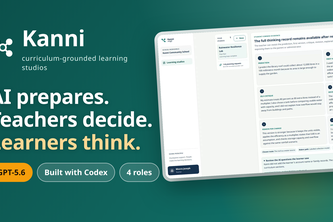
Kanni is a self-reported educational AI product built for use in Kerala’s schools, designed to support student learning through teacher-led planning and AI-assisted scaffolding. It is described as a tool that enables students to engage in thinking processes rather than simply receive answers, with a focus on curriculum-aligned learning studios.
What changed
The project evolved from an initial static lesson into a structured system involving four roles (administrator, teacher, learner, parent), with AI used for planning and coaching but not for completing student work. The author states that the core idea was shaped through collaboration with Codex during development.
Single most important open question — the commercial due-diligence read
Is there evidence of real-world adoption or traction beyond the hackathon submission? The description does not indicate any revenue, customers, or usage data beyond its own self-reported development and testing.
What The Product Actually Is
The description states that Kanni is a learning studio platform connecting four roles: administrator, teacher, learner, and parent. It supports curriculum-based learning through structured workflows:
- Teachers use AI to generate lesson plans based on curriculum materials.
- Students go through a multi-step process: predict, build, critique, revise, explain, reflect — with AI coaching only available after initial attempts.
- Parents receive reviewed home activities and follow-up questions.
- Administrators manage accounts, curriculum mapping, and workflow status.
The system uses Next.js, React, PostgreSQL, Prisma, Zod, and integrates with OpenRouter (GPT-5.6 Luna) for AI functions. It includes a RAG-based retrieval system that limits AI input to specific, curated curriculum sections.
Not evidenced:
- Whether Kanni is currently used in schools.
- If it has any live users or data beyond its own test environments.
- Any production deployment or customer feedback.
Positioning & Claim Evolution
The author states that Kanni was built "from the other end" — starting with teachers rather than students, aiming to avoid the problem where AI answers first and learners become passengers. The positioning is:
“A better student chatbot helps one learner for one moment. A better planning tool helps one teacher prepare several routes through the same goal…”
This reflects a shift from generic AI tools toward teacher-led AI integration, emphasizing thinking over output.
The claim evolution shows:
- Initial idea: static lesson.
- Evolved to: structured learning studio with role-based access and AI-assisted scaffolding.
- Final version: minimal AI use, strong emphasis on student agency and teacher control.
Not evidenced:
- Any external validation or market positioning beyond the author's own description.
- Whether this approach has been tested in real schools or found effective by educators.
Target Customer & ICP
The target customer is Kerala-based schools, particularly those using SCERT (State Council of Educational Research and Training) curriculum. The system supports students from Class 6 to 9, with a focus on:
- Teachers who want to plan lessons aligned with curriculum.
- Parents seeking to support learning at home.
- Administrators managing school-level access and workflows.
Not evidenced:
- Specific school names or pilot programs.
- Number of schools using the product.
- Customer segmentation beyond role-based access.
Business Model & Pricing Evidence
The description does not contain any information about pricing, monetization, or business model. It also does not indicate whether Kanni is intended for sale, licensing, or free use.
Not evidenced:
- Revenue streams.
- Subscription plans or pricing tiers.
- Licensing or deployment models.
- Any commercial relationship with schools or educational institutions.
Technical & Delivery Signals
The system is built using modern web technologies:
- Frontend: Next.js 16, React 19, TailwindCSS
- Backend: Node.js, TypeScript, PostgreSQL 18, Prisma 7
- AI Integration: OpenRouter (GPT-5.6 Luna), RAG with local retrieval
- Security Features: Role-based access control, database-level privacy enforcement, schema validation via Zod, browser tests for data leakage
Not evidenced:
- Deployment in production environments.
- Scalability or performance metrics.
- Any external security audits or compliance certifications.
Traction & Maturity Signals
The project is described as a hackathon submission (Devpost entry for OpenAI 2026 hackathon). It includes:
- 61 unit tests, 51 deterministic evaluation cases
- A four-role browser flow
- No AI credits consumed in testing
Not evidenced:
- Real-world usage or adoption.
- Customer feedback or product iteration history.
- Any revenue, ARR, or user base.
Competitive Context
The description does not mention competitors or direct market comparisons. It focuses on the unique design choices around teacher control, student thinking, and privacy.
Not evidenced:
- Direct competitors in the educational AI space.
- Market size or competitive landscape.
- Any differentiation from existing platforms like Khan Academy, Duolingo, or other AI-assisted learning tools.
Open Questions & Risks
- No real-world traction: The product is described as a hackathon submission with no evidence of live use or adoption.
- Unverified claims: All features and design decisions are self-reported without external validation.
- Limited scope: Supports only Classes 6–9, one school per installation.
- No monetization strategy: No indication of how the product will be sold or funded.
- Single-founder team: Only one member listed (Arnol P S), which may limit execution capacity.
Questions the description leaves open
- Has Kanni been tested in real schools? If so, what were the results?
- What is the plan for scaling beyond one school per installation?
- How will you monetize this product? Is there a pricing model or revenue path?
- Are there any partnerships with educational authorities or organizations in Kerala?
- What are the plans for localization (e.g., Malayalam translation, cultural adaptation)?
- How do you plan to ensure child safety and data privacy beyond the current architecture?
Overall Assessment
Not evidenced: There is no evidence of revenue, customers, or traction beyond the hackathon submission.
The description presents a well-thought-out concept, but it remains unproven in practice. The team has built a functional prototype with strong technical design and clear intent around student agency and privacy. However, without any real-world usage or commercialization efforts, this is a pre-product idea — not a product ready for investment or partnership.
Confidence Level: Low. This analysis is based entirely on self-reported content and lacks any external corroboration or evidence of traction.
User Stories BotA demo video on every pull request
Get a demo video on every new feature
GitHub App that watches your pull requests and records a narrated, captioned demo.
Save time on demo prep and make informed decisions faster with a video walkthrough of every new feature.
Source
Submitted to the OpenAI 2026 hackathon on Devpost. Project home on Devpost. Back to the full gallery on Devpost.
This competitive analysis was produced by top-founders.com (opens in a new tab)
Generated by a language model from this project's public Devpost page — its tagline, the author's own write-up and any built-with tags listed there — as captured in August 2026. Short quotations are the author's words. It is an opinion on the idea as a business, not on the people behind it, and it reflects the description as published then. If the project has moved on, request a correction below. The analysis is not independent research and contains no verified traction, revenue or customer data.
An independent guide by KFG International LLC — not affiliated with, endorsed by, or connected to Devpost or OpenAI.