

Archive position — measured, not model output
1 like on Devpost
505 of the 7,850 archived projects have more likes, and 1,758 share exactly 1 — so this project's #831 place in the like-ranked listing is a tie-break inside that group, not a ranking.
Projects (log scale)
Likes on Devpost. ▲ marks this project's group.
Show the figures
| Likes | Projects | Share of archive |
|---|---|---|
| 0 | 5,587 | 71.2% |
| 1 | 1,758 | 22.4% |
| 2 | 284 | 3.6% |
| 3–4 | 132 | 1.7% |
| 5–9 | 75 | 1.0% |
| 10+ | 14 | 0.2% |
 User Stories BotA demo video on every pull request
Get a demo video on every new feature
GitHub App that watches your pull requests and records a narrated, captioned demo.
Save time on demo prep and make informed decisions faster with a video walkthrough of every new feature.
Executive Summary
What the company appears to be
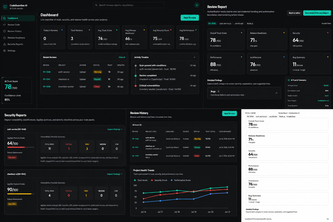
CodeGuardian AI is an AI-powered code review platform that the author describes as a multi-agent system analyzing source code and public GitHub repositories. It claims to detect bugs, security vulnerabilities, performance issues, architectural flaws, and recommend testing strategies — generating executive release-readiness reports.
What changed
This is a self-reported project submitted to the OpenAI 2026 hackathon by one developer (Bojja Ravikanth). It represents an early-stage prototype or proof-of-concept with no evidence of commercial traction, revenue, or customer adoption.
Single most important open question
Is there any indication that CodeGuardian has progressed beyond a personal hackathon project into a product with real-world usage or monetization potential?
What The Product Actually Is
The description states that CodeGuardian AI is a multi-agent AI-powered code review platform. It analyzes source code and public GitHub repositories using:
- A React frontend built with Vite, Tailwind CSS, and React Router
- A Node.js backend using Express.js and REST APIs
- Integration with the Google Gemini API
- Multiple specialized AI agents:
- Bug Detection Agent
- Security Agent
- Performance Agent
- Architecture Agent
- QA/Test Agent
- CEO Agent (for executive summary)
The system allows users to upload code files or submit GitHub repository URLs, and produces structured reports on software quality.
Inference It is not evidenced whether the product functions as described in production — only that it was built as a prototype with these components.
Positioning & Claim Evolution
The author positions CodeGuardian AI as an automated code review assistant, aiming to help developers by providing instant, actionable feedback so they can focus on higher-level design decisions. It is framed as not replacing human reviewers but augmenting them.
It claims to offer:
- Bug detection
- Security vulnerability identification
- Performance improvement suggestions
- Software architecture evaluation
- Testing strategy recommendations
- Executive release-readiness reports
Inference The positioning reflects a common trend in AI-assisted development tools, but no evidence supports whether this is a novel or differentiated approach in the market.
Target Customer & ICP
The description does not name specific target customers. However, it implies that CodeGuardian targets developers, especially those working with source code or GitHub repositories.
It suggests use cases for:
- Developers reviewing pull requests
- Teams needing automated quality checks before merging code
- Organizations seeking faster and more consistent code review processes
Inference There is no evidence of a defined ICP beyond general developer audiences. No segmentation, personas, or customer types are mentioned.
Business Model & Pricing Evidence
No business model or pricing information is provided in the description.
The author mentions future features such as:
- GitHub Pull Request integration
- CI/CD integration
- PDF exports
- Team collaboration features
But no indication of monetization strategy, pricing tiers, or revenue streams exists.
Inference There is no evidence of a business model beyond the idea of an AI-powered code review tool — no commercialization plan or pricing structure described.
Technical & Delivery Signals
The technical stack includes:
- Frontend: React, Vite, Tailwind CSS, React Router
- Backend: Node.js, Express.js, REST APIs
- AI: Google Gemini API
- Integrations: GitHub Repository API, Repository Context Engine
The system uses a multi-agent architecture, where each agent focuses on a specific aspect of code quality before being consolidated into an executive report.
Challenges mentioned include:
- GitHub repository analysis
- Asynchronous AI workflows
- Rate limits and timeouts
- Frontend presentation of large reports
Inference While the technical implementation is detailed, there is no evidence that this system has been deployed at scale or integrated into real development workflows.
Traction & Maturity Signals
The project was submitted to a hackathon (OpenAI 2026), indicating it’s an early-stage prototype. The author notes:
- Built a complete full-stack AI application
- Integrated GitHub repository analysis
- Designed a multi-agent AI review pipeline
- Created a modern interactive dashboard
- Successfully deployed the project to GitHub
However, there is no evidence of users, customers, or adoption beyond the single developer’s work.
Inference This appears to be a personal project with no demonstrated traction or product-market fit.
Competitive Context
The author does not reference existing competitors. However, based on the described functionality (code review automation), similar tools in the market include:
- GitHub Copilot
- SonarQube
- CodeClimate
- DeepCode
- Snyk
These platforms offer code analysis, security scanning, and quality metrics.
Inference No competitive positioning or differentiation is stated. The author does not compare CodeGuardian to existing tools, nor does the description indicate how it would differ from them.
Open Questions & Risks
Key risks and open questions based on the self-reported information:
- Single-person team: Only one developer (Bojja Ravikanth) is listed.
- No commercial traction or revenue: No evidence of customers, usage, or monetization.
- Prototype nature: Submitted to a hackathon; no indication of production deployment or scalability.
- Limited integration scope: Currently supports only public GitHub repositories.
- Unproven AI collaboration: Multi-agent architecture is described but not validated in practice.
- No data on accuracy or reliability of AI outputs.
Inference The project lacks validation, real-world usage, and commercial viability indicators. It may be a concept or prototype with no clear path to product-market fit.
Questions the description leaves open
- What is the current status of CodeGuardian? Is it in active development, or has it been shelved?
- Has any team member worked on similar projects previously?
- Are there any early adopters or pilot users of the platform?
- How does CodeGuardian plan to differentiate itself from existing tools like GitHub Copilot or SonarQube?
- What is the roadmap for monetization and scaling beyond the current prototype?
- Has the multi-agent AI architecture been tested in real-world scenarios?
- Are there any partnerships or integrations with development platforms (e.g., GitHub, CI/CD tools)?
- How does CodeGuardian handle private repositories or enterprise use cases?
Overall Assessment
Not evidenced.
There is no evidence of revenue, customers, traction, or commercial viability beyond a single-person hackathon submission.
The project is described as a prototype with no indication of product-market fit, scalability, or monetization strategy.
Confidence Level Low This analysis is based entirely on self-reported information and lacks any external validation. The author states the project's features, but does not provide evidence of execution, adoption, or commercial potential.
User Stories BotA demo video on every pull request
Get a demo video on every new feature
GitHub App that watches your pull requests and records a narrated, captioned demo.
Save time on demo prep and make informed decisions faster with a video walkthrough of every new feature.
Source
Submitted to the OpenAI 2026 hackathon on Devpost. Project home on Devpost. Back to the full gallery on Devpost.
This competitive analysis was produced by top-founders.com (opens in a new tab)
Generated by a language model from this project's public Devpost page — its tagline, the author's own write-up and any built-with tags listed there — as captured in August 2026. Short quotations are the author's words. It is an opinion on the idea as a business, not on the people behind it, and it reflects the description as published then. If the project has moved on, request a correction below. The analysis is not independent research and contains no verified traction, revenue or customer data.
An independent guide by KFG International LLC — not affiliated with, endorsed by, or connected to Devpost or OpenAI.