

Archive position — measured, not model output
1 like on Devpost
505 of the 7,850 archived projects have more likes, and 1,758 share exactly 1 — so this project's #832 place in the like-ranked listing is a tie-break inside that group, not a ranking.
Projects (log scale)
Likes on Devpost. ▲ marks this project's group.
Show the figures
| Likes | Projects | Share of archive |
|---|---|---|
| 0 | 5,587 | 71.2% |
| 1 | 1,758 | 22.4% |
| 2 | 284 | 3.6% |
| 3–4 | 132 | 1.7% |
| 5–9 | 75 | 1.0% |
| 10+ | 14 | 0.2% |
 User Stories BotA demo video on every pull request
Get a demo video on every new feature
GitHub App that watches your pull requests and records a narrated, captioned demo.
Save time on demo prep and make informed decisions faster with a video walkthrough of every new feature.
Executive Summary
Company: CodePilot AI
Self-reported purpose: A tool to help developers understand unfamiliar codebases by creating structured, searchable views of repositories and offering AI-powered analysis and documentation generation.
Key commercial signals: The project is a self-contained, full-stack application built for a hackathon with no evidence of revenue, customers or traction. It uses a mix of open-source and proprietary tools including FastAPI, React, Qdrant, and Google Gemini.
Most important open question: Is there a viable market need for this type of developer tooling, or is it a one-off hackathon project?
What The Product Actually Is
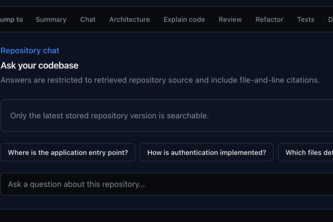
The description states that CodePilot AI accepts public GitHub repositories or ZIP uploads and creates a structured, searchable view of the codebase. It provides:
- Repository intelligence (languages, frameworks, dependencies, folder structure, functions, classes, services, Docker, environment, database signals)
- AI project summaries covering architecture, features, and application flows
- Citation-grounded repository chat using RAG
- An interactive architecture graph for exploring frontend, backend, services, and data connections
- Explain Code functionality
- Repository-wide code review with severity, confidence, and recommendations
- AI Refactoring Advisor with impact analysis, generated diffs, and accept/reject workflow
- Unit-test generation for pytest, Jest, and JUnit
- Generated README, API, installation, folder, and usage documentation
- Dashboard, repository history, protected accounts, and secure repository ownership
Inference: The product appears to be a developer tool focused on code comprehension and refactoring assistance. It combines static analysis with AI features like RAG chat and code review.
Positioning & Claim Evolution
The tagline is: “Build better code. Learn faster. Ship confidently.”
The author states that the inspiration was to turn a slow, fragmented process of understanding unfamiliar codebases into one private engineering workspace.
Inference: The positioning appears to be that CodePilot AI helps developers work more efficiently by reducing friction in codebase exploration and refactoring. It positions itself as an assistant for developers working with complex or unfamiliar code.
Target Customer & ICP
The description does not explicitly state the target customer segment.
It is implied that the tool targets developers who need to understand large, unfamiliar codebases quickly.
Inference: The primary user appears to be a developer or engineering team working on projects where rapid onboarding and understanding of existing systems is critical.
Business Model & Pricing Evidence
There is no evidence in the description of any pricing model or business model.
The author mentions that the hosted demo uses Gemini server-side, while local development can use Ollama without paid OpenAI credits.
They also note that they added retry-friendly error handling and request pacing for the hosted free-tier provider.
Inference: The tool appears to be offered as a free-tier service with potential paid upgrades for higher-volume usage, but no specific pricing or monetization details are provided.
Technical & Delivery Signals
The frontend is built with React, Vite, Tailwind CSS, React Query, Zustand, Framer Motion, and React Flow.
The backend is FastAPI with Clean Architecture, SQLAlchemy, Alembic, PostgreSQL, JWT authentication, and Docker.
AI features use a provider abstraction; the hosted demo uses Gemini server-side, while local development can use Ollama.
Inference: The technical stack suggests a full-stack application built with modern tools and practices, including clean architecture, containerization (Docker), and modular frontend design.
Traction & Maturity Signals
The project was submitted to the OpenAI 2026 hackathon.
It has a live demo and source code available on GitHub.
There is no evidence of revenue, customers, or adoption beyond its own demonstration.
Inference: The product exists as a working prototype but lacks any measurable traction or commercial validation.
Competitive Context
The description does not mention competitors directly.
However, the features described (codebase understanding, RAG chat, refactoring assistance) align with tools in the AI developer tooling space such as GitHub Copilot, Tabnine, and others that offer similar capabilities.
Inference: CodePilot AI enters a competitive market for AI-assisted code development tools. However, there is no evidence of how it differentiates itself from existing solutions or whether it has gained any market traction.
Open Questions & Risks
- The project is a hackathon submission with no evidence of commercial traction.
- No revenue, customer base, or monetization strategy are described.
- The tool relies heavily on AI providers like Gemini and Ollama, which may introduce dependency risks.
- The author states that the AI features are designed to be resilient to quota limits, but this is a speculative design choice without real-world testing or feedback.
Inference: The risk of commercial viability is high due to lack of evidence for market demand or product-market fit.
Questions the description leaves open
- What specific problem in codebase understanding are you solving, and how does this differ from existing tools?
- Have you conducted any user research or interviews with developers who might use this tool?
- How do you plan to monetize the product beyond free-tier usage?
- What is your go-to-market strategy for reaching developers?
- Are there any technical limitations or edge cases that have not been addressed in the current prototype?
Overall Assessment
Not evidenced.
The project is a hackathon submission with no evidence of traction, revenue, or customer adoption. It lacks clear commercial signals or a defined business model. While it demonstrates technical capability and a potential use case, there is insufficient evidence to support an investment or partnership decision at this stage.
Confidence level: Low — based on self-reported description only, with no independent verification or data on usage, revenue, or market validation.
User Stories BotA demo video on every pull request
Get a demo video on every new feature
GitHub App that watches your pull requests and records a narrated, captioned demo.
Save time on demo prep and make informed decisions faster with a video walkthrough of every new feature.
Source
Submitted to the OpenAI 2026 hackathon on Devpost. Project home on Devpost. Back to the full gallery on Devpost.
This competitive analysis was produced by top-founders.com (opens in a new tab)
Generated by a language model from this project's public Devpost page — its tagline, the author's own write-up and any built-with tags listed there — as captured in August 2026. Short quotations are the author's words. It is an opinion on the idea as a business, not on the people behind it, and it reflects the description as published then. If the project has moved on, request a correction below. The analysis is not independent research and contains no verified traction, revenue or customer data.
An independent guide by KFG International LLC — not affiliated with, endorsed by, or connected to Devpost or OpenAI.