

Archive position — measured, not model output
0 likes on Devpost
2,263 of the 7,850 archived projects have more likes, and 5,587 share exactly 0 — so this project's #6,714 place in the like-ranked listing is a tie-break inside that group, not a ranking.
Projects (log scale)
Likes on Devpost. ▲ marks this project's group.
Show the figures
| Likes | Projects | Share of archive |
|---|---|---|
| 0 | 5,587 | 71.2% |
| 1 | 1,758 | 22.4% |
| 2 | 284 | 3.6% |
| 3–4 | 132 | 1.7% |
| 5–9 | 75 | 1.0% |
| 10+ | 14 | 0.2% |
 User Stories BotA demo video on every pull request
Get a demo video on every new feature
GitHub App that watches your pull requests and records a narrated, captioned demo.
Save time on demo prep and make informed decisions faster with a video walkthrough of every new feature.
Executive Summary
What the company appears to be
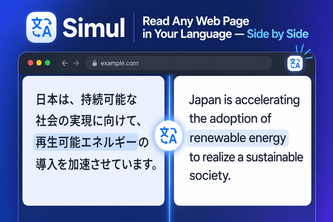
Simul is a browser-based tool that allows users to view web pages in their native language while interacting with the original website. It runs locally on device and uses Chrome's built-in translation API and Tesseract OCR for text extraction.
What changed
The project was submitted as part of the OpenAI 2026 hackathon, indicating it is a prototype or proof-of-concept built in a short timeframe.
Single most important open question
Is there evidence of any commercial traction, revenue, or customer adoption beyond the author's personal use case?
The description states that Simul was built as a hackathon project and is intended to be open-sourced. There is no evidence of any revenue, customers, or product-market fit beyond the author’s own use case.
What The Product Actually Is
- The description states that Simul allows users to browse the internet in their native language while interacting with the original website.
- It operates through a side panel or pop-out window.
- It runs locally on device without sending private data elsewhere for processing.
- It uses Chrome's built-in translation tool API (requires Chrome 138) and Tesseract OCR for text extraction.
- The product was built using the BMAD framework, with "a very long session of codecs."
Not evidenced: No details about specific functionality beyond basic browsing and translation.
Positioning & Claim Evolution
- The description states that Simul was inspired by frustration with existing translation tools that break web pages and require switching between languages.
- It positions itself as a solution to the problem of broken translations and form filling when traveling or using foreign websites.
- The author claims it was built quickly and iteratively, with improvements made over time.
- It is described as a tool that "runs everything on device" and avoids sending private data elsewhere.
Not evidenced: No information about how this compares to existing tools or whether there are any unique features beyond what's already available in browsers.
Target Customer & ICP
- The description states that the inspiration came from someone who travels or lives in a foreign country.
- It is implied that users would be people who frequently encounter websites in languages they don't understand and need to interact with them.
- The author mentions personal use cases, such as filling out forms on foreign websites.
Not evidenced: No specific customer segments, personas, or target markets are identified. No evidence of any market research or user interviews.
Business Model & Pricing Evidence
- The description states that Simul will be available as an open-source project.
- It is not clear if there are any monetization plans beyond the open-source model.
- There is no mention of pricing, subscriptions, or paid features.
Not evidenced: No evidence of any business model, pricing strategy, or revenue streams.
Technical & Delivery Signals
- The description states that Simul uses Chrome's built-in translation tool API and Tesseract OCR.
- It requires Chrome 138 to function.
- It was built using the BMAD framework.
- The author mentions challenges with extracting text from images in multiple languages.
- It is designed to run locally on device.
Not evidenced: No information about scalability, performance metrics, or technical architecture beyond basic components.
Traction & Maturity Signals
- The description states that Simul was built as a hackathon project and released quickly.
- It has been iterated upon based on user feedback.
- It is intended to be open-sourced for anyone to fork or contribute to.
- The author claims it was useful from day one.
Not evidenced: No evidence of any user base, adoption metrics, or product maturity beyond initial development.
Competitive Context
- The description does not provide information about competitors or the competitive landscape.
- It is implied that existing translation tools are inadequate for the use case described.
Not evidenced: No competitive analysis, market positioning, or differentiation from other tools.
Open Questions & Risks
- The project was built as a hackathon submission and has no commercial traction.
- It relies on Chrome 138, which may limit its accessibility.
- It uses Tesseract OCR, an older tool for text extraction.
- There is no evidence of any revenue, customers, or product-market fit.
- The open-source nature suggests no immediate monetization strategy.
Not evidenced: No data to support claims about risks or open questions beyond the project's current state.
Questions the description leaves open
- What specific problems are you solving that existing tools don't address?
- How many users have you tested with, and what feedback have you received?
- Are there any plans for monetization or commercialization beyond open-sourcing?
- What is the long-term vision for Simul beyond the current prototype?
- Have you considered how to scale this solution across different browsers or platforms?
Not evidenced: These are speculative questions based on the limited information provided.
Overall Assessment
- The description states that Simul was built as a hackathon project and is intended to be open-sourced.
- There is no evidence of any commercial traction, revenue, customers, or product-market fit.
- It appears to be a prototype with no clear path to monetization or scalability.
Not evidenced: No basis for investment or partnership decision due to lack of commercial data.
User Stories BotA demo video on every pull request
Get a demo video on every new feature
GitHub App that watches your pull requests and records a narrated, captioned demo.
Save time on demo prep and make informed decisions faster with a video walkthrough of every new feature.
Source
Submitted to the OpenAI 2026 hackathon on Devpost. Project home on Devpost. Back to the full gallery on Devpost.
This competitive analysis was produced by top-founders.com (opens in a new tab)
Generated by a language model from this project's public Devpost page — its tagline, the author's own write-up and any built-with tags listed there — as captured in August 2026. Short quotations are the author's words. It is an opinion on the idea as a business, not on the people behind it, and it reflects the description as published then. If the project has moved on, request a correction below. The analysis is not independent research and contains no verified traction, revenue or customer data.
An independent guide by KFG International LLC — not affiliated with, endorsed by, or connected to Devpost or OpenAI.