

Archive position — measured, not model output
0 likes on Devpost
2,263 of the 7,850 archived projects have more likes, and 5,587 share exactly 0 — so this project's #2,789 place in the like-ranked listing is a tie-break inside that group, not a ranking.
Projects (log scale)
Likes on Devpost. ▲ marks this project's group.
Show the figures
| Likes | Projects | Share of archive |
|---|---|---|
| 0 | 5,587 | 71.2% |
| 1 | 1,758 | 22.4% |
| 2 | 284 | 3.6% |
| 3–4 | 132 | 1.7% |
| 5–9 | 75 | 1.0% |
| 10+ | 14 | 0.2% |
 User Stories BotA demo video on every pull request
Get a demo video on every new feature
GitHub App that watches your pull requests and records a narrated, captioned demo.
Save time on demo prep and make informed decisions faster with a video walkthrough of every new feature.
Executive Summary
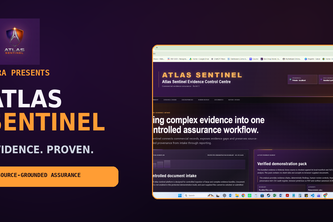
What the company appears to be: Atlas Sentinel Evidence Control Centre is a self-reported single-user, localhost-based prototype for processing synthetic commercial documents into traceable evidence chains. The author describes it as a "protected evidence-assurance prototype" that verifies provenance and links records into audit outputs without allowing AI-generated suggestions to override deterministic audit truth.
What changed: The project is presented as a demonstration built during OpenAI Build Week, with no prior commercial traction or production deployment evidenced. It represents an initial architectural proof-of-concept for handling fragmented commercial evidence in a deterministic way.
Single most important open question: Is there a viable commercial market need for this type of deterministic evidence-assurance system, and can the author scale beyond the current single-user localhost prototype to support multi-user, production-grade document processing?
What The Product Actually Is
The description states that Atlas Sentinel is:
- A "protected evidence-assurance prototype" that processes synthetic documents
- Built as a "secure single-user localhost prototype using Python, HTML, CSS and JavaScript"
- Designed to verify provenance, link records into traceable evidence chains, flag gaps, and produce source-grounded audit outputs
- Capable of processing a fixed, checksum-verified fictional demonstration pack containing seven synthetic documents
- Not intended for use with real client or production data
- Delivers deterministic classifications (Proven, Review Required, Not Proven) without AI override
- Includes features like:
- SHA-256 checksum verification
- Evidence chain linking
- Missing document detection
- Report Studio previews
- CSV audit export
- Print/Save as PDF
- Canonical UTF-8 JSON with artifact hash verification
Inference: The product is a proof-of-concept prototype, not a production-ready system. It operates in isolation and does not support real-world document ingestion or multi-user access.
Positioning & Claim Evolution
The author claims:
- Atlas Sentinel addresses "real commercial document-intelligence challenges" where evidence is scattered across multiple documents
- The core problem is not finding information but proving how each conclusion connects back to its source
- It aims to transform fragmented records into traceable evidence chains without AI overriding deterministic audit truth
- GPT-5.6 may optionally provide isolated advisory processing, but cannot alter deterministic outcomes
Inference: This positioning reflects a niche market need for deterministic document analysis in regulated or compliance-heavy environments (e.g., legal, accounting, audit). The author frames it as solving a problem that goes beyond simple extraction.
Target Customer & ICP
The description states:
- No specific customer or industry is named
- The prototype focuses on "commercial document-intensive environments"
- The author mentions potential future sectors including "legal, accounting, audit, medical, insurance, commercial and other document-intensive environments"
- The current prototype is limited to a single-user localhost environment with no multi-user support
Inference: The target customer appears to be organisations requiring deterministic evidence assurance in regulated or compliance-heavy industries. However, no explicit ICP (Ideal Customer Profile) has been defined beyond this general category.
Business Model & Pricing Evidence
The description states:
- No pricing model is mentioned
- No revenue streams are described
- The prototype is a demonstration built for a hackathon
- No commercial relationships or partnerships are referenced
- The system is presented as a single-user localhost tool with no indication of monetization
Inference: There is no evidence of any business model or pricing structure. This remains an unproven concept without any commercial traction.
Technical & Delivery Signals
The description states:
- Built using Python, HTML, CSS, JavaScript
- Uses Codex as a coding collaborator
- Implements SHA-256 checksum verification
- Includes Host and Origin validation, request-token protection, security headers, immutable analysis snapshots
- Supports browser Print / Save as PDF
- Generates canonical UTF-8 JSON with exact-artifact SHA-256 verification
- Has 103 passing regression tests
- Operates only on localhost (127.0.0.1)
- Does not support OCR, PDF parsing, or arbitrary document-content endpoints
Inference: The technical stack is basic and focused on local execution with strong security controls. It lacks scalability features such as cloud deployment, multi-user access, or large-scale document ingestion.
Traction & Maturity Signals
The description states:
- No revenue, customers, or adoption data are provided
- The prototype is a single-user localhost tool built for a hackathon
- No production use cases or real-world deployments are mentioned
- The author describes the project as a "protected prototype" and not a commercial product
- The system does not support real document ingestion or multi-user access
Inference: There is no evidence of traction, maturity, or commercial viability. This remains an early-stage prototype with no demonstrated market fit.
Competitive Context
The description states:
- No competitors are explicitly named
- The author references "real-world experience" in document intelligence but does not identify existing solutions
- The focus is on deterministic evidence assurance rather than general document extraction tools
- The system avoids AI override, which may differentiate it from other AI-assisted document tools
Inference: There is no competitive landscape described. The author does not reference existing tools or platforms that address similar needs.
Open Questions & Risks
The description states:
- The prototype is a single-user localhost tool with no multi-user support
- No real-world data processing capabilities (OCR, PDF parsing, etc.)
- No commercial traction or revenue model
- The author has no coding background and is new to the field
- The system does not support production-grade document ingestion or export formats beyond CSV and JSON
- The prototype is limited to synthetic documents only
Inference: Key risks include lack of scalability, limited functionality for real-world use cases, and absence of commercial viability. The project may struggle to transition from prototype to product.
Questions the description leaves open
- What specific industries or use cases are you targeting with this solution?
- How do you plan to scale beyond the current localhost-only prototype?
- Are there any real-world partners or customers who have expressed interest in this approach?
- What is your roadmap for adding OCR, PDF parsing, and multi-user support?
- How will you ensure data privacy and security at scale?
- What are your plans for monetization and pricing?
- Have you identified any existing tools that compete with or complement this solution?
Overall Assessment
Not evidenced: There is no evidence of commercial traction, revenue, customer adoption, or a clear path to market. The project remains a single-user prototype built during a hackathon, with no indication of scalability, functionality for real-world use cases, or business model.
Confidence level: Low — based entirely on self-reported information without corroboration or external validation.
Assessment: Not ready for investment or partnership consideration at this stage. The project shows potential in addressing a niche problem but lacks the maturity, traction, and commercial viability to warrant further due diligence.
User Stories BotA demo video on every pull request
Get a demo video on every new feature
GitHub App that watches your pull requests and records a narrated, captioned demo.
Save time on demo prep and make informed decisions faster with a video walkthrough of every new feature.
Source
Submitted to the OpenAI 2026 hackathon on Devpost. Project home on Devpost. Back to the full gallery on Devpost.
This competitive analysis was produced by top-founders.com (opens in a new tab)
Generated by a language model from this project's public Devpost page — its tagline, the author's own write-up and any built-with tags listed there — as captured in August 2026. Short quotations are the author's words. It is an opinion on the idea as a business, not on the people behind it, and it reflects the description as published then. If the project has moved on, request a correction below. The analysis is not independent research and contains no verified traction, revenue or customer data.
An independent guide by KFG International LLC — not affiliated with, endorsed by, or connected to Devpost or OpenAI.