

Archive position — measured, not model output
0 likes on Devpost
2,263 of the 7,850 archived projects have more likes, and 5,587 share exactly 0 — so this project's #4,752 place in the like-ranked listing is a tie-break inside that group, not a ranking.
Projects (log scale)
Likes on Devpost. ▲ marks this project's group.
Show the figures
| Likes | Projects | Share of archive |
|---|---|---|
| 0 | 5,587 | 71.2% |
| 1 | 1,758 | 22.4% |
| 2 | 284 | 3.6% |
| 3–4 | 132 | 1.7% |
| 5–9 | 75 | 1.0% |
| 10+ | 14 | 0.2% |
 User Stories BotA demo video on every pull request
Get a demo video on every new feature
GitHub App that watches your pull requests and records a narrated, captioned demo.
Save time on demo prep and make informed decisions faster with a video walkthrough of every new feature.
Executive Summary
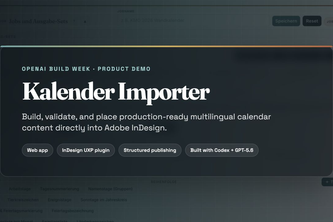
The company appears to be a solo developer project named Kalender Importer, built as an Adobe InDesign plugin to automate calendar content import from a MySQL database. The author states it was developed iteratively using Codex and GPT-5.6, with the goal of improving workflow efficiency in calendar design.
What changed: The author reports that previously time-consuming manual processes for calendar creation are now completed in minutes or hours instead of days. This suggests an improvement in automation and data handling within a specific niche (calendar design for print).
The single most important open question: Is there evidence of actual use beyond the developer's own workflow? The description does not indicate any external customers, revenue, or adoption — only that the tool is used daily by its creator.
This analysis is based entirely on the self-reported project description provided by the author. No independent verification or additional data sources are available.
What The Product Actually Is
The description states:
- Kalender Importer is a plugin for Adobe InDesign.
- It integrates with a MySQL database running locally via MAMP.
- It uses a PHP API to validate and transform records into predictable export structures.
- An HTML/JavaScript interface inspects and prepares the data.
- A small production pipeline connects this to InDesign through an Adobe UXP plugin, placing structured content into existing calendar templates.
- The system handles multilingual calendar content, including symbols, fonts, and regional data.
This is a self-reported description of how the tool functions. No evidence of actual product delivery or usage outside the developer’s own workflow.
Positioning & Claim Evolution
The author claims:
- The tool was developed to improve their personal workflow as a graphic designer working in calendar production.
- It allows for fast generation of large book calendars, reducing manual labor from days to hours or minutes.
- It addresses the challenge of organically grown calendar data inconsistency, which previously broke automated processes.
These are claims about intent and perceived benefits, not proof of traction or market demand. The positioning is narrow — focused on one individual’s internal process.
Target Customer & ICP
The description states:
- The primary user is the developer (Dominik Lehner), who works in a calendar company.
- The tool supports calendar design for print, particularly book calendars.
- It handles multilingual content, suggesting potential use in international markets.
No evidence of external customers or target segments beyond the developer’s own use case. No indication of whether this is a product for other designers, agencies, or clients.
Business Model & Pricing Evidence
The description states:
- The tool is built and used by one person (Dominik Lehner).
- It was developed as part of a personal workflow improvement effort, not as a commercial offering.
- There is no mention of pricing, licensing, or monetization strategy.
No evidence of any business model or pricing structure. The project appears to be personal and non-commercial.
Technical & Delivery Signals
The description states:
- Built using Adobe UXP, PHP, JavaScript, MySQL, HTML5, Python, Codex, GPT-5.6, and XLSX.
- The development process involved iterative testing with real calendar data and InDesign documents.
- It focuses on reliable output rather than demo prototypes.
- The system includes data validation, normalization, and integration across multiple environments (database → API → browser → plugin → InDesign).
Technical details suggest a functional prototype built for internal use. No evidence of scalability or delivery to third parties.
Traction & Maturity Signals
The description states:
- The tool is used daily by the developer.
- Features are implemented nearly weekly, indicating ongoing development.
- It replaced manual processes that previously took days and now take hours or minutes.
No evidence of external adoption, customer feedback, or measurable impact beyond the developer’s own workflow. No revenue, users, or market traction is reported.
Competitive Context
The description states:
- The author works in a calendar company, implying there may be existing tools or workflows in that space.
- The tool addresses manual calendar creation inefficiencies.
- It leverages existing Adobe InDesign and UXP ecosystem tools.
No evidence of competitors, market analysis, or competitive positioning. The project appears to address an internal need rather than a broader market.
Open Questions & Risks
- Single-user dependency: The tool is built and used by one person — no evidence of external adoption.
- Lack of commercialization: No pricing, licensing, or monetization strategy.
- No third-party validation: The entire project is self-reported with no independent verification.
- Limited scope: The solution appears tailored to a specific internal workflow, not scalable for general use.
- Unverified claims: All benefits and outcomes are self-reported without external corroboration.
These risks suggest the project may be a personal tool rather than a commercial product or viable business opportunity.
Questions the description leaves open
- What is the actual production workflow that this tool replaces, and how much time does it save?
- Are there any other users or customers beyond yourself?
- Have you considered how to scale this for others in your industry?
- Is there a plan to monetize or commercialize this tool?
- How do you handle data privacy and security when integrating with databases and InDesign documents?
Overall Assessment
The description states:
- This is a personal project built by one developer.
- It improves internal workflow but has no evidence of external traction, revenue, or market demand.
- The tool is used daily but not sold or shared beyond the creator.
Not evidenced as a commercial opportunity. No signs of product-market fit, scalability, or external adoption. Likely a personal tool with no investment or partnership potential at this stage.
User Stories BotA demo video on every pull request
Get a demo video on every new feature
GitHub App that watches your pull requests and records a narrated, captioned demo.
Save time on demo prep and make informed decisions faster with a video walkthrough of every new feature.
Source
Submitted to the OpenAI 2026 hackathon on Devpost. Project home on Devpost. Back to the full gallery on Devpost.
This competitive analysis was produced by top-founders.com (opens in a new tab)
Generated by a language model from this project's public Devpost page — its tagline, the author's own write-up and any built-with tags listed there — as captured in August 2026. Short quotations are the author's words. It is an opinion on the idea as a business, not on the people behind it, and it reflects the description as published then. If the project has moved on, request a correction below. The analysis is not independent research and contains no verified traction, revenue or customer data.
An independent guide by KFG International LLC — not affiliated with, endorsed by, or connected to Devpost or OpenAI.