

Archive position — measured, not model output
0 likes on Devpost
2,263 of the 7,850 archived projects have more likes, and 5,587 share exactly 0 — so this project's #4,753 place in the like-ranked listing is a tie-break inside that group, not a ranking.
Projects (log scale)
Likes on Devpost. ▲ marks this project's group.
Show the figures
| Likes | Projects | Share of archive |
|---|---|---|
| 0 | 5,587 | 71.2% |
| 1 | 1,758 | 22.4% |
| 2 | 284 | 3.6% |
| 3–4 | 132 | 1.7% |
| 5–9 | 75 | 1.0% |
| 10+ | 14 | 0.2% |
 User Stories BotA demo video on every pull request
Get a demo video on every new feature
GitHub App that watches your pull requests and records a narrated, captioned demo.
Save time on demo prep and make informed decisions faster with a video walkthrough of every new feature.
Executive Summary
Project: KalmOps
Self-reported basis: The description is entirely self-reported and unverified, based on a Devpost submission for the OpenAI 2026 hackathon. No third-party corroboration or archived evidence exists.
What it appears to be: A tool that helps solo developers or small teams structure project ideas into bounded, security-aware launch plans with human review gates. It is positioned as a solution for "solo builders" rather than traditional project management tools.
What changed: The project was submitted to a hackathon, suggesting early-stage development and a focus on prototyping or proof-of-concept.
Most important open question: What is the actual problem KalmOps solves, and how does it differ from existing tools or manual processes?
What The Product Actually Is
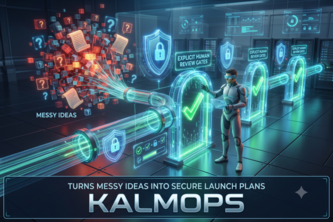
The description states that KalmOps “turns messy project ideas into bounded, security-aware launch plans with explicit human review gates.” It is built for solo builders, not project-management textbooks.
- Claimed function: Structuring unstructured project ideas into defined, secure, and reviewed launch plans.
- Inferred purpose: To reduce ambiguity in early-stage development by introducing structure, security checks, and human oversight.
- Not evidenced: The actual product interface, workflow, or how it implements these features.
Positioning & Claim Evolution
The tagline positions KalmOps as a tool for solo builders, not for traditional project management. It emphasizes:
- Bounded plans (i.e., clear scope)
- Security awareness
- Human review gates
These claims suggest an intent to address the lack of structure and oversight in early-stage development by solo developers.
Inference: The positioning implies that current tools are either too complex or not tailored for individuals working alone.
Not evidenced: How this differs from existing project planning tools, or whether it addresses a real pain point beyond what a developer might handle manually.
Target Customer & ICP
The description states KalmOps is “built for solo builders, not project-management textbooks.”
- Claimed target: Solo developers or small teams working on early-stage projects.
- Inference: The tool may be aimed at people who lack formal project management processes or tools.
- Not evidenced: Specific customer personas, use cases, or whether the tool is intended for internal use or client-facing projects.
Business Model & Pricing Evidence
No information provided about pricing, monetization, or business model.
- Claimed: Not stated.
- Inference: If this is a hackathon project, it may be in prototype or proof-of-concept stage, with no commercial model yet.
- Not evidenced: Revenue streams, pricing tiers, or customer acquisition strategies.
Technical & Delivery Signals
The author lists the following technologies:
- ChatGPT
- Firebase (App Check, Auth, Cloud Functions, Hosting)
- Google Antigravity (likely a placeholder or typo)
- Google Cloud Secret Manager
- Google Gemini
- GPT-5.6-Luna (likely a placeholder or typo)
- OpenAI Responses API
- React, TypeScript, Vite, Vitest, Zod
Inference: The tool is likely built using modern web and AI stack, with integration into cloud services and AI models.
- Not evidenced: How these technologies are used in the product’s core functionality, or whether they are integrated in a novel way.
Traction & Maturity Signals
The project was submitted to the OpenAI 2026 hackathon.
- Claimed maturity: Early-stage prototype or proof-of-concept.
- Not evidenced: Any traction, user feedback, or adoption metrics.
- Inference: The product is likely not yet in production or used by real users.
Competitive Context
No information provided about competitors or market positioning.
- Claimed: Not stated.
- Inference: If the tool is for solo developers and project planning, it may compete with tools like Notion, Trello, or Airtable, but this is speculative.
- Not evidenced: Competitor analysis, differentiation, or market size.
Open Questions & Risks
- Risk 1: The project is a hackathon submission, suggesting early-stage development and no proven product-market fit.
- Risk 2: The use of placeholder or non-standard tech names (e.g., GPT-5.6-Luna, Google Antigravity) raises questions about technical depth or clarity.
- Risk 3: No evidence of traction, revenue, or customer validation.
- Open Question: The lack of a detailed write-up or description beyond the tagline suggests limited development or planning.
Questions the description leaves open
- What specific problem does KalmOps solve that existing tools don’t?
- How does it implement “security-aware” launch plans? Is this a feature or a process?
- What is the actual workflow for a solo builder using this tool?
- Is there any user feedback or testing from real developers yet?
- What are the key assumptions about how solo builders work, and how do you validate them?
Overall Assessment
Not evidenced: No basis to assess investment or partnership potential at this stage.
- Inference: If this is a prototype with no traction or clear value proposition, it may not be ready for investment or partnership.
- Confidence level: Low — based on thin evidence and lack of commercial signals.
User Stories BotA demo video on every pull request
Get a demo video on every new feature
GitHub App that watches your pull requests and records a narrated, captioned demo.
Save time on demo prep and make informed decisions faster with a video walkthrough of every new feature.
Source
Submitted to the OpenAI 2026 hackathon on Devpost. Project home on Devpost. Back to the full gallery on Devpost.
This competitive analysis was produced by top-founders.com (opens in a new tab)
Generated by a language model from this project's public Devpost page — its tagline and any built-with tags listed there, since the author published no write-up — as captured in August 2026. Short quotations are the author's words. It is an opinion on the idea as a business, not on the people behind it, and it reflects the description as published then. If the project has moved on, request a correction below. The analysis is not independent research and contains no verified traction, revenue or customer data.
An independent guide by KFG International LLC — not affiliated with, endorsed by, or connected to Devpost or OpenAI.