

Archive position — measured, not model output
0 likes on Devpost
2,263 of the 7,850 archived projects have more likes, and 5,587 share exactly 0 — so this project's #4,755 place in the like-ranked listing is a tie-break inside that group, not a ranking.
Projects (log scale)
Likes on Devpost. ▲ marks this project's group.
Show the figures
| Likes | Projects | Share of archive |
|---|---|---|
| 0 | 5,587 | 71.2% |
| 1 | 1,758 | 22.4% |
| 2 | 284 | 3.6% |
| 3–4 | 132 | 1.7% |
| 5–9 | 75 | 1.0% |
| 10+ | 14 | 0.2% |
 User Stories BotA demo video on every pull request
Get a demo video on every new feature
GitHub App that watches your pull requests and records a narrated, captioned demo.
Save time on demo prep and make informed decisions faster with a video walkthrough of every new feature.
Executive Summary
What the company appears to be
Kanji A Day is a self-reported iOS/iPadOS flashcard app for Japanese language learners, focused on kana (Hiragana and Katakana) and over 2,000 kanji characters. The app is described as simple, usable, and accessible, with support for dynamic font sizing and reduced motion settings.
What changed
The author states that the app was built using AI tools like GPT-5.6 and Codex, significantly accelerating development time from months to days. It was submitted to the App Store within a week of starting development.
Single most important open question
Is there any evidence of user adoption, revenue, or customer engagement beyond the author’s self-reported claims?
What The Product Actually Is
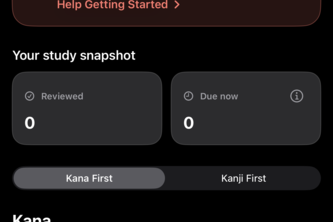
The description states that Kanji A Day is a Japanese kana and kanji flashcard app for iOS/iPadOS. It includes:
- Flashcards for Hiragana, Katakana, and over 2,000 kanji.
- Simple user interaction: "Remembered" or "Study again" options.
- Customized flashcard decks based on user performance.
- Basic learning resources and external links.
The app is built using Swift, Xcode, SQLite, StoreKit 2, The Composable Architecture (TCA), and supports accessibility features like dynamic font sizing and reduced motion.
Evidence
- Author states: “Kanji A Day allows people to study kana (Hiragana and Katakana) and over 2,000 different kanji flashcards.”
- Author states: “It was built with Swift, Xcode, SQLite, StoreKit 2, The Composable Architecture (TCA), and more.”
- Author states: “Kanji A Day includes some information about how to get started and some external links about where to learn more.”
Inference The app is a mobile learning tool for Japanese language education.
Positioning & Claim Evolution
The author positions Kanji A Day as:
- A simple, easy-to-use flashcard app.
- An accessible app that respects iOS accessibility settings.
- Built using AI tools (GPT-5.6 and Codex) to speed up development.
Evidence
- Author states: “finding a good Japanese flashcard app that is simple and easy to use is surprisingly difficult.”
- Author states: “I've had the idea for Kanji A Day for years now but finding the time to build it was always a challenge.”
- Author states: “I could built it with the help of GPT-5.6 in days not months!”
Inference The app is positioned as solving a gap in the market for accessible, simple flashcard tools.
Target Customer & ICP
The description indicates that Kanji A Day targets:
- Japanese language learners.
- Users who value usability and accessibility.
Evidence
- Author states: “Kanji A Day allows people to study kana (Hiragana and Katakana) and over 2,000 different kanji flashcards.”
- Author states: “finding iOS apps that honor accessibility settings such as proper dynamic font sizing and reduced motion settings is not as common as it should be.”
Inference The ICP is likely self-directed learners of Japanese who prioritize ease-of-use and accessibility.
Business Model & Pricing Evidence
No evidence of pricing, monetization strategy, or business model is provided in the description.
Evidence
- Author states: “I was also able to plan back and forth other important aspects of the app like the app's monetization strategy.”
- No mention of in-app purchases, subscriptions, or freemium models.
- No mention of revenue streams or pricing tiers.
Inference The business model is not clearly defined by the author.
Technical & Delivery Signals
The app was built using:
- Swift and Xcode
- SQLite for data persistence
- StoreKit 2 for transactions
- The Composable Architecture (TCA)
- AI tools like GPT-5.6 and Codex for development acceleration
Evidence
- Author states: “I have been building for iOS platforms for many years, so I wanted to use Codex and GPT-5.6 to help me accelerate my speed.”
- Author states: “It was built with Swift, Xcode, SQLite, StoreKit 2, The Composable Architecture (TCA), and more.”
- Author states: “Codex and GPT-5.6 helped with creating the App Store Connect description, keywords, etc.”
Inference The app is technically sound for iOS, but no evidence of production deployment or performance data.
Traction & Maturity Signals
No evidence of user traction, downloads, or adoption is provided.
Evidence
- Author states: “Kanji A Day is live in the App Store and ready for users to enjoy.”
- Author states: “Next I would like to add some useful features such as a widget and watchOS app.”
Inference The app is live, but no data on usage or user feedback is shared.
Competitive Context
No evidence of competitors or market positioning is provided.
Evidence
- Author states: “finding a good Japanese flashcard app that is simple and easy to use is surprisingly difficult.”
- No mention of existing apps or competitive analysis.
Inference The author sees a gap in the market, but no data on who else is doing this or how they compare.
Open Questions & Risks
- Unverified claims: The description is self-reported and unverified.
- No revenue or traction: No evidence of monetization or user engagement.
- AI dependency: Heavy reliance on AI tools for development may not be scalable or replicable.
- Limited scope: App is focused only on iOS, with no mention of cross-platform support.
Evidence
- Author states: “Everything above is the authors' own account. It is not independently verified.”
- Author states: “No revenue, customer or traction data is available beyond what they state.”
Questions the description leaves open
- What is your monetization strategy? Are there any in-app purchases or subscriptions?
- Have you received any user feedback or reviews from the App Store?
- How do you plan to scale beyond a single developer?
- What are the technical limitations of relying on AI for development?
- Do you have plans to expand beyond iOS (e.g., Android, web)?
- What is your long-term vision for the app and its user base?
Overall Assessment
Not evidenced.
Evidence
- No financials, revenue, or customer data.
- No indication of traction or market validation.
- No clear business model or monetization strategy.
Inference The project is in an early stage with no demonstrated commercial viability. It may be a prototype or proof-of-concept, not yet ready for investment or partnership.
User Stories BotA demo video on every pull request
Get a demo video on every new feature
GitHub App that watches your pull requests and records a narrated, captioned demo.
Save time on demo prep and make informed decisions faster with a video walkthrough of every new feature.
Source
Submitted to the OpenAI 2026 hackathon on Devpost. Project home on Devpost. Back to the full gallery on Devpost.
This competitive analysis was produced by top-founders.com (opens in a new tab)
Generated by a language model from this project's public Devpost page — its tagline, the author's own write-up and any built-with tags listed there — as captured in August 2026. Short quotations are the author's words. It is an opinion on the idea as a business, not on the people behind it, and it reflects the description as published then. If the project has moved on, request a correction below. The analysis is not independent research and contains no verified traction, revenue or customer data.
An independent guide by KFG International LLC — not affiliated with, endorsed by, or connected to Devpost or OpenAI.