

Archive position — measured, not model output
0 likes on Devpost
2,263 of the 7,850 archived projects have more likes, and 5,587 share exactly 0 — so this project's #4,756 place in the like-ranked listing is a tie-break inside that group, not a ranking.
Projects (log scale)
Likes on Devpost. ▲ marks this project's group.
Show the figures
| Likes | Projects | Share of archive |
|---|---|---|
| 0 | 5,587 | 71.2% |
| 1 | 1,758 | 22.4% |
| 2 | 284 | 3.6% |
| 3–4 | 132 | 1.7% |
| 5–9 | 75 | 1.0% |
| 10+ | 14 | 0.2% |
 User Stories BotA demo video on every pull request
Get a demo video on every new feature
GitHub App that watches your pull requests and records a narrated, captioned demo.
Save time on demo prep and make informed decisions faster with a video walkthrough of every new feature.
Executive Summary
What the company appears to be
Kanji Shisho is a self-reported educational tool for learning Japanese reading (hiragana, katakana, and kanji) that uses verified dictionary data and a GPT-5.6 model for personalized mistake explanations. It is described as a serverless, AI-powered application built during an OpenAI hackathon.
What changed
The project was developed over the course of a hackathon and is presented as a proof-of-concept with a focus on trust boundaries, deterministic logic, and personalization using GPT-5.6 in a controlled way.
Single most important open question
Is there any evidence of user adoption or revenue generation beyond the author’s own description? The project is self-reported, unverified, and lacks traction data.
What The Product Actually Is
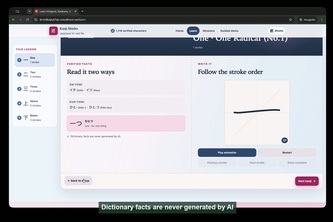
The description states that Kanji Shisho teaches Japanese reading — including hiragana, katakana, and 1,026 MEXT Grade 1–6 kanji — through verified study cards, practice sessions, and applied sign-reading missions. It features a resident guide named "Shisho" (司書), which lives in the header of every page.
The system uses verified dictionary data (MEXT, KANJIDIC2/JMdict, KanjiVG) for facts and logic, while GPT-5.6 is used only for explanations. The model receives a minimal fact envelope; it does not generate answers but explains mistakes live in the learner's language.
The product is built with AWS Lambda, API Gateway, CloudFormation, S3, CloudFront, Node.js, TypeScript, and Codex. It includes CI/CD pipelines, infrastructure-as-code, and security scanning.
Evidence
- The author states: “Kanji Shisho teaches Japanese reading — 46 hiragana, 46 katakana, and all 1,026 MEXT Grade 1–6 kanji.”
- The system uses verified dictionary data for facts.
- GPT-5.6 is used only for explanations.
- Built with AWS Lambda, API Gateway, CloudFormation, S3, CloudFront, Node.js, TypeScript, and Codex.
Inference The product is an AI-enhanced educational platform focused on Japanese reading comprehension, using a hybrid of deterministic logic and generative AI for personalized feedback.
Positioning & Claim Evolution
The project positions itself as a third way between flashcard apps (which offer canned feedback) and chatbots (which may confidently invent readings). It claims to be a tutor that is “never wrong about facts” and always personal in explanation.
The author states:
- “We wanted a third thing: a tutor that is never wrong about facts and always personal in explanation.”
- “Verified dictionary data (MEXT, KANJIDIC2/JMdict, KanjiVG) and deterministic logic own every fact, reading, score, and answer. GPT-5.6 owns only the explanation.”
This positioning emphasizes trust, accuracy, and personalization.
Evidence
- The author claims to have built a system that avoids fabricated output by using verified data and deterministic logic.
- The model is used only for explanations, not for generating facts or answers.
Inference The product is positioned as an educational tool that balances AI personalization with factual integrity — a niche in the language-learning space.
Target Customer & ICP
The description states that Kanji Shisho targets learners of Japanese reading, specifically those studying hiragana, katakana, and MEXT Grade 1–6 kanji. It is designed for users who want to progress through structured lessons and receive accurate, personalized feedback.
Evidence
- “Kanji Shisho teaches Japanese reading — 46 hiragana, 46 katakana, and all 1,026 MEXT Grade 1–6 kanji.”
- The system supports applied sign-reading missions.
- The product is described as a tutor for learners progressing through structured content.
Inference The target customer is likely Japanese language learners at beginner to intermediate levels, particularly those using formal curricula (e.g., MEXT standards).
Business Model & Pricing Evidence
There is no evidence of pricing or business model in the description. The project is presented as a hackathon submission with no mention of monetization, subscriptions, or paid features.
Evidence
- No pricing information.
- No mention of revenue streams or monetization strategy.
- The product is described as a demo or proof-of-concept.
Inference The business model is not evident. It may be early-stage or non-existent at this point.
Technical & Delivery Signals
The system is built using serverless AWS infrastructure (Lambda, API Gateway, CloudFormation), with CI/CD pipelines using Codex. The team used deterministic quality gates including 200+ tests, 8,963 exercise contracts, and full-tree security scans.
Key technical details:
- Uses GPT-5.6 for explanations only.
- Output is capped at 192 tokens to meet latency requirements.
- Implements fail-closed guards to prevent model drift.
- Infrastructure is managed with CloudFormation and reviewed via change sets.
- CI/CD pipeline runs in ~2m38s per run.
Evidence
- “Built with Codex end to end: an artifact-promotion CI/CD pipeline (build once, hash, promote the same bytes dev→production)”
- “Every change landed through a protected PR with deterministic quality gates: 200+ tests, 8,963 exercise contracts, a rendered site-governance pass, and a full-tree security scan.”
- “Capping output at 192 tokens (the envelope supplies the facts; the model only words them) brought live responses to 5.0 s measured, 137 output tokens, zero reasoning tokens.”
Inference The technical stack is robust for a hackathon-scale product and shows attention to security, reproducibility, and performance.
Traction & Maturity Signals
There is no evidence of user traction, adoption, or revenue. The project is described as a hackathon submission with no mention of users, customers, or usage metrics.
Evidence
- “This project was submitted to the OpenAI 2026 hackathon on Devpost.”
- No mention of users, customers, or product usage.
- No evidence of monetization or revenue.
Inference The product is at a very early stage and lacks any demonstrated traction or maturity in the market.
Competitive Context
There are no references to competitors or market positioning beyond the claim that this is a “third thing” between flashcards and chatbots. The author does not name or describe existing tools in the Japanese language-learning space.
Evidence
- “Apps either drill flashcards with canned feedback, or bolt on a chatbot that confidently invents readings.”
- No mention of competitors or market analysis.
Inference The competitive context is unclear. It may be competing with educational apps and AI-powered tutors in the Japanese language-learning space, but no direct comparison is made.
Open Questions & Risks
- No traction or revenue: The project is described as a hackathon submission with no evidence of adoption.
- Unverified claims: All claims are self-reported and unverified.
- Single founder: The team size is listed as 1, which may limit scalability or execution capacity.
- AI dependency: Reliance on GPT-5.6 for explanations introduces risk if the model becomes unavailable or misaligned.
- Limited scope: The product focuses only on MEXT Grade 1–6 kanji and hiragana/katakana — a narrow educational domain.
Evidence
- “Team size: 1”
- “No revenue, customer or traction data is available beyond what they state.”
- “The model receives a minimal fact envelope; on live questions the correct answer is structurally absent from its context, so it cannot leak.”
Inference The project is at a very early stage and faces risks related to scalability, execution, and market validation.
Questions the description leaves open
- What is your plan for scaling beyond a single developer?
- How do you intend to monetize this product?
- Have you validated demand with potential users or educators?
- What are the risks of relying on GPT-5.6 for explanations, and how do you mitigate them?
- Are there any plans to expand beyond MEXT Grade 1–6 kanji?
- How do you intend to build trust in the educational space without a track record?
Overall Assessment
The project is described as a hackathon submission with no evidence of traction, revenue, or customer adoption. It is presented as an experimental tool that combines verified data with generative AI for personalized feedback.
Evidence
- “This project was submitted to the OpenAI 2026 hackathon on Devpost.”
- No mention of users, customers, or monetization.
- The product is described as a demo or proof-of-concept.
Inference At this stage, the project is not ready for investment or partnership. It lacks commercial viability, traction, and a clear path to market adoption. It may be an interesting experiment but does not yet demonstrate a product-market fit or scalable business model.
User Stories BotA demo video on every pull request
Get a demo video on every new feature
GitHub App that watches your pull requests and records a narrated, captioned demo.
Save time on demo prep and make informed decisions faster with a video walkthrough of every new feature.
Source
Submitted to the OpenAI 2026 hackathon on Devpost. Project home on Devpost. Back to the full gallery on Devpost.
This competitive analysis was produced by top-founders.com (opens in a new tab)
Generated by a language model from this project's public Devpost page — its tagline, the author's own write-up and any built-with tags listed there — as captured in August 2026. Short quotations are the author's words. It is an opinion on the idea as a business, not on the people behind it, and it reflects the description as published then. If the project has moved on, request a correction below. The analysis is not independent research and contains no verified traction, revenue or customer data.
An independent guide by KFG International LLC — not affiliated with, endorsed by, or connected to Devpost or OpenAI.