

Archive position — measured, not model output
1 like on Devpost
505 of the 7,850 archived projects have more likes, and 1,758 share exactly 1 — so this project's #826 place in the like-ranked listing is a tie-break inside that group, not a ranking.
Projects (log scale)
Likes on Devpost. ▲ marks this project's group.
Show the figures
| Likes | Projects | Share of archive |
|---|---|---|
| 0 | 5,587 | 71.2% |
| 1 | 1,758 | 22.4% |
| 2 | 284 | 3.6% |
| 3–4 | 132 | 1.7% |
| 5–9 | 75 | 1.0% |
| 10+ | 14 | 0.2% |
 User Stories BotA demo video on every pull request
Get a demo video on every new feature
GitHub App that watches your pull requests and records a narrated, captioned demo.
Save time on demo prep and make informed decisions faster with a video walkthrough of every new feature.
Executive Summary
What the company appears to be
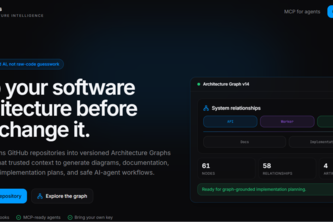
CodeAtlas is a self-reported AI-native Architecture Intelligence Platform for software teams. The description states it connects GitHub repositories, scans source code, and generates versioned architecture graphs that serve as the foundation for documentation, diagrams, AI assistance, and implementation planning.
What changed
The project was submitted to the OpenAI 2026 hackathon on Devpost. It is described as a proof-of-concept or prototype built in a short timeframe, not yet a commercial product with customers or revenue.
Single most important open question
Is there evidence of traction, adoption, or early customer feedback beyond the self-reported project description?
What The Product Actually Is
The description states that CodeAtlas is an AI-native Architecture Intelligence Platform for software teams. It connects GitHub repositories, scans and analyzes source code in background workers, extracts source facts, and projects them into a versioned Architecture Graph.
From this canonical graph, teams can:
- Explore components and dependencies
- Generate documentation and diagrams (Mermaid, Draw.io, C4)
- Identify architecture drift
- Ask architecture-focused questions
- Create implementation plans for proposed changes
The platform uses:
- GitHub OAuth, JWT authentication, RBAC, and workspaces
- Background repository scanning with Celery and Redis
- PostgreSQL and pgvector for data storage
- Neo4j for the immutable, versioned Architecture Graph
- OpenAI API for AI reasoning grounded in the graph
- MCP integration for AI coding agents
Inference The product appears to be a developer tool that aims to make software architecture more traceable, actionable, and integrated with AI.
Positioning & Claim Evolution
The description states that CodeAtlas transforms software architecture from static documentation into a living, continuously synchronized system powered by AI. It positions itself as an alternative to outdated diagrams and scattered repositories, aiming to make architecture a "living asset" rather than a "static document."
It claims to:
- Derive a versioned Architecture Graph from the codebase
- Use that graph as trusted context for documentation, diagrams, impact analysis, AI assistance, and implementation planning
- Ground AI responses in structured, graph-based facts instead of raw repositories
Inference The positioning is focused on solving architecture drift and improving developer workflows by making system understanding more reliable and AI-assisted.
Target Customer & ICP
The description states that CodeAtlas is for software teams. It targets engineers who spend time reconstructing system boundaries, dependencies, data flows, and design decisions from scattered repositories, tickets, and outdated diagrams.
It also mentions that it supports:
- GitHub repositories
- Pull-request workflows
- Multi-workspace use
- Role-based access control (RBAC)
Inference The primary ICP appears to be engineering teams working with codebases that are large or complex enough to benefit from structured architecture visualization and AI-assisted change planning.
Business Model & Pricing Evidence
The description does not state anything about pricing, business model, monetization, or customer acquisition. It only describes the technical functionality of the platform.
Not evidenced
Technical & Delivery Signals
The project is built with:
- Frontend: React and TypeScript
- Backend: FastAPI monolith
- Data storage: PostgreSQL, pgvector, Neo4j
- Background processing: Celery, Redis
- Authentication: GitHub OAuth, JWT, RBAC
- AI layer: OpenAI API with graph-derived context
- Deployment: Docker for local orchestration
It supports:
- WebSocket scan progress events
- MCP integration
- Multi-tenant architecture
- Secure GitHub access with encrypted credentials and signed webhooks
Inference The technical stack suggests a developer-focused platform built with modern tools, designed to be modular and scalable.
Traction & Maturity Signals
The description states that this was submitted as a hackathon project (OpenAI 2026) and is not yet a commercial product. It includes:
- A production-ready local Docker workflow
- A usable frontend preview
- End-to-end repository scan-to-graph verification
However, there is no evidence of:
- Customers or users
- Revenue or monetization
- Product-market fit or adoption metrics
- Any traction beyond the project submission
Not evidenced
Competitive Context
The description does not mention any competitors. It only describes what CodeAtlas does, not how it compares to existing tools in the architecture visualization or AI-assisted development space.
Not evidenced
Open Questions & Risks
- Unverified claims: All descriptions are self-reported and unverified.
- No traction or customers: The platform is described as a hackathon project with no evidence of real-world usage.
- Limited scope: The product appears to be focused on GitHub repositories and may not support other platforms or workflows.
- AI dependency: Reliance on OpenAI APIs may create cost and availability risks.
- Early-stage prototype: No evidence of product-market fit, scalability, or long-term roadmap beyond the hackathon.
Questions the description leaves open
- What is the current stage of development? Is this a prototype or an early version of a product?
- Are there any users or pilot customers currently testing the platform?
- How does CodeAtlas handle large-scale codebases or complex dependency graphs?
- What are the plans for monetization and pricing?
- How does it compare to existing tools in architecture visualization or AI-assisted development?
- What is the long-term roadmap beyond the hackathon project?
Overall Assessment
The description states that CodeAtlas is a self-reported hackathon project submitted to the OpenAI 2026 hackathon. There is no evidence of revenue, customers, traction, or commercial viability.
Confidence: Low
This is a preliminary concept, not a product with demonstrated market demand or adoption. The platform appears technically feasible and aligned with current trends in AI-assisted development and architecture visualization, but lacks any evidence of real-world usage or business traction.
Inference If this were to be considered for investment or partnership, it would require further due diligence into:
- Product-market fit
- Customer feedback
- Technical scalability
- Commercial viability
Until such evidence is provided, the project remains a conceptual prototype, not a commercial opportunity.
User Stories BotA demo video on every pull request
Get a demo video on every new feature
GitHub App that watches your pull requests and records a narrated, captioned demo.
Save time on demo prep and make informed decisions faster with a video walkthrough of every new feature.
Source
Submitted to the OpenAI 2026 hackathon on Devpost. Project home on Devpost. Back to the full gallery on Devpost.
This competitive analysis was produced by top-founders.com (opens in a new tab)
Generated by a language model from this project's public Devpost page — its tagline, the author's own write-up and any built-with tags listed there — as captured in August 2026. Short quotations are the author's words. It is an opinion on the idea as a business, not on the people behind it, and it reflects the description as published then. If the project has moved on, request a correction below. The analysis is not independent research and contains no verified traction, revenue or customer data.
An independent guide by KFG International LLC — not affiliated with, endorsed by, or connected to Devpost or OpenAI.