

Archive position — measured, not model output
0 likes on Devpost
2,263 of the 7,850 archived projects have more likes, and 5,587 share exactly 0 — so this project's #6,692 place in the like-ranked listing is a tie-break inside that group, not a ranking.
Projects (log scale)
Likes on Devpost. ▲ marks this project's group.
Show the figures
| Likes | Projects | Share of archive |
|---|---|---|
| 0 | 5,587 | 71.2% |
| 1 | 1,758 | 22.4% |
| 2 | 284 | 3.6% |
| 3–4 | 132 | 1.7% |
| 5–9 | 75 | 1.0% |
| 10+ | 14 | 0.2% |
 User Stories BotA demo video on every pull request
Get a demo video on every new feature
GitHub App that watches your pull requests and records a narrated, captioned demo.
Save time on demo prep and make informed decisions faster with a video walkthrough of every new feature.
Executive Summary
What the company appears to be
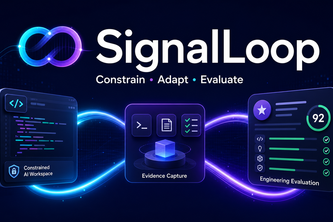
SignalLoop is a self-reported AI-native coding assessment platform designed for software engineering hiring. It allows candidates to work with a constrained AI collaborator during an evaluation, capturing evidence of how engineers frame, ask for help, verify, and own their work—using a model called FAVO (Frame, Ask, Verify, Own). The system is built as both a hosted pilot and open-source reference implementation.
What changed
The project evolved from a proof-of-concept into a runnable hosted pilot and an open-source release. It includes features like browser-based coding with Monaco Editor, constrained AI interaction, deterministic scoring, and bounded GPT-5.6 advisory support. The authors state it was built during the OpenAI 2026 hackathon.
Single most important open question
Is there evidence of real-world adoption or employer interest in SignalLoop’s approach to AI-assisted coding assessments? The description does not mention any customers, revenue, or traction beyond its own development and submission context.
What The Product Actually Is
The description states that SignalLoop is an AI-native candidate evaluator for software engineering hiring. It provides a browser-based coding workspace where candidates interact with a constrained AI assistant (GPT-5.6) to solve problems. The system captures code snapshots, test runs, AI interactions, and final explanations.
It uses:
- Frontend: Next.js, React, TypeScript, Monaco Editor
- Backend: FastAPI, Python, PostgreSQL, SQLAlchemy, Alembic
- Execution isolation: Docker locally, ECS/Fargate in production
- Authentication: Clerk
- Hosting: Render, Supabase
The AI collaborator is designed with multiple safety layers:
- Pre-gate blocking solution generation
- Policy classifier evaluating intent
- Bounded response component
- Anti-decomposition to prevent assembling full solutions through small requests
It also includes an Engineering Evidence Report that combines technical correctness with FAVO evaluation criteria.
This is a self-reported product, not independently verified. No evidence of actual use or customer data exists beyond its own development lifecycle.
Positioning & Claim Evolution
The authors state SignalLoop aims to explore a “third path” in coding assessments:
- Not banning AI (which they say feels unrealistic)
- Not giving unrestricted access (which erases the signal being measured)
Instead, it lets candidates work with a constrained AI collaborator, focusing on evaluating:
- Framing of problems
- Use of AI as a focused collaborator vs. delegate
- Verification of assumptions and AI changes
- Ownership of final results
They describe this approach as shifting focus from detecting AI use to understanding how responsibility is divided between engineer and AI.
This positioning reflects an attempt to align with evolving norms around AI in software engineering while maintaining assessment integrity.
Claims are self-reported; no external validation or market positioning data provided.
Target Customer & ICP
The description states that SignalLoop targets employers creating coding assessments for software engineering roles. Employers can:
- Create assessments manually
- Provide a role and job description for guided matching
It maps requirements to supported assessments, identifying tested, partially tested, or unsupported skills.
Candidates receive access via a browser-based workspace with constrained AI assistance.
The authors do not specify whether SignalLoop targets specific industries, company sizes, or hiring teams (e.g., startups vs. enterprise). No segmentation or targeting criteria beyond employer use are described.
ICP is inferred from the stated audience: employers seeking to evaluate engineering capability in an AI-native context.
Business Model & Pricing Evidence
There is no evidence of pricing, revenue models, or monetization strategy in the description.
The authors state that SignalLoop is currently a hosted pilot and open-source reference implementation, not yet a production-grade hiring system.
They mention:
- A hosted pilot
- Open-source release under Apache-2.0 license
No indication of paid subscriptions, usage fees, or SaaS pricing exists in the description.
Technical & Delivery Signals
SignalLoop is built using:
- Frontend: Next.js, React, TypeScript, Monaco Editor
- Backend: FastAPI, Python, PostgreSQL, SQLAlchemy, Alembic
- Execution isolation: Docker locally, ECS/Fargate for production
- Authentication: Clerk
- Hosting: Render, Supabase
It includes:
- Browser-based coding environment with public tests and AI assistant
- Execution-provider abstraction (local, hosted pilot, ECS/Fargate)
- Multiple safety layers for AI interaction:
- Pre-gate blocking solution generation
- Intent classification
- Bounded responses
- Anti-decomposition policy
The system supports:
- Code snapshots
- Test runs
- Candidate-created tests
- AI interactions
- Final explanations
It also includes a bounded GPT-5.6 advisory that summarizes evidence gaps and suggests interview focus areas, but does not score or alter deterministic outcomes.
These technical details are self-reported and not independently verified.
Traction & Maturity Signals
The description states that SignalLoop:
- Started as a proof of concept before Build Week
- Evolved into a runnable hosted pilot
- Is now an open-source reference implementation
- Was submitted to the OpenAI 2026 hackathon
It includes:
- Automated API, worker, migration, frontend, and browser validation
- Full-history security scanning
- Hosted end-to-end testing
- Documentation and demo video production
However, there is no evidence of customer adoption, revenue, ARR, or usage metrics beyond its own development cycle.
The authors explicitly state it is not yet a production-grade hiring system.
Competitive Context
There is no mention of competitors in the description. The authors do not reference existing platforms for technical assessments or AI-assisted hiring tools.
No competitive landscape, differentiation strategy, or market positioning relative to other vendors is described.
This leaves open questions about how SignalLoop compares to current offerings in the space.
Open Questions & Risks
- Unproven traction: No evidence of real-world usage or employer adoption.
- Limited maturity: Described as a hosted pilot and open-source reference implementation, not yet production-ready.
- Unclear commercial viability: No pricing, monetization, or revenue model described.
- Self-reported claims: All descriptions are self-reported without independent verification.
- No customer feedback or validation: No mention of user testing, employer interviews, or feedback loops.
- AI safety assumptions: Relies on multiple safety layers to constrain AI behavior — but these may not be sufficient in practice.
Questions the description leaves open
- What specific employers or hiring teams have expressed interest in using SignalLoop?
- How does SignalLoop plan to scale beyond the current hosted pilot and open-source model?
- What is the roadmap for moving from a reference implementation to a production-grade platform?
- Are there any early adopters or pilots currently underway?
- How will SignalLoop handle fairness, accessibility, and resistance to gaming in assessments?
- What are the key challenges in transitioning from constrained AI collaboration to full-scale deployment?
- How does SignalLoop ensure consistent scoring across different roles and cohorts?
- What is the expected timeline for production-grade execution and operational hardening?
Overall Assessment
SignalLoop is a self-reported, early-stage product built during a hackathon, currently functioning as a hosted pilot and open-source reference implementation. It explores a novel approach to AI-assisted coding assessments by focusing on process rather than output.
There is no evidence of traction, revenue, or customer adoption beyond its own development lifecycle.
The authors describe a clear vision and technical execution, but lack independent validation or commercial proof-of-concept.
Confidence Level: Low
This project should be considered exploratory at best. Any investment or partnership decision would require further due diligence into:
- Real-world employer engagement
- Scalability of the platform
- Commercial viability
- Market demand for this specific type of assessment
Until such evidence emerges, SignalLoop remains a conceptual prototype with potential, not a proven business.
User Stories BotA demo video on every pull request
Get a demo video on every new feature
GitHub App that watches your pull requests and records a narrated, captioned demo.
Save time on demo prep and make informed decisions faster with a video walkthrough of every new feature.
Source
Submitted to the OpenAI 2026 hackathon on Devpost. Project home on Devpost. Back to the full gallery on Devpost.
This competitive analysis was produced by top-founders.com (opens in a new tab)
Generated by a language model from this project's public Devpost page — its tagline, the author's own write-up and any built-with tags listed there — as captured in August 2026. Short quotations are the author's words. It is an opinion on the idea as a business, not on the people behind it, and it reflects the description as published then. If the project has moved on, request a correction below. The analysis is not independent research and contains no verified traction, revenue or customer data.
An independent guide by KFG International LLC — not affiliated with, endorsed by, or connected to Devpost or OpenAI.