

Archive position — measured, not model output
0 likes on Devpost
2,263 of the 7,850 archived projects have more likes, and 5,587 share exactly 0 — so this project's #6,693 place in the like-ranked listing is a tie-break inside that group, not a ranking.
Projects (log scale)
Likes on Devpost. ▲ marks this project's group.
Show the figures
| Likes | Projects | Share of archive |
|---|---|---|
| 0 | 5,587 | 71.2% |
| 1 | 1,758 | 22.4% |
| 2 | 284 | 3.6% |
| 3–4 | 132 | 1.7% |
| 5–9 | 75 | 1.0% |
| 10+ | 14 | 0.2% |
 User Stories BotA demo video on every pull request
Get a demo video on every new feature
GitHub App that watches your pull requests and records a narrated, captioned demo.
Save time on demo prep and make informed decisions faster with a video walkthrough of every new feature.
Executive Summary
What the company appears to be
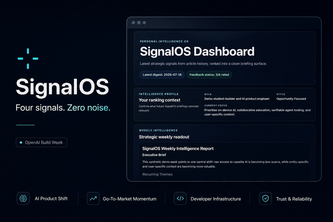
SignalOS is a personal intelligence operating system built by one developer (Super-Wendy To) that aggregates AI, technology, business, and education news from RSS feeds and delivers four ranked, actionable signals daily via Discord. It uses GPT-5.6 for strategic ranking of articles based on relevance, information quality, and strategic importance, with a focus on minimizing hallucination risk by not allowing the model to reconstruct article metadata.
What changed
The project evolved from an early command-line prototype into a more structured system during OpenAI Build Week, incorporating a FastAPI dashboard, weekly reports, persistent feedback mechanisms, and improved state management. It now includes GitHub Actions automation, JavaScript enhancements for responsiveness, and configurable model selection.
Single most important open question — the commercial due-diligence read
Is there a viable path to scaling this product beyond a single-user prototype? The description states no revenue or customer data exist; traction is not evidenced.
What The Product Actually Is
The description states that SignalOS:
- Collects articles from RSS feeds across AI, software engineering, business, education, and technology.
- Normalises and deduplicates incoming articles.
- Filters stale or previously seen content.
- Balances candidates across different sources.
- Limits ranking input to control API cost.
- Uses GPT-5.6 to rank the most strategically useful articles.
- Selects four final daily signals.
- Explains why each signal matters.
- Provides a concrete action takeaway.
- Delivers the briefing through Discord.
- Displays the latest intelligence in a FastAPI dashboard.
- Generates a weekly intelligence summary.
- Stores article feedback for future ranking improvements.
It is described as a personal intelligence operating system designed to turn information overload into focused action.
Inference SignalOS appears to be an AI-powered curation tool tailored for student-builders, not a general-purpose news aggregator or enterprise SaaS product.
Positioning & Claim Evolution
The author claims:
- SignalOS solves the problem of information overload for ambitious builders.
- Most feeds optimize for volume and engagement but do not help answer “what actually matters to me?”
- The goal is not to summarize everything, but to decide what deserves attention and turn information into action.
Inference Positioning has evolved from a personal prototype to a scalable intelligence system that aims to serve individual users who are focused on building in specific domains (AI, software engineering, etc.). However, no evidence of market positioning beyond the author's own use case is provided.
Target Customer & ICP
The description states:
- SignalOS targets “student-builders” working on AI, software engineering, local models, data science, and education technology.
- It is built for individuals who want to stay informed without being overwhelmed.
Inference The target customer segment is narrow — likely self-directed learners or early-stage developers. No evidence of broader ICP expansion or segmentation beyond this niche.
Business Model & Pricing Evidence
There is no evidence in the description of:
- Revenue streams
- Pricing models
- Monetization strategy
- Customer acquisition costs
- Any commercial activity
Inference No business model or pricing evidence exists. The product appears to be a personal tool with no indication of monetization.
Technical & Delivery Signals
The description states:
- Built primarily with Python.
- Uses RSS feeds as information source.
- Articles are converted into typed Python data models.
- Filters locally, deduplicates through URL and title normalisation.
- Limits ranking input to reduce API cost.
- GPT-5.6 is used for strategic ranking only — not for fetching or reconstructing content.
- Delivers signals via Discord webhook.
- Displays intelligence in a FastAPI dashboard.
- GitHub Actions runs daily and weekly pipelines on schedule.
- Feedback forms work without JavaScript, but JS enhances responsiveness.
- Local JSON state is protected through atomic writes, file locking, backups, and corruption detection.
Inference The system is technically sound for a personal prototype. It shows awareness of API cost control, data integrity, and user experience design. However, no evidence suggests it has been scaled beyond one user or deployed in production environments.
Traction & Maturity Signals
There is no evidence of:
- Revenue
- Customers
- User base
- Adoption metrics
- Product-market fit indicators
- Market traction
Inference The product remains at the prototype stage. It was submitted to a hackathon and has not demonstrated any measurable traction or maturity beyond its initial development.
Competitive Context
There is no evidence of:
- Competitors
- Market analysis
- Competitive positioning
- Differentiation from existing tools
Inference No competitive context is provided. The author does not reference similar products or markets, nor does the description indicate awareness of alternatives.
Open Questions & Risks
Key risks and open questions include:
- Scalability risk: The system is built for a single user and lacks multi-user support.
- Dependency on GPT-5.6: No fallbacks or alternative models are mentioned, which could pose a risk if access changes.
- No monetization strategy: No indication of how the product will generate revenue.
- Limited audience: The narrow ICP may limit growth potential.
- Unverified claims: All statements are self-reported and unverified.
Inference The project is not yet mature enough to be considered a commercial venture. It lacks any evidence of scalability, monetization, or market validation.
Questions the description leaves open
- What specific user needs does SignalOS address that existing tools do not?
- How would you scale this beyond one user?
- Are there plans to integrate with other platforms or APIs?
- What is the long-term vision for monetization?
- Have you tested SignalOS with any external users or teams?
- What are the technical limitations of using GPT-5.6 in this way?
- How do you plan to handle data privacy and security concerns?
- What metrics would indicate product-market fit?
Overall Assessment
Assessment Not evidenced.
The description provides no evidence of revenue, customers, traction, or commercial viability. It describes a personal prototype with limited scope and no indication of a path to monetization or scalability.
This is a pre-product-stage project, not a company ready for investment or partnership. Any potential value lies in the founder's ability to iterate and build out the concept — but that remains unproven.
Confidence level Low. The entire analysis rests on self-reported claims with no corroboration.
User Stories BotA demo video on every pull request
Get a demo video on every new feature
GitHub App that watches your pull requests and records a narrated, captioned demo.
Save time on demo prep and make informed decisions faster with a video walkthrough of every new feature.
Source
Submitted to the OpenAI 2026 hackathon on Devpost. Project home on Devpost. Back to the full gallery on Devpost.
This competitive analysis was produced by top-founders.com (opens in a new tab)
Generated by a language model from this project's public Devpost page — its tagline, the author's own write-up and any built-with tags listed there — as captured in August 2026. Short quotations are the author's words. It is an opinion on the idea as a business, not on the people behind it, and it reflects the description as published then. If the project has moved on, request a correction below. The analysis is not independent research and contains no verified traction, revenue or customer data.
An independent guide by KFG International LLC — not affiliated with, endorsed by, or connected to Devpost or OpenAI.