

Archive position — measured, not model output
0 likes on Devpost
2,263 of the 7,850 archived projects have more likes, and 5,587 share exactly 0 — so this project's #2,769 place in the like-ranked listing is a tie-break inside that group, not a ranking.
Projects (log scale)
Likes on Devpost. ▲ marks this project's group.
Show the figures
| Likes | Projects | Share of archive |
|---|---|---|
| 0 | 5,587 | 71.2% |
| 1 | 1,758 | 22.4% |
| 2 | 284 | 3.6% |
| 3–4 | 132 | 1.7% |
| 5–9 | 75 | 1.0% |
| 10+ | 14 | 0.2% |
 User Stories BotA demo video on every pull request
Get a demo video on every new feature
GitHub App that watches your pull requests and records a narrated, captioned demo.
Save time on demo prep and make informed decisions faster with a video walkthrough of every new feature.
Executive Summary
Company: AstraComply
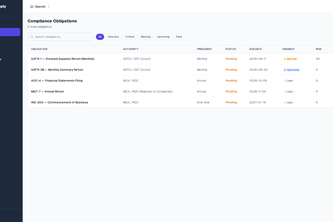
Self-reported purpose: An AI compliance operating system for Indian companies that maps obligations, flags risks, organizes evidence, and powers grounded answers.
Key claim: Built with Codex and GPT-5.6 to accelerate development and deliver a structured compliance workflow.
What changed: The project is a self-contained, full-stack web application submitted as a hackathon entry. It does not appear to have launched or scaled beyond the prototype stage.
Single most important open question: Is there any evidence of traction, revenue, or customer adoption beyond the author's own description?
What The Product Actually Is
The description states that AstraComply is an AI-powered compliance operating system for Indian companies. It includes:
- A compliance rules engine
- A dashboard
- A document vault
- A risk engine
- An AI assistant
- An audit trail
It is described as a full-stack web application built with technologies including React, Next.js, Node.js, Python, FastAPI, PostgreSQL, and pgvector.
Evidence: The author's own write-up.
Confidence: Low — no independent verification or demonstration of product functionality.
Positioning & Claim Evolution
The project is positioned as a compliance OS for Indian companies that aims to make compliance proactive rather than reactive. It claims to:
- Map company details to relevant obligations
- Track deadlines and show risk signals
- Organize compliance documents
- Provide grounded AI assistance
- Maintain an audit trail
It also states that it was built using Codex and GPT-5.6, which the authors claim accelerated development.
Evidence: The author's own write-up.
Confidence: Low — claims are self-reported and unverified.
Target Customer & ICP
The description states that AstraComply is for Indian companies, particularly startups managing GST, MCA filings, deadlines, documents, and audit proof across spreadsheets, calendars, and disconnected PDFs.
It also mentions that the system targets founders and finance teams.
Evidence: The author's own write-up.
Confidence: Low — no evidence of customer validation or segmentation beyond stated intent.
Business Model & Pricing Evidence
Not evidenced. The description does not mention any pricing model, monetization strategy, or business model.
Evidence: None provided.
Confidence: Not evidenced.
Technical & Delivery Signals
The project is built as a full-stack web application with:
- React frontend
- Next.js framework
- Node.js backend
- Python and FastAPI for API logic
- PostgreSQL and pgvector for data storage
- AI tools including Codex and GPT-5.6
It includes features like document vault, risk simulation, and an AI assistant.
Evidence: The author's own write-up.
Confidence: Low — no demonstration or independent validation of delivery.
Traction & Maturity Signals
Not evidenced. There is no mention of revenue, customers, usage metrics, or product maturity beyond the hackathon submission.
Evidence: None provided.
Confidence: Not evidenced.
Competitive Context
Not evidenced. The description does not mention competitors or market positioning relative to other compliance tools in India.
Evidence: None provided.
Confidence: Not evidenced.
Open Questions & Risks
- No traction or revenue evidence: The project is described as a hackathon submission with no indication of real-world adoption.
- Unverified claims: Use of Codex and GPT-5.6 is self-reported; no validation of these tools' use or impact.
- Limited team size: Only two members, which may limit execution capacity.
- No customer feedback or market validation: The description lacks any evidence of real user testing or feedback.
Evidence: Self-reported only.
Confidence: Low — all risks inferred from lack of evidence.
Questions the description leaves open
- What specific compliance regulations in India does AstraComply currently support?
- How is the AI assistant grounded in company-specific data versus generic responses?
- Have you conducted any user testing with actual founders or finance teams?
- Is there a plan to monetize this product, and if so, what model are you considering?
- What are the key challenges in scaling compliance rules across different types of Indian companies?
Evidence: Self-reported only.
Confidence: Low — these questions are based on gaps in the description.
Overall Assessment
Not evidenced. The project is described as a hackathon submission with no evidence of traction, revenue, or customer adoption. It is not clear whether it has moved beyond prototype stage or has any commercial viability.
Evidence: Self-reported only.
Confidence: Not evidenced.
User Stories BotA demo video on every pull request
Get a demo video on every new feature
GitHub App that watches your pull requests and records a narrated, captioned demo.
Save time on demo prep and make informed decisions faster with a video walkthrough of every new feature.
Source
Submitted to the OpenAI 2026 hackathon on Devpost. Project home on Devpost. Back to the full gallery on Devpost.
This competitive analysis was produced by top-founders.com (opens in a new tab)
Generated by a language model from this project's public Devpost page — its tagline, the author's own write-up and any built-with tags listed there — as captured in August 2026. Short quotations are the author's words. It is an opinion on the idea as a business, not on the people behind it, and it reflects the description as published then. If the project has moved on, request a correction below. The analysis is not independent research and contains no verified traction, revenue or customer data.
An independent guide by KFG International LLC — not affiliated with, endorsed by, or connected to Devpost or OpenAI.