

Archive position — measured, not model output
0 likes on Devpost
2,263 of the 7,850 archived projects have more likes, and 5,587 share exactly 0 — so this project's #4,732 place in the like-ranked listing is a tie-break inside that group, not a ranking.
Projects (log scale)
Likes on Devpost. ▲ marks this project's group.
Show the figures
| Likes | Projects | Share of archive |
|---|---|---|
| 0 | 5,587 | 71.2% |
| 1 | 1,758 | 22.4% |
| 2 | 284 | 3.6% |
| 3–4 | 132 | 1.7% |
| 5–9 | 75 | 1.0% |
| 10+ | 14 | 0.2% |
 User Stories BotA demo video on every pull request
Get a demo video on every new feature
GitHub App that watches your pull requests and records a narrated, captioned demo.
Save time on demo prep and make informed decisions faster with a video walkthrough of every new feature.
Executive Summary
What the company appears to be
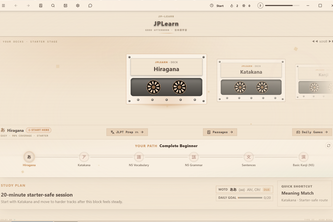
JPLearn is a self-developed desktop application for learning Japanese, built by one person over nearly three weeks for OpenAI Build Week. It combines structured study with interactive minigames, local progress tracking, and an optional AI tutor. The app is designed to be offline-first, private, and visually engaging.
What changed
The project evolved from a set of study minigames into a full learning platform with progression systems, spaced repetition, statistics, and an AI tutor. It was built as a solo effort within a short timeframe, using Electron, React, Python, and SQLite.
Single most important open question — the commercial due-diligence read
Is there evidence of any traction, revenue, or customer feedback beyond the author’s own account? The description does not indicate whether JPLearn has been used by others, monetized, or validated in a market context. Without such data, it is unclear if this represents a viable product or just an experimental prototype.
What The Product Actually Is
The description states that JPLearn is:
- A desktop application for studying hiragana, katakana, kanji, vocabulary, and conversation.
- An offline-first tool with local progress tracking.
- A structured learning experience using spaced repetition and active recall.
- A platform with minigames such as romaji conversion, reading Japanese to romaji, multiple choice, matching kanji with meanings, and mixed sessions.
- A system that includes daily study plans, mastery tracking, streaks, XP points, progression systems, and statistics.
- An application with an optional AI tutor that can be downloaded locally.
It is not evidenced whether these features are implemented or tested beyond the author’s own use.
Positioning & Claim Evolution
The author claims:
- JPLearn was built to address frustrations with existing Japanese apps—especially those that feel repetitive, subscription-dependent, or lack long-term progression.
- The app aims to be focused, visually engaging, private, and usable offline.
- It is positioned as a desktop-first learning tool for personal use.
There is no evidence of prior positioning or evolution in the market. The claim is based solely on the author’s stated intent and self-description.
Target Customer & ICP
The description states:
- JPLearn targets individuals learning Japanese, particularly those who want a private, offline-friendly experience.
- It is designed for learners at various levels—beginners and more advanced users alike.
- The app supports both structured progression and exploration.
No evidence of actual user segmentation or customer validation exists. The ICP appears to be inferred from the author’s own needs rather than market data.
Business Model & Pricing Evidence
The description states:
- JPLearn is a desktop application that can be downloaded locally.
- It includes an optional AI tutor, which users can download through setup or settings.
- No pricing information, monetization strategy, or business model is provided.
There is no evidence of any revenue streams, subscriptions, or paid features beyond the optional AI model download.
Technical & Delivery Signals
The description states:
- The app was built using Electron, React, TypeScript, Python 3.11, SQLite, Tailwind CSS, Radix UI, Vitest, Pytest, Mypy, Ruff, Oxlint, and local language models.
- It uses a layered architecture with domain, data, and frontend components.
- Communication between frontend and backend is handled via typed IPC contracts.
- The app supports offline functionality and local storage of learning data.
There is no evidence of production deployment, scalability, or performance metrics. The technical setup reflects a prototype built in a short time frame.
Traction & Maturity Signals
The description states:
- The project was completed by one developer over nearly three weeks.
- It was submitted to the OpenAI Build Week hackathon.
- No evidence of user adoption, retention, or usage metrics is provided.
There are no signs of traction beyond the author’s own development and submission. No customer base, downloads, or engagement data are mentioned.
Competitive Context
The description states:
- JPLearn aims to improve upon existing Japanese-learning apps that feel repetitive or overly subscription-based.
- It offers a desktop-first experience with offline capabilities and local AI support.
No evidence of competitive analysis, market positioning, or awareness of competitors is provided. The author does not reference other tools in the space.
Open Questions & Risks
The description indicates:
- The app was built by one person in a short time.
- Features like the AI tutor are optional and require local setup.
- No evidence of user feedback, market testing, or product-market fit.
- The project is described as experimental and not yet commercialized.
Key risks include lack of scalability, limited validation, and absence of any monetization strategy or customer base.
Questions the description leaves open
- What specific user needs does JPLearn address that are not already met by existing tools?
- Have you tested the app with real users beyond yourself? If so, what feedback did you receive?
- How do you plan to monetize or scale this product beyond a personal prototype?
- What is your roadmap for content expansion and AI tutor capabilities?
- Are there any technical limitations or scalability concerns with the current architecture?
Overall Assessment
The description states:
- JPLearn is a solo-built prototype submitted to a hackathon.
- It includes some advanced features like spaced repetition, local AI integration, and layered architecture.
- There is no evidence of traction, revenue, or commercial viability.
Assessment This is an experimental project with strong technical foundations but no demonstrated market traction or business model. The lack of customer data, revenue, or validation makes it difficult to assess its potential as a commercial product or investment opportunity. It may represent a promising idea in need of further development and market testing.
User Stories BotA demo video on every pull request
Get a demo video on every new feature
GitHub App that watches your pull requests and records a narrated, captioned demo.
Save time on demo prep and make informed decisions faster with a video walkthrough of every new feature.
Source
Submitted to the OpenAI 2026 hackathon on Devpost. Project home on Devpost. Back to the full gallery on Devpost.
This competitive analysis was produced by top-founders.com (opens in a new tab)
Generated by a language model from this project's public Devpost page — its tagline, the author's own write-up and any built-with tags listed there — as captured in August 2026. Short quotations are the author's words. It is an opinion on the idea as a business, not on the people behind it, and it reflects the description as published then. If the project has moved on, request a correction below. The analysis is not independent research and contains no verified traction, revenue or customer data.
An independent guide by KFG International LLC — not affiliated with, endorsed by, or connected to Devpost or OpenAI.