

Archive position — measured, not model output
0 likes on Devpost
2,263 of the 7,850 archived projects have more likes, and 5,587 share exactly 0 — so this project's #4,733 place in the like-ranked listing is a tie-break inside that group, not a ranking.
Projects (log scale)
Likes on Devpost. ▲ marks this project's group.
Show the figures
| Likes | Projects | Share of archive |
|---|---|---|
| 0 | 5,587 | 71.2% |
| 1 | 1,758 | 22.4% |
| 2 | 284 | 3.6% |
| 3–4 | 132 | 1.7% |
| 5–9 | 75 | 1.0% |
| 10+ | 14 | 0.2% |
 User Stories BotA demo video on every pull request
Get a demo video on every new feature
GitHub App that watches your pull requests and records a narrated, captioned demo.
Save time on demo prep and make informed decisions faster with a video walkthrough of every new feature.
Executive Summary
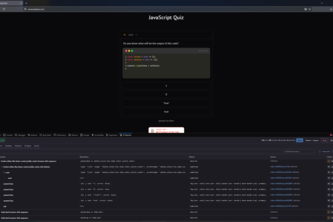
JS Disector is a self-reported browser-based tool for inspecting, modifying and replaying JavaScript behavior in real time, built as a hackathon submission. The author states it enables users to manipulate webpage functions and variables directly from Firefox DevTools, with AI-assisted analysis capabilities. It appears to be a developer-focused utility aimed at understanding or exploiting client-side JavaScript code.
The project is described as a first-of-its-kind tool, but no evidence of revenue, customers, or adoption exists. The author claims it works, but does not provide data on usage, performance or market traction. The tool is said to use Codex and Firefox Developer Edition for development.
Key open question
What is the actual commercial viability or market need for a tool that allows real-time manipulation of client-side JavaScript, particularly in enterprise or developer contexts?
What The Product Actually Is
The description states that JS Disector is a tool that:
- Monitors, inspects, modifies and replays a webpage's JavaScript behavior
- Operates directly from Firefox DevTools
- Allows breaking on network requests and responses
- Enables editing of function outputs and replaying of functions
- Includes a built-in AI agent for analyzing captured output
The author describes it as a tool that "breaks the barrier" between user and client-side code, allowing users to manipulate variables and functions in real time.
Evidence The description states this is what JS Disector does. It is not evidenced by any external data or performance metrics.
Positioning & Claim Evolution
The author positions JS Disector as:
- A tool for developers to understand how people can break their websites
- A way to "bend client code to my will"
- The first of its kind (according to the author)
- Capable of analyzing JavaScript behavior in real time with AI assistance
It is framed as a debugging and reverse-engineering tool, with both defensive (helping developers understand vulnerabilities) and offensive (enabling exploitation) use cases.
Evidence These are claims made by the author. No evidence of market positioning or customer feedback exists.
Target Customer & ICP
The description states that JS Disector is aimed at:
- Developers who want to understand how client-side code can be exploited
- Users who want to manipulate website behavior (e.g., bypassing HR training quizzes)
- Anyone interested in inspecting and modifying JavaScript in real time
There is no evidence of a defined customer segment beyond the author's personal use case or developer interest.
Evidence The description states this. No data on actual users, personas or segments is provided.
Business Model & Pricing Evidence
The description does not contain any information about:
- Revenue streams
- Pricing model
- Monetization strategy
- Subscription plans or licensing
Evidence Not evidenced. The author makes no claims about how the product would be sold or funded.
Technical & Delivery Signals
The project is described as:
- Built with Codex and Firefox Developer Edition
- A working prototype (as stated by the author)
- Requires manual testing
- Uses AI agent for analysis
- Has a complex and fragile codebase
It is presented as a hackathon submission, not a production-ready product.
Evidence The description states this. No information on scalability, stability or technical architecture is provided.
Traction & Maturity Signals
The description does not contain any evidence of:
- Revenue
- Customers
- User adoption
- Market traction
- Product maturity beyond the hackathon prototype
It is described as a "working product" but no data on usage or impact is provided.
Evidence Not evidenced. The author states it works, but provides no metrics or feedback.
Competitive Context
The description does not mention:
- Competitors
- Market landscape
- Existing tools in the same space
- Differentiation from similar offerings
It claims to be "first of its kind", but this is unverified and not supported by external data.
Evidence Not evidenced. The author makes a claim about uniqueness, but no competitive analysis is provided.
Open Questions & Risks
Key risks or open questions based on the description:
- The tool appears to be a hackathon prototype with no evidence of production readiness
- It may be used for malicious purposes (e.g., bypassing quizzes or exploiting websites)
- The codebase is described as "extremely complex and somewhat fragile"
- The author states Codex keeps "thinking I'm writing malware", suggesting potential ethical or technical issues
- No commercial viability, revenue model or customer base is evident
Inference The tool's use case may be limited to niche developer scenarios, with unclear commercial potential.
Questions the description leaves open
- What specific real-world use cases have you identified for JS Disector beyond the hackathon prototype?
- How do you plan to address the ethical concerns around tools that enable exploitation of websites?
- What is your strategy for monetization or scaling beyond a prototype?
- Have you tested the tool with actual users or in production environments?
- What are the technical limitations or scalability issues you've encountered?
- How does this tool differ from existing browser debugging or automation tools?
Overall Assessment
The description states that JS Disector is a hackathon submission, built by one person (Kevin Duke), and claims to be "first of its kind". There is no evidence of revenue, customers, traction, or commercial viability. The tool appears to be experimental and not yet ready for market.
Inference Without further development, testing, or market validation, the project does not appear to be a viable investment or partnership opportunity at this stage.
Confidence Low — based entirely on self-reported information with no external verification or traction data.
User Stories BotA demo video on every pull request
Get a demo video on every new feature
GitHub App that watches your pull requests and records a narrated, captioned demo.
Save time on demo prep and make informed decisions faster with a video walkthrough of every new feature.
Source
Submitted to the OpenAI 2026 hackathon on Devpost. Project home on Devpost. Back to the full gallery on Devpost.
This competitive analysis was produced by top-founders.com (opens in a new tab)
Generated by a language model from this project's public Devpost page — its tagline, the author's own write-up and any built-with tags listed there — as captured in August 2026. Short quotations are the author's words. It is an opinion on the idea as a business, not on the people behind it, and it reflects the description as published then. If the project has moved on, request a correction below. The analysis is not independent research and contains no verified traction, revenue or customer data.
An independent guide by KFG International LLC — not affiliated with, endorsed by, or connected to Devpost or OpenAI.